Philadelphia committee holds hearing on Office of Freedmen Affairs; advocates call it a constitutional duty
Loading...
Summary
The City Council Committee on Public Safety heard testimony supporting Resolution 250,781 to explore creating an Office of Freedmen Affairs. Witnesses argued the city should use administrative tools to enforce the Thirteenth Amendment's protections and address entrenched disparities; the committee did not take a vote.
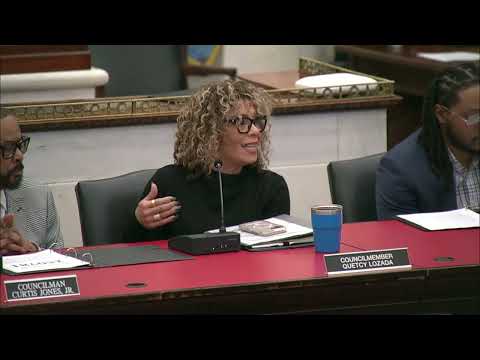
Philadelphia’s Committee on Public Safety held a public hearing at City Hall to gather testimony on Resolution 250,781, which authorizes committee hearings to examine the potential establishment of an Office of Freedmen Affairs.
Advocates from the Philadelphia Reparations Coalition for American Freedmen and allied academics argued the office would be more than symbolic. "This is not a favor. This is not a symbolic gesture. The establishment of the Office of Freedmen Affairs is a constitutional obligation," said Obona Hagans, president of the Philadelphia Reparations Coalition for American Freedmen. Panelists said the office would coordinate enforcement, research and remedies tied to harms they described as the "badges and incidents of slavery."
Witnesses laid out legal and administrative rationales. Anthony Dickerson, chief compliance officer for the coalition, warned courts often treat harms rooted in racial history as ordinary misconduct under a rational-basis lens, which he said downgrades their constitutional significance. "When these acts are stripped of their historical meaning, they are pushed into the lowest level of constitutional scrutiny," he said. Legal experts on the panel recommended a municipal structure that collects data, enforces existing local laws, and provides legal support for claims tied to structural harms.
Speakers also traced historical examples. Will Jackson, an administrator with the coalition, reviewed the Freedmen’s Bureau and the Freedman’s Savings Bank, and said those institutions’ closure and mismanagement left lasting economic damage for descendants of enslaved people. He urged the city to consider measures—including genealogy and archival work—that would identify rightful beneficiaries and remedies. "The Freedmen's Bureau...was created in 1865," Jackson said, describing a case for institutional continuity to prevent repeating the historical pattern of underfunding remedies.
Penn Carey Law professor Cara McClellan urged a practical, city-level design: "A bureau could provide centralized support, track outcomes and enforce the city's slavery disclosure law," she said, recommending divisions for legal affairs, data and research, and program administration. She also recommended a required racial-impact statement for city policies and regular public reporting to measure progress.
Committee members asked how success would be measured. Panelists suggested both qualitative and quantitative indicators—community sense of cultural restoration and measurable improvements such as increased homeownership, higher graduation rates, reduced incarceration rates among descendants of enslaved people, and growth in entrepreneurship and wealth-building in historically disinvested neighborhoods.
City officials attending said the mayor’s office would review the recommendations. Anton Moore, executive director of public engagement, and Abu Edwards, director of Black Male Engagement, said their offices would consider how an Office of Freedmen Affairs might coordinate with existing city programs and services.
More than a dozen public commenters gave personal testimony, offering family histories of dispossession, calls for hiring pipelines and leadership pathways for descendants, and appeals for land repatriation and trauma-informed services. Several witnesses cited Philadelphia’s slavery disclosure ordinance (Philadelphia Code 17-1042) and urged its enforcement as a funding and accountability tool.
Chairman Jones closed the hearing by thanking presenters and saying the committee would distribute the report to members and move to introduce legislation based on the testimony. No formal vote on a bill was taken during the hearing.
The committee’s next steps include drafting legislation and follow-up meetings to refine structure, metrics and funding sources for any proposed Office of Freedmen Affairs.