Get Full Government Meeting Transcripts, Videos, & Alerts Forever!
Get email alerts on the Committee Roundup topic
No spam. Unsubscribe anytime.
House Community Safety Committee reports out six public-safety bills including sentencing relief and immigration-enforcement clarity
Summary
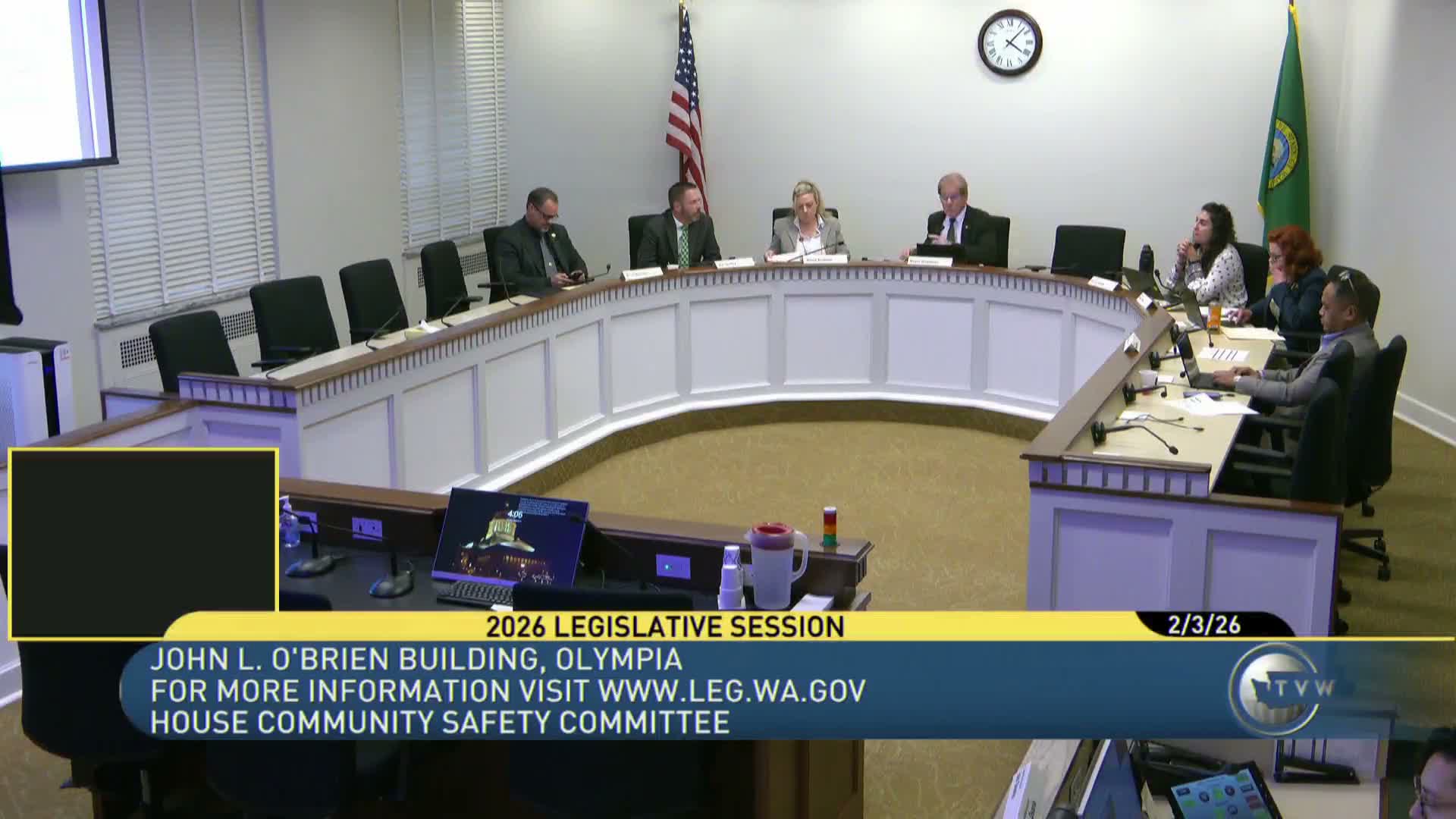
At an executive-session meeting Feb. 3 the House Community Safety Committee reported out substitutes for six bills covering sentencing relief for survivor-defendants, child-exploitation, oversight of the Criminal Justice Training Commission, a higher victim penalty assessment, prostitution-related offenses, and guidance on local interactions with federal immigration enforcement.
The House Community Safety Committee met Feb. 3 to take executive action on bills previously heard and reported substitutes for six measures addressing criminal justice, victim services and law-enforcement practice.
Notable actions and outcomes: substitute House Bill 15 91 (sentencing relief for defendants who are survivors of domestic violence, sexual assault, or human trafficking) was reported out with a due-pass recommendation after discussion of eligibility limitations and documentary evidence requirements; the roll call was 7 ayes and 2 nays. Substitute House Bill 21 46 (expanding the exploitation-of-a-minor offense) was amended (PAT 348) to narrow the covered conduct to cases where the minor's viewing — rather than the conduct itself — will be photographed or part of a live performance; the amendment was adopted and the substitute reported out with all members present and voting in the affirmative. Substitute House Bill 22 20 (CJTC oversight) removes a proposed 'clear and convincing' standard for certification hearings, increases certain hearing-panel sizes and requires rulemaking to implement final orders; the committee reported the bill out 7–2. Substitute House Bill 24 30 increases the crime-victim penalty assessment (CVPA) for felonies and misdemeanors, authorizes an additional surcharge (up to $50,000) for defendants with substantial financial resources, requires documentary proof of indigency to claim exemption, and was reported out unanimously. Substitute House Bill 25 26 (prostitution-related offenses) was amended to add referral requirements for first and second investigative detentions and was reported out 5–4 after extensive debate and survivor testimony. Substitute House Bill 26 48 (state and local interactions with federal immigration enforcement) had an amendment adopted (Lang 185) requiring body/dash cameras during encounters with federal agents and shifting indemnity responsibilities to employing local government entities or the state; the substitute was reported out 6–3.
Several bills raised implementation questions that committee members noted would require further stakeholder work, including whether referral programs exist statewide for diversion policies, how CJTC rulemaking will work under the Administrative Procedures Act, and how indemnification and indemnity claims will be handled at the local-government level. The committee recessed for caucus and returned to take votes in executive session.
Votes at a glance (committee action): HB 15 91 — substitute H3302.1 reported out (7 ayes, 2 nays); HB 21 46 — amended (PAT 348) and reported out (unanimous per record); HB 22 20 — substitute H3305.3 reported out (7 ayes, 2 nays); HB 24 30 — substitute H3352.1 reported out (unanimous per record); HB 25 26 — substitute H3308.1 with Amendment Wale 275 reported out (5 ayes, 4 nays); HB 26 48 — substitute reported out (6 ayes, 3 nays).
Next steps: each substitute moves to the House floor for further consideration. Committee members repeatedly said additional stakeholder meetings, rulemaking or roundtables would be necessary to address implementation and capacity issues before provisions take effect.