Get Full Government Meeting Transcripts, Videos, & Alerts Forever!
Get email alerts on the Privacy Gender Marker Records topic
No spam. Unsubscribe anytime.
Committee hears emotional debate over SB 60-81 privacy protections for gender‑marker records
Summary
SB 60-81 would exempt records used to prove gender‑marker designation in Department of Licensing and vital records from public disclosure, while preserving access for courts and law enforcement; proponents cited doxxing and safety risks, opponents warned of harms to record accuracy and public transparency.
The Senate Transportation Committee heard hours of testimony Feb. 3 on SB 60-81, a proposed substitute that would limit public disclosure of gender‑marker (designation) change records in Department of Licensing and Department of Health systems while preserving access for courts, law enforcement and agencies acting under lawful authority.
Greg Vogel, committee staff, described the substitute’s core protections: records or documentation used to prove a designation change for driver licenses, permits or ID cards would be exempt from public disclosure; confidential plates, driver credentials and digital records issued after a designation change would show only the current marker and not indicate that a change occurred. Vogel said the Department of Licensing may not display or transmit supporting documentation of a designation change without the person’s consent.
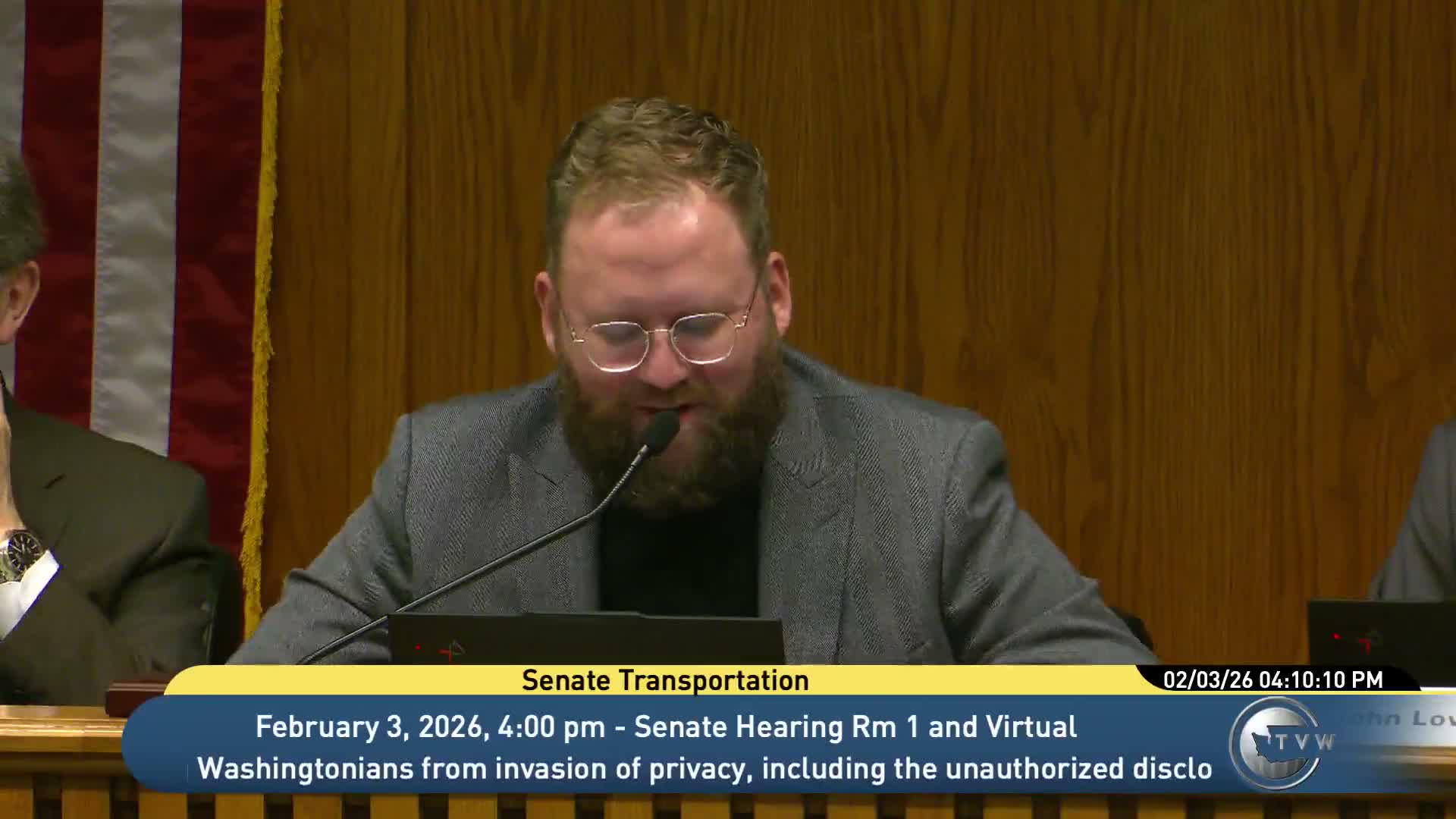
Senator Jamie Petersen, the bill’s sponsor, framed the measure as a narrowly tailored privacy-safety bill to prevent malicious actors from using public records to harass or endanger transgender Washingtonians. "It is to say that that record of a designation change maintained in our state records is private and should not be available to others," he said.
Proponents included transgender people who testified about doxxing, harassment and safety risks if designation-change histories remain publicly accessible. Dana Savage, an assistant attorney general, and multiple advocates said the bill draws a line between public inspection and lawful government use, and does not erase records or block background checks. "This bill limits only public disclosure, just as Washington already does for medical records, adoption records, juvenile records, and survivor information," testified Jevon Hudson, a privacy attorney and law professor.
Opponents raised concerns about the implications for record accuracy, medical care, athletic eligibility and other downstream uses. Sharon Damoff, testifying in opposition, warned that changing or concealing records could render official records "meaningless" for some purposes and said existing laws already address harassment and threats.
Committee staff and agency representatives described fiscal and administrative impacts. Brian Moore estimated roughly $1,000,000 in Department of Licensing IT and staffing costs over the first four years to implement redaction/exclusion systems; the Department of Health did not have a fiscal note but indicated minimal anticipated impact in informal discussions.
The Department of Licensing said it supports the policy and believes the bill is implementable, but signed in "other" due to fiscal considerations. Supporters urged an earlier effective date than the bill’s draft implementation timeline. The committee closed the public hearing after extensive testimony; no committee action occurred in the session.
As written in testimony, the bill preserves lawful access to records for courts and public-safety agencies while narrowing public disclosure of sensitive designation-change information; implementation costs and an appropriate effective date were prominent themes for further negotiation.