Get Full Government Meeting Transcripts, Videos, & Alerts Forever!
Get email alerts on the Transportation Shuttles Bat Lanes topic
No spam. Unsubscribe anytime.
Senate panel hears bill to pilot employer shuttles in BAT lanes in King County
Summary
A two‑year pilot in ESHB 19-80 would let private employer shuttles use business access and transit (BAT) lanes in counties of 2,000,000+ population with transit-agency approval, subject to performance standards, vehicle markings and fee-for-use processes. Proponents say it will reduce single‑occupancy trips; transit groups warn about lost fare revenue and implementation hurdles.
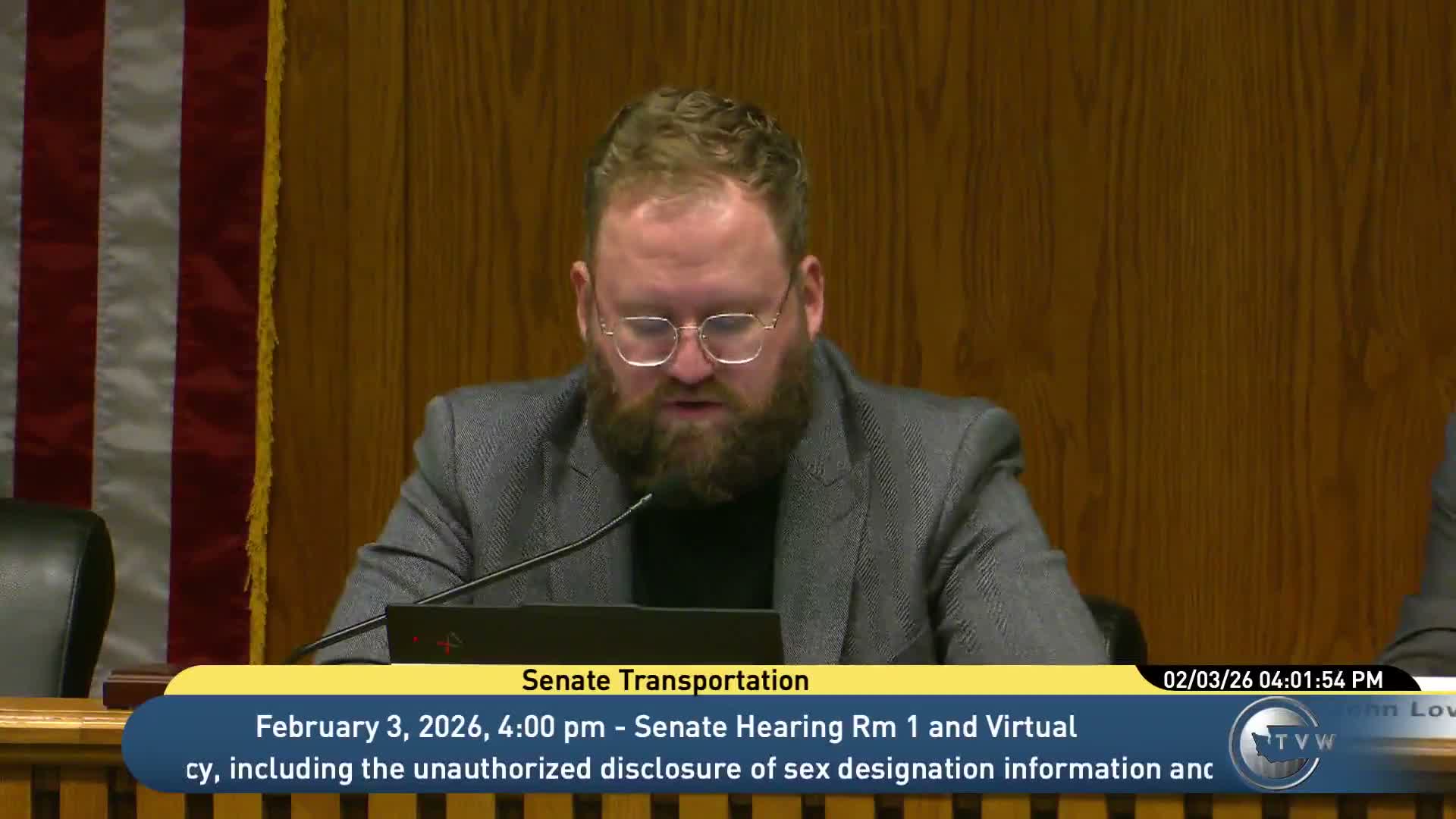
The Senate Transportation Committee heard testimony Feb. 3 on ESHB 19-80, a bill that would let private employer shuttle services use business access and transit (BAT) lanes in large counties as a two‑year pilot, provided local authorities and public transit agencies approve and performance standards are met.
Clint McCarthy, staff to the committee, told members the bill authorizes local authorities, with approval from public transportation providers, to allow private employer vehicles with a minimum capacity of eight passengers to operate in BAT lanes in counties with populations of 2,000,000 or more — a threshold that currently applies only to King County. McCarthy said the bill requires a fee-for-use process, vehicle markings for authorized shuttles, and performance metrics; fee revenue would be used for administrative costs or maintenance improvements consistent with public-transit plans.
Representative Janice Zahn, the bill’s prime sponsor, said the measure was revised from last year to add a pilot and labor representation in developing performance standards. "This bill actually is very meaningful to me," Zahn said, and she noted the bill includes a 10‑year sunset so the pilot would not become permanent if not completed by 2035/36.
Supporters that testified included downtown business groups, employers and cities seeking predictable commute options. Mo Malakoutian, mayor of Bellevue, said the measure would let municipalities use limited right of way more efficiently while keeping transit riders the priority. Jeremy Burdette of TransWest said employer shuttles remove millions of single-occupancy vehicle trips annually and reduce emissions.
Transit advocates and association staff urged caution on implementation and compensation. Justin Layton of the Washington State Transit Association signed in "other with concerns," citing updated information from King County Metro that may raise the estimated fiscal impact; he said agencies and the legislature must address the lost fare revenue and administrative burdens to make any expansion workable.
Committee members asked whether BAT lanes are primarily city streets and who would set lane access; Zahn and staff explained BAT lanes are implemented locally and that King County Metro is the relevant public-transportation provider in the Seattle/Bellevue area. The bill directs transit providers to establish performance measures and to work with representatives of labor organizations when developing standards.
The committee closed the public hearing on ESHB 19-80 after multiple proponent witnesses but did not take a final vote during the session.
The bill’s implementation details — including how fees would be set, how performance metrics would be enforced and how agencies would be compensated for any lost fare revenue — were central themes of testimony and will be points for potential amendment as the measure moves through the process.