
Hammond mayor hails bipartisan advance of Senate Bill 27 as framework for potential Chicago Bears stadium
Get AI-powered insights, summaries, and transcripts
Subscribe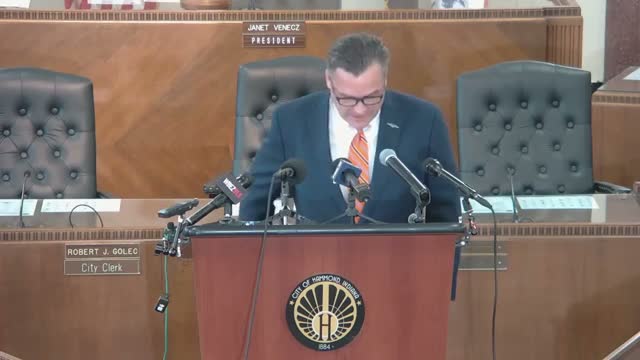
Summary
The mayor of Hammond told a packed council chamber that Senate Bill 27 — advanced 24-0 in the Indiana House Ways and Means Committee — creates a stadium authority and financing model to enable a potential Chicago Bears relocation to Hammond, while confirming property acquisition and local tax proposals would be part of the package.
The mayor of Hammond, speaking at a city-hosted event, said Senate Bill 27 — advanced 24-0 in the Indiana House Ways and Means Committee — sets up a Northwest Indiana Stadium Authority and a development framework designed to support a possible Chicago Bears stadium near Wolf Lake.
The mayor said the state would contribute more than $1 billion toward the proposal, and described a financing approach that could include a local admissions tax, higher Lake County innkeepers tax and a Lake/Porter County food-and-beverage tax modeled on the financing used for Lucas Oil Stadium in Indianapolis. "The state's gonna spend over $1,000,000,000 dollars on this proposal, and it's we're gonna require payback," the mayor said, adding that the state would expect repayment through those revenues.
Why it matters: If enacted and accepted by the team, the legislation would create the institutional structure to acquire property, finance construction, and operate a stadium. The bill also names Hammond as the defined "city" in the statute; the mayor said the precise site remained subject to the Bears' due diligence and the team's announcement.
What the bill would do: The mayor described two elements in the measure: formation of a Northwest Indiana Stadium Authority and designation of a Northwest Indiana Professional Sports Development Area. According to the mayor, those entities would have roles in property acquisition, financing, leasing, construction and eventual operation. He said the redevelopment commission in Hammond was prepared to take next steps to establish the area under state statute.
Funding and local taxes: The mayor said state investment would be substantial — citing figures that ranged up to $1.5 billion–$2 billion in different remarks — and said local revenue tools were expected to help repay the state. He said, "Hammond, there will be taxes on the people that enter this facility," and specifically mentioned an admissions tax, increases to Lake County innkeepers tax and a Lake/Porter County food-and-beverage tax. He did not provide enacted ordinance text, rate levels or implementation dates; those details were described as part of follow-on negotiations.
Property acquisition and infrastructure: The mayor acknowledged that property acquisition "was going to be involved," that some property owners had already been contacted by the state, and that "hundreds of millions of dollars of infrastructure" improvements would be required. He did not provide a parcel list, acquisition schedule, or a timeline for when property purchases would occur.
Team engagement and competition with Illinois: The mayor said he had met Bears ownership and described the team as frustrated with the process in Illinois, saying the treatment in Indiana had been more favorable so far. He argued that the team's choice would be driven by the financial offer and long-term business climate: "I think 9 times out of 10 the Bears pick Indiana," he said. The mayor also urged the team to "move to Hammond," and offered assurances about proximity to Chicago and regional airports.
Questions from the audience: In a question-and-answer session, the mayor confirmed the Bears had discussed a practice facility with city officials and acknowledged geotechnical work had begun in the northern part of Hammond. He said he believed the stadium would be a dome to allow year-round programming, and that nearby airports such as Gary Airport could see increased traffic from the project.
What is not decided: The mayor emphasized that the team — not the city — would determine the final site and that Senate Bill 27 still had legislative steps to complete: the mayor said the bill needed to finish in the House, return to the Senate, and be signed by the governor. He said he expected the governor to sign the bill based on leadership statements but provided no formal timeline for final approvals or land transactions.
Context and caveats: The mayor repeatedly framed the project as a regional opportunity and compared the structure to past stadium deals in Indianapolis but acknowledged uncertainty about final costs and the precise site. He cited committee-level approval in the House but did not describe any local votes authorizing property sale or tax rate changes. "This is the Bears' project and when they're comfortable and ready to talk they're going to talk about it," he said.
Next steps: Legislative action remains pending; local implementation measures (tax ordinances, land acquisitions, infrastructure contracts) would follow only after additional approvals and negotiations.