
Tennessee committee hears health boards’ deficits; agencies point to fee increases and multi-year projections
Get AI-powered insights, summaries, and transcripts
Subscribe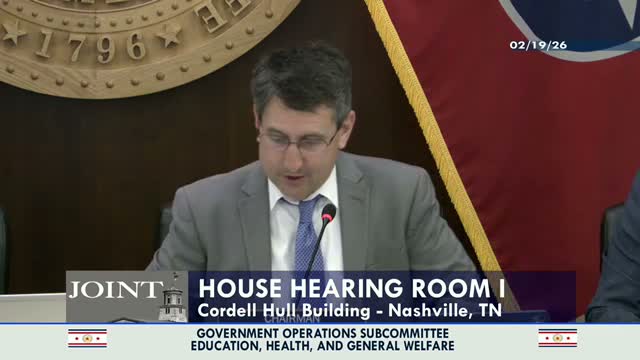
Summary
Department of Health officials told the Joint Government Operations Committee on Feb. 19 that multiple health-related licensing boards ran deficits in 2023–25 and are pursuing fee changes and system upgrades; legal staff and lawmakers debated why agencies use two- to three-year projections and noted past statutory sweeps of reserve funds.
The Joint Government Operations Committee held statutorily required self-sufficiency hearings on Feb. 19, 2026, to review several health-related licensing boards that have operated in the red for two consecutive years. Department of Health staff reported deficits, reserve balances and planned fee changes for a range of boards from dentistry to nursing.
Jennifer Putnam, assistant commissioner for the Division of Health Licensure and Regulation, summarized each board’s finances and whether boards are considering or have approved fee changes to address shortfalls. ‘‘In fiscal year 2024, the board’s expenditures exceeded revenues by $1,040,331,’’ Putnam said of the Board of Dentistry, noting that the board approved a fee increase at its Jan. 8 meeting. She reported the Board of Nursing ran deficits of $1,155,843 in FY2024 and $2,487,597 in FY2025 and said a fee increase is set to take effect April 8 (date stated in the presentation). For other boards, Putnam detailed reserve balances and whether fee reductions or increases are planned or already implemented.
Why not fix shortfalls more quickly? Lawmakers pressed department staff on the timing. Matt McSpadden, fiscal director for Health Licensure and Regulation, said projections account for licensee renewal cycles and system costs and that, ‘‘we would be looking at self sufficiency within 3 fiscal years’’ under the fee proposal presented to the board in January.
The committee briefly recessed for a legal explanation. Doug Garrett of the Office of Legal Services described the calculations as a moving target and said the ‘‘rule of thumb has always been 2.5 times their annual operating expenses’’ for reserve targets. Garrett added that rulemaking under the Administrative Procedure Act typically takes six to nine months to implement, and agencies generally need additional time to monitor the effects of fee changes, which helps explain multi-year projections.
Rep. Richard Hardaway pushed for clearer, faster timelines and criticized prior statutory ‘‘sweeps’’ of reserve funds, saying the committee’s concern began when the governor’s administration moved licensing reserves into the general fund. ‘‘We had the governor stealing money that was going towards licensing and regulatory fees and taking it and putting it into the general fund,’’ Hardaway said; Garrett responded that such sweeps were statutory and that he would check when they last occurred.
Putnam offered specific drivers for larger deficits in 2024–25: the state market study that raised state salaries, increased investigations and complaints as professions grow, and rising technology and modernization costs for licensing systems. She told the committee that some boards have already implemented fee increases (for example, physical therapy’s Dec. 31, 2025 increase and a December 2025 increase for polysomnography) while others plan proposals (medical laboratory on April 24, 2026) or are continuing discussions (podiatry on May 8, 2026).
The committee did not take action; members said the hearing fulfilled the statutory requirement to hear from boards and staff and may call boards back if conditions worsen. The chair closed the session and directed a brief pause before the next subcommittee meeting for AV and gaveling adjustments.
Sources: Committee hearing transcript, Feb. 19, 2026.