
Tennessee committee reviews licensing board finances; few fee increases recommended
Get AI-powered insights, summaries, and transcripts
Subscribe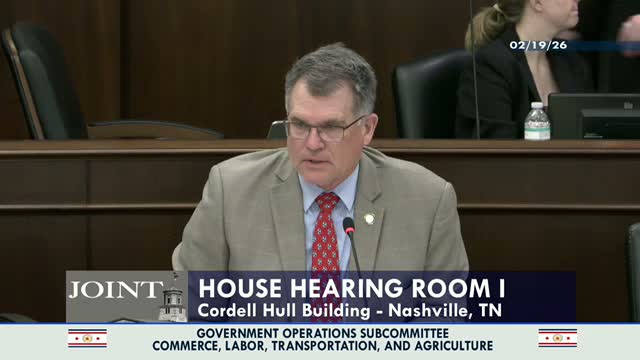
Summary
Department of Commerce and Insurance officials told a joint legislative committee that most professional licensing programs hold reserves within committee guidance and do not need immediate fee increases; select boards have enacted or proposed fee changes to restore solvency.
At a joint self-sufficiency hearing of the Tennessee Legislature’s commerce, labor, transportation, agriculture and joint evaluation committees, Department of Commerce and Insurance officials briefed lawmakers on the fiscal status of multiple professional licensing boards and programs.
Reed Witcher, assistant commissioner for the regulatory boards division at the Tennessee Department of Commerce and Insurance, told the committee that "using guidance provided by this committee, our division aims for programs to have a reserve fund balance between 1 and 2 and half times annual expenditures." He presented status updates for boards that have run deficits in recent years but in many cases retain reserve balances that meet or approach that guidance.
Highlights from the department’s updates: the Tennessee Board of Accountancy reported operating deficits in the last two fiscal years but maintains a reserve greater than one year of expenditures; the Board of Cosmetology and Barber Examiners ran modest deficits recently but holds a reserve slightly under one year and department staff said a 2025 change to inspection requirements will reduce costs; the Home Inspector Licensing Program reported a reserve within the committee’s 1–2.5 guidance; the Motor Vehicle Commission implemented a fee increase in September 2025 that staff project will restore self-sufficiency within two years and sustain it for at least six years; and the Detection Services Licensing Program implemented a fee increase in June 2025 with similar projected effects.
Greg Gilbert, chair of the Tennessee Board of Accountancy, told the committee he "has served about a year and a half in the capacity of chair of the board" and said much of the board’s recent deficit was tied to changes in staff compensation following a state fair-market-value study. When asked about the board’s budget size, department staff said the Board of Accountancy’s annual expenditures for the last three fiscal years were in the $960,000 to $1,000,000 range and that reported expenditures include staff, technology, investigations and legal services.
Robert Gribble, executive director for the Board of Funeral Directors and Embalmers, said the board previously reported a $27,000 deficit and later a larger shortfall; the board held a rulemaking hearing on Jan. 13, 2026 to increase fees and staff anticipate that the fee change will return the program to self-sufficiency within two years and maintain solvency for about six years.
Representative Brian Parkinson (Representative Parkinson), praising cosmetology board leadership during the hearing, referenced recent legislation that altered inspection requirements, saying it removed the obligation to inspect all 12,000 shops and schools annually. Department staff clarified the change means inspections will move to a biannual basis for many shops and schools and that lower inspection frequency is expected to reduce program costs.
No committee action or vote was required at the hearing. Committee staff confirmed the department met the statutory public hearing requirements; the committee adjourned the self-sufficiency hearing and planned to proceed to rule review without taking immediate action on fees.
What happens next: the boards that have announced or completed rulemaking (for example, the funeral directors’ fee rulemaking) will implement fee changes according to their rule schedules; committees may revisit programs in future reviews if reserve levels or expenditures change.