Get Full Government Meeting Transcripts, Videos, & Alerts Forever!
Get email alerts on the House Bill 2200 topic
No spam. Unsubscribe anytime.
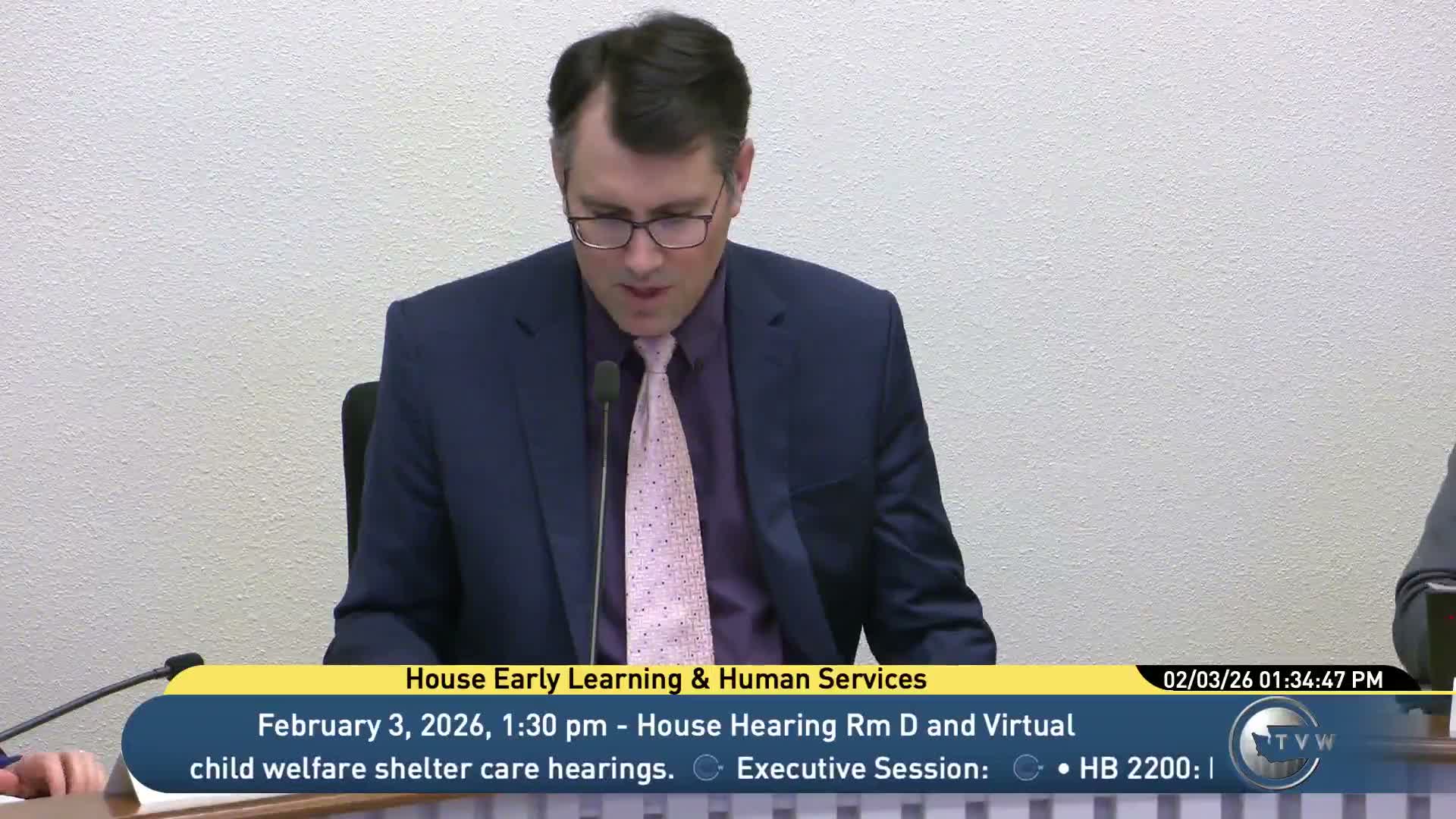
Committee backs substitute for House Bill 2,200 to shift dashboard to annual report and task JLARC with methodology
Summary
The Early Learning & Human Services Committee voted to report substitute House Bill 2,200 with a due-pass recommendation. The substitute delays some JLARC deadlines, replaces a proposed DSHS online dashboard with an annual downloadable report beginning in 2028, and asks JLARC to recommend a methodology for ongoing data collection and analysis.
The Early Learning & Human Services Committee reported substitute House Bill 2,200 out of committee with a due-pass recommendation after adopting a technical amendment.
Representative Penner, sponsor of the substitute, said the bill directs the Joint Legislative Audit and Review Committee (JLARC) to conduct a four-year review (2023–2026) of safety and stability outcomes across residential settings for Department of Social and Health Services (DSHS) developmental disability clients and to recommend a methodology for ongoing tracking. "By changing that to a demodable report and looking at JLARC to give us a direction on what that would look like, it eliminates, I think, the driver of that fiscal note," Penner said.
The substitute delays JLARC data-collection and reporting dates by one year in the offered substitute and replaces the previously proposed DSHS public dashboard with an annual reporting requirement due Sept. 1 each year beginning in 2028. A technical amendment (HARO 799) was adopted to remove a remaining scrivener reference to a dashboard.
Representative Ortiz Self said she supports moving the measure forward to evaluate what data can be collected. Representative Taylor voiced reservations about public-facing data, saying she feared it could stigmatize providers and "drive out the vendors who are doing very difficult work," citing a provider whose insurance premiums rose dramatically after an incident.
The clerk announced a roll call of 9 ayes and 2 nays; by that vote the committee reported substitute House Bill 2,200 out of committee with a due-pass recommendation.
The committee’s action now sends the substitute to the next legislative step; no implementation timeline beyond the substitute’s specified reporting dates was adopted in committee.