Get Full Government Meeting Transcripts, Videos, & Alerts Forever!
Get email alerts on the Committee Legislation topic
No spam. Unsubscribe anytime.
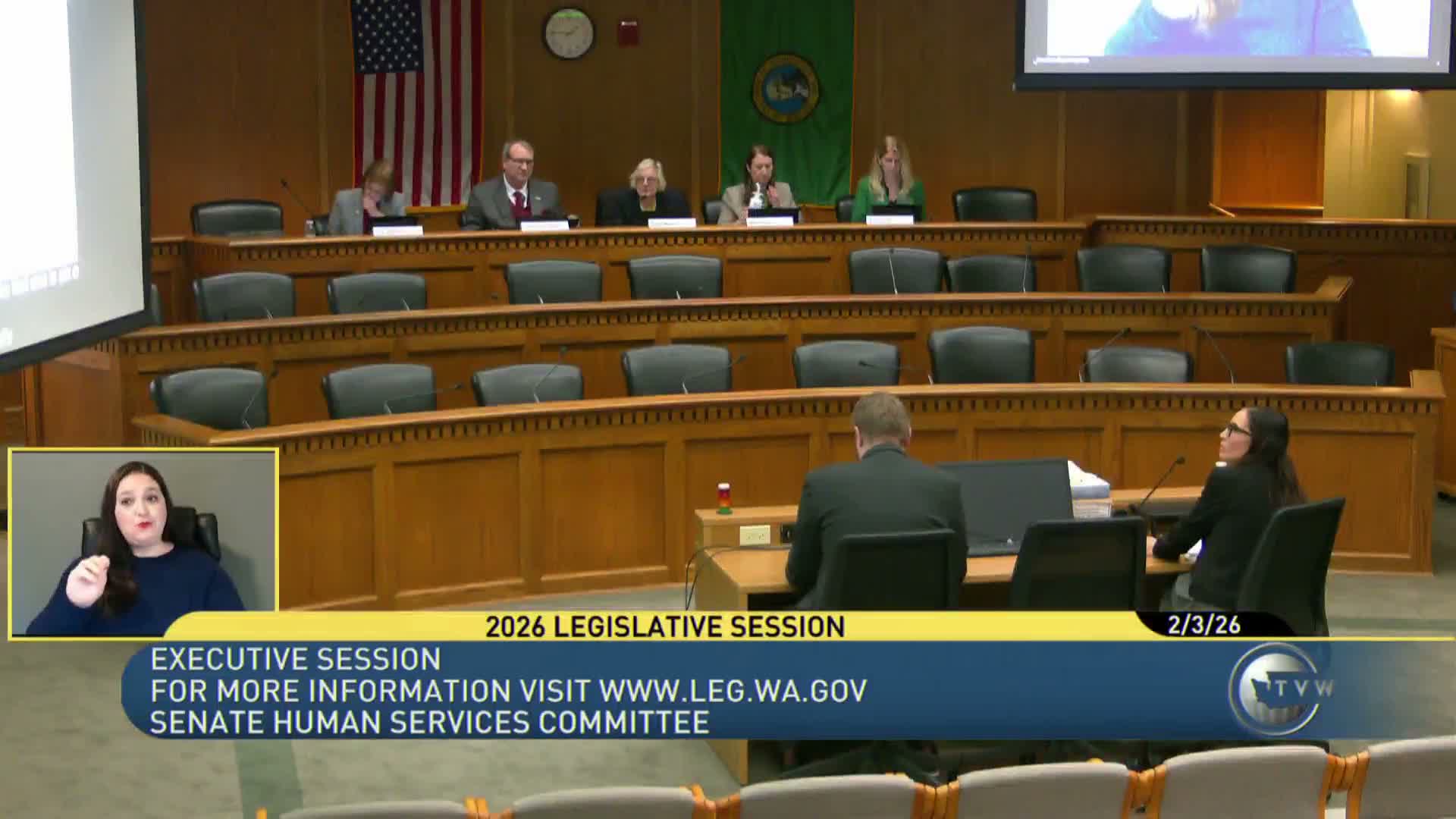
Senate Human Services Committee advances juvenile, child-welfare and detention-related bills after extensive amendment debates
Summary
During executive session on Feb. 3 the committee debated amendments and advanced substitutes on multiple bills — including SB 6,062 (juvenile midpoint review), SB 6,308 (shelter care for children under 5), SB 6,319 (opioid‑related referral pathway), SB 6,286 (private detention inspections), SB 6,080 (jail federal custody contracts) and SB 6,184 (technical updates) — sending them to Ways and Means or Rules, with most sponsor-proposed amendments failing by voice vote.
The Senate Human Services Committee recessed from its Feb. 3 public hearing into executive session and reviewed a packet of six bills. Committee staff briefed members on each bill and senators debated a series of amendments; most amendments failed on voice votes but several substitute bills were advanced and sent to the next committees for consideration.
Key actions and outcomes:
- SB 6,062 (juvenile dispositions, midpoint review): Staff outlined a proposed substitute that would require a midpoint review after six months at a juvenile rehabilitation facility and clarify rated‑bed capacity thresholds; six amendments (A1–A6) offered by Senator Christian (addressing age‑based transfer rules, victim notice, infractions disqualifying midpoint review, ISRB review, voluntary transfer language, and a 110% capacity threshold) were debated and all failed. The committee adopted the proposed substitute and gave it a 'due pass' recommendation to Ways and Means (passed subject to signatures).
- SB 6,308 (shelter care for children under 5): The bill would allow courts at shelter care hearings to order conditions to keep a child under 5 safe; several amendments seeking additional staff or mandatory removal in cases of unlawful substances were defeated, but amendment B5 clarifying that the bill does not supersede the Washington Indian Child Welfare Act (WICWA) was adopted; the substitute was sent to Ways and Means.
- SB 6,319 (referral pathway for families with young children and opioid exposure): The proposed substitute would require DCYF to develop community-based referral pathways and initiate substance‑use referrals within seven days for cases assessed at moderate or high risk; amendments pressing for mandatory removal when dangerous drugs are suspected and for additional CPS frontline staff were defeated; a technical amendment clarifying referral timing (C4) was adopted and the substitute was sent to Ways and Means.
- SB 6,286 (Department of Health inspection authority and fines for private detention facilities): The bill would authorize fines for facilities denying inspection and create an Enforcement Accountability and Community Repair account to assist certain affected families; amendments addressing safety exceptions, reduced fines for juvenile detention, annual inspection limits, cost recovery, and an Attorney General opinion were debated and largely failed; the proposed substitute was adopted and the bill was sent to Ways and Means. A fiscal note estimated roughly $581,000 in the biennium for inspection teams.
- SB 6,080 (discretion for jails to hold persons in federal custody): The substitute gives jails discretion to accept people in federal custody, allows 180 days to enter a contract with the federal government after first acceptance, and includes multiple amendments addressing public records, registers and AG review that were defeated; sponsors said the language was developed with sheriffs and chiefs and the substitute was adopted and sent to Rules.
- SB 6,184 (technical updates and Office of Homeless Youth moves to DCYF): Staff described statutory modernization changes and a preliminary $4,000 one‑time fiscal impact; the item was scheduled for executive session the following day.
Throughout the session, Senator Christian frequently proposed staffing increases, mandatory removal standards when dangerous drugs are suspected, and requirements for AG review of bills' federal legality; the committee routinely rejected those amendments in favor of sponsor-proposed substitutes. Voice votes determined amendment outcomes; where the transcript records 'The amendment has failed' or 'The proposed substitute is adopted,' the committee action is recorded as such.
Next steps: Substitutes advanced to Ways and Means or Rules, and the committee scheduled executive‑session consideration of additional bills and a gubernatorial appointment for the next day.