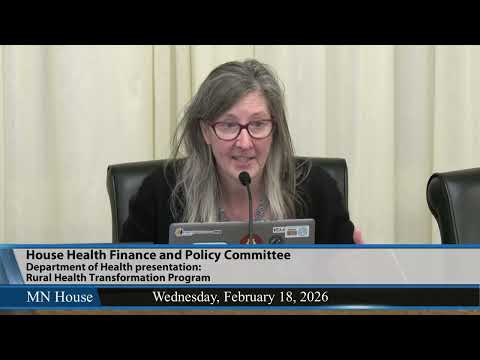
Minnesota health officials outline $193 million first-year rural health grant and warn of limits
Loading...
Summary
The Minnesota Department of Health told the House Health Committee it received a roughly $193 million first-year award from the federal Rural Health Transformation Program and outlined five priorities — workforce, chronic care, community-based access, regional care models and financial stability — while stressing CMS review, reporting rules and spending restrictions could delay disbursements.
The Minnesota Department of Health told the House Health Committee on Friday that the state has been awarded just over $193,000,000 for the first year of the federal Rural Health Transformation Program and outlined how the agency plans to use the funds to shore up rural hospitals and services.
Diane Reidrick, director of the Health Policy Division at MDH, said the grant grew out of federal legislation frequently referenced in testimony as “HR 1, the ‘Big Beautiful Bill,’” a five‑year, $50 billion federal program from which states were asked to apply for roughly $200 million per year. Reidrick said Minnesota submitted an application to CMS and received notice of the first‑year award on Dec. 29; she cautioned the application is a “living” plan and CMS may require changes as the program proceeds.
MDH staff outlined five priority goals tied to CMS guidance: improving outcomes for people with chronic conditions such as cardiovascular disease, diabetes and chronic kidney disease; growing and retaining the rural health workforce; expanding community‑based access including telehealth; strengthening partnerships across providers; and improving the financial health of rural providers. Zora Radacevich, director of the Office of Rural Health and Primary Care, described specific initiatives: boosting chronic disease screening and self‑management programs, expanding rural clinical rotations and residencies, piloting ambulance reimbursement for nontransport calls, supporting obstetrics and birthing centers with bridge grants and investing in data, revenue‑cycle systems and cybersecurity.
MDH said the first‑year allocation strategy will direct roughly 70% of funds to eligible hospitals (94 hospitals identified for first‑year allocations) with a mix of direct allotments and competitive grants for other projects. Radacevich said the state has submitted an updated budget to CMS and cannot obligate funds until CMS completes its review; she added funds are restricted and MDH must meet reporting and evaluation requirements, including quarterly and annual submissions to CMS.
Stakeholders raised implementation concerns during public testimony and question time. Michelle Benson of the Minnesota Hospital Association said hospitals are ‘‘cautiously optimistic’’ and warned that the MDH model requiring hospitals to incur costs up front before reimbursement could complicate projects and cash flow. "Hospitals provide over $1,000,000,000 in uncompensated care," Benson said, and urged close coordination on timing and provider approval.
Dr. Dania Camp, a rural family physician and president‑elect of the Minnesota Medical Association, welcomed funds targeted at workforce development but warned federal changes tied to HR 1 could also reduce federal Medicaid support to Minnesota; she cited a Minnesota DHS estimate that HR 1 may reduce federal Medicaid support by about $1.4 billion annually and said that would offset some program benefits for rural residents.
Martha Jones Sichko, a rural health advocate from Freeborn County, urged the committee to address what she called longstanding local failures in ambulance response and hospital services, and questioned whether MDH’s outreach had adequately included patients and counties that later reported limited engagement.
On operational questions, MDH explained CMS set a 10% administrative cap, and MDH expects to hire additional staff (about two dozen positions) for grant administration, monitoring and financial management; MDH said it will provide a detailed FTE breakdown to the committee. Radacevich also said MDH will use listservs, webinars and partner organizations to post notices of funding opportunity and technical assistance once funds are released.
Committee members pressed MDH on how telehealth access points and ambulance reimbursement pilots would operate. Radacevich said applicants would propose telehealth access models and that the ambulance pilot aims to pay services for some 911 responses that result in patient contact but do not require transport, with the goal of sustaining rural EMS operations while gathering data over the five‑year program.
MDH emphasized the grant cannot be used to offset Medicaid shortfalls or reimburse costs already eligible for other federal payments; staff said the program is intended to build capacity and new models that may help rural providers be more resilient but will not fully replace losses tied to federal policy changes.
MDH said it will follow federal reporting requirements, perform site visits and provide technical assistance to grantees. The committee asked MDH to provide additional detail on the proposed staffing plan, county outreach efforts and mechanisms to ensure rural clinics and community providers can compete for competitive grants.
The committee did not take any formal votes on MDH’s presentation. MDH staff said they would follow up with requested clarifications and additional detail for members.