
Minn. House education panel hears emotional testimony backing bill to limit ICE access to schools
Get AI-powered insights, summaries, and transcripts
Subscribe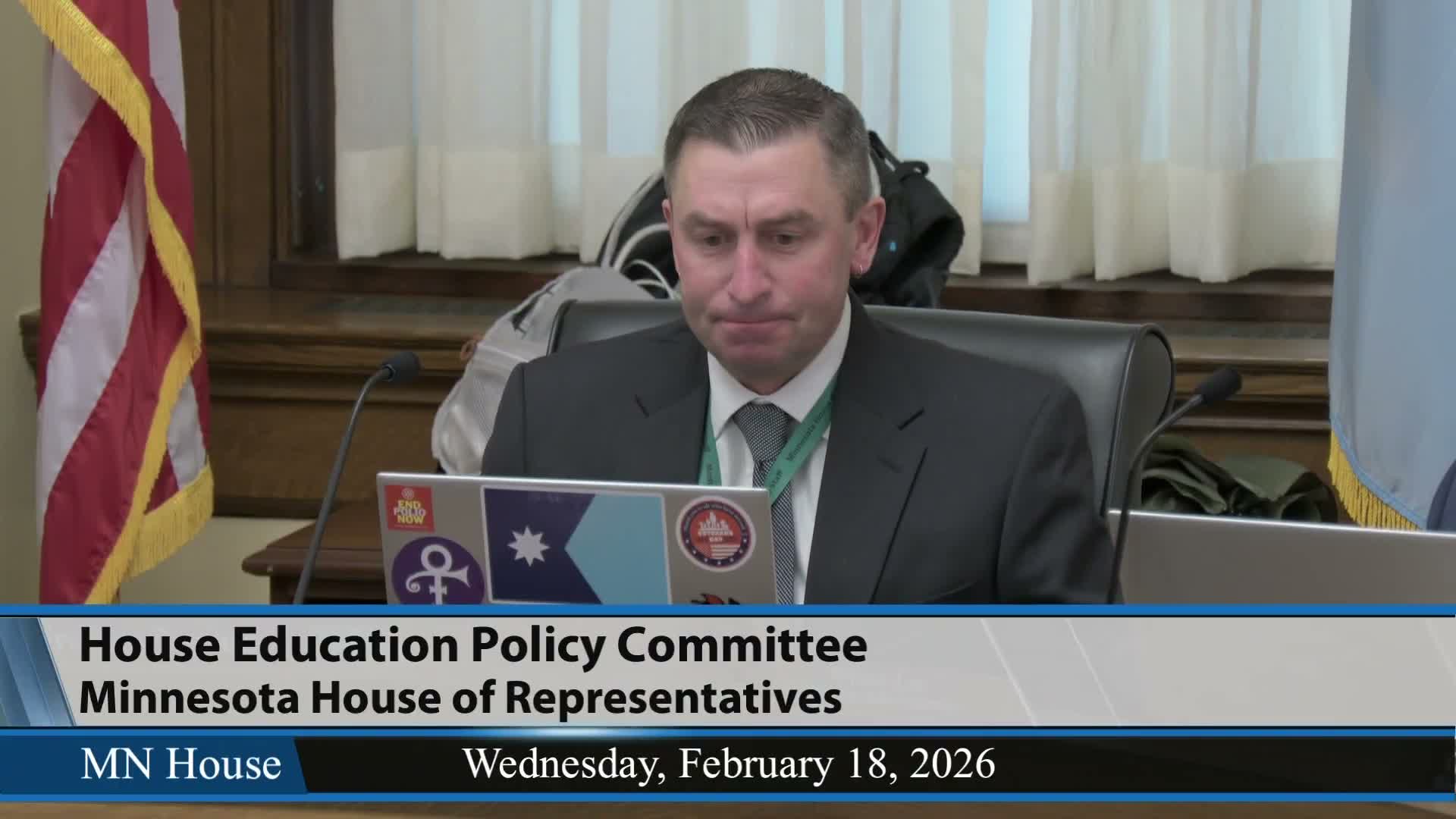
Summary
Educators, students and union representatives told the House Education Policy Committee that federal immigration enforcement near school grounds has driven attendance drops, trauma and operational disruption; a committee amendment was adopted but a motion to refer House File 3435 tied 7-7 and the bill was laid over.
The Minnesota House Education Policy Committee heard more than two hours of testimony urging lawmakers to restrict federal immigration enforcement activity near schools, with witnesses describing dramatic attendance losses, family separations and a surge in student anxiety.
Chair Jordan introduced House File 3435 — modeled on the former DHS "sensitive locations" policy — saying the bill would bar immigration enforcement on school property except when agents present a valid judicial warrant, require agents to show identification, and require the superintendent or school counsel be notified. The committee adopted the author's amendment (DE1) to clarify the bill's language.
Supporters, including Fridley superintendent Brenda Lewis, said the disruptions are immediate and measurable. "We are a school system of 2,700 students…Since December, 112 students…are no longer with us," Lewis said, adding that the district built a virtual learning program in four days and about 400 students are currently learning remotely because families are sheltering at home. Josh Hermerding, a multilingual teacher in North Minneapolis, described ICE vehicles "staging" in school parking lots and nearby blocks and said one class fell from 35 to four in-person students; "I'm scared and exhausted," he said.
Education Minnesota's general counsel, David Aaron, told the committee that a long-standing DHS policy that limited enforcement at schools was rescinded early in the current administration and that the change has prompted enforcement activity at schools and bus stops. "These bills provide needed clarity for educators and families," Aaron said, adding that the bill's requirements — judicial warrants, ID presentation and superintendent approval — mirror practices many districts already use.
Several witnesses described acute trauma and operational strain: a special-education coordinator said her district saw absences spike to 790 and then 1,214 on a single day after enforcement activity rose; another witness said a district reported nearly 7,000 students missing at peak and 832 of those students were served by individualized education programs.
Committee debate turned to the question of what state policy should require school staff to do when agents appear. Co-chair Bennett offered a separate amendment (DE2) directing the Minnesota Department of Education general counsel to work with the attorney general to draft guidance for schools; Bennett said the amendment provides flexible, practical guidance rather than imposing a one-size-fits-all mandate. The amendment failed on a 7–7 tie after a roll call.
Representative Jordan renewed his motion to refer HF3435 (as amended) to the general register, but that motion also failed on a 7–7 roll call. The chair said he would lay the bill over for a later committee date. No final policy was enacted at the hearing.
Supporters urged lawmakers to act quickly, citing wide geographic impact — testimony included teachers and school leaders from metro and Greater Minnesota — and the committee packet included written requests from multiple districts asking for clear statutory protections. Opponents or cautious members warned that strict statutory mandates could expose school staff to legal risks if they were asked to validate warrants or make enforcement decisions, and suggested statutory language should be carefully balanced with guidance and coordination with legal authorities.
The committee did not take final action on HF3435; members left the record with both the adopted amendment and an unresolved debate over whether the state should set statutory limits on enforcement or instead provide centralized guidance.