House committee deadlocks on $50 million emergency rental assistance bill
Loading...
Summary
A Minnesota House Housing Finance and Policy Committee split 7–7 on a proposal to send $50 million in one‑time emergency rental assistance (House File 3403) to Ways and Means. Supporters said the funds would stave off mass evictions after recent federal enforcement actions; opponents objected to moving supplemental dollars before the February revenue forecast.
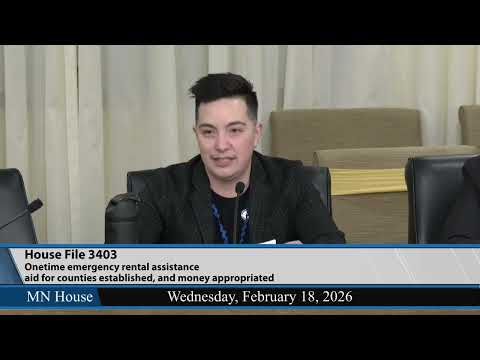
A Minnesota House committee on Friday voted 7–7 on whether to advance House File 3403, a one‑time $50 million emergency rental assistance package aimed at preventing a surge in evictions. The tie vote meant the motion to refer the bill to the committee on Ways and Means did not prevail.
Representative Kozlowski, the bill sponsor, told the Housing Finance and Policy Committee HF3403 would move $44 million to counties and $6 million to tribal nations through the Department of Revenue, using the existing local homeless prevention aid (FHPAP) formula to distribute funds quickly and locally. "We cannot GoFundMe our way out of this structural housing crisis," Kozlowski said, arguing the funds should go directly to landlords through existing county or tribal-administered programs.
Supporters included county officials and nonprofit advocates who described steep increases in demand for rent help and exhausted local funds. Stephanie L. Lewis, associate vice president for advocacy and community impact at Greater Twin Cities United Way, said the United Way 211 helpline saw 3,211 requests for rental assistance in the week of Jan. 12, a 238% increase over a Q4 baseline. Hennepin County Commissioner Angela Connolly told the committee Hennepin has allocated $9.6 million to emergency rent assistance this year but still faces record eviction filings; "the most effective and timely avenue for keeping residents housed is to deploy emergency rent assistance at a scale adequate to the need," she said.
Opponents including Representative Nash and others said it was premature to approve a $50 million supplemental on the first day of committee work without waiting for the February revenue forecast and clearer budget targets. Nash said the reported surplus may be "dubious" and warned against moving large appropriations before the state economic outlook is finalized.
Committee members also debated whether the housing problems cited were primarily caused or exacerbated by federal immigration enforcement actions referred to throughout the hearing as "Operation Metro Surge." Supporters tied the emergency to those actions and the resulting economic disruption in affected communities; some members questioned that framing and urged standard budgetary process.
The tie vote was recorded by the committee clerk: Howard, Kozlowski, Buck, Hussain, Lamonte Hilsley, Norris and Rehrer voted yes; Igo, Dotseth, Johnson, Meckland, Myers, Nash and Scribe voted no; the tally was 7 ayes, 7 nays. Chair Howard said the committee could revisit the bill later.
The bill would target households roughly at or below 200% of the federal poverty level and pay assistance to landlords via county, tribal or contracted providers. The sponsor described the funds as time‑limited and intended to be administered through existing programs to avoid creating new bureaucracy. Whether the measure advances will depend on future committee action and any adjustments to the state budget outlook.
Next steps: HF3403 failed to move out of committee on a tie and may be brought back for future consideration or modified prior to another vote.