Committee debates criminalizing protests at private residences; bill laid over for redrafting
Loading...
Summary
House File 2809, which would prohibit protests at private dwellings, drew extensive debate over First Amendment limits and scope; members supported the intent to protect homes but asked for narrower language and amendments. The bill was laid over for further drafting.
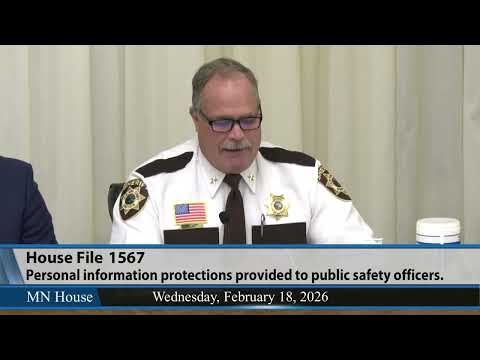
Representative Hudson presented House File 2809 to the House Public Safety Committee on Feb. 18, 2026, saying the measure "simply establishes that bringing a protest to someone's dwelling crosses the line into criminal conduct." He described the bill as a narrow, constitutional response to what he called coercive residential protesting.
Hudson framed the bill as protecting the "peaceful enjoyment of our property" and cited the Supreme Court case Frisbie v. Schultz to argue courts have recognized limits on focused residential picketing. He said the bill would not prohibit protest at public venues like the Governor’s Mansion if those sites are commonly used for public meetings.
Multiple members raised constitutional and drafting concerns. Representative Lisa Curran and others asked whether the bill’s broad phrasing could criminalize lawful or small-scale on-property protests, sidewalk or public-property activity adjacent to homes, or routine activities such as someone standing in their own yard with a sign. Representatives Pinto and Hutt questioned how the bill would define "protest," how courts would apply the standard, and whether existing statutes (harassment, targeted residential picketing, disturbing the peace, trespass) already cover the problematic conduct.
An ACLU-affiliated former board member and several members suggested amending existing harassment statutes rather than creating broad new language. Hudson acknowledged multiple concerns and said he was open to amendments that would preserve protections for constitutionally protected activity "that occur in a place where you have the right to be." Members raised specific edge cases — Airbnbs, sidewalks, lawful service of process — and asked staff to draft clarifying language.
Because many members favored the bill’s intent but not its current breadth, Representative Hudson changed his motion and the committee laid HF2809 over to work on narrowed language and specific exemptions. The committee did not record a roll-call vote; the transcript records the bill being laid over.
Next steps: Committee staff and the author will work on amendments to narrow the definition of prohibited conduct and to add explicit exemptions for constitutionally protected activities and lawful conduct; the bill will return after redrafting.