Minn. committee advances bill to shield public safety officers’ personal data after doxing incidents
Loading...
Summary
The House Public Safety Committee moved House File 1567, which would allow Minnesota public safety officers to request that certain personal information be treated as private, to the general register after testimony describing doxing incidents and debate over scope and transparency concerns.
House File 1567, a bill to restrict the public posting and sale of certain personal information for public safety officers and correctional officers, was advanced by the Minnesota House Public Safety Committee on Feb. 18, 2026.
Representative Fernando Duran, the bill’s author, said the proposal was "an added extra precaution for law enforcement and data privacy," and moved an author’s technical amendment (A4) updating the bill’s effective dates; the committee adopted A4 by voice vote before considering testimony.
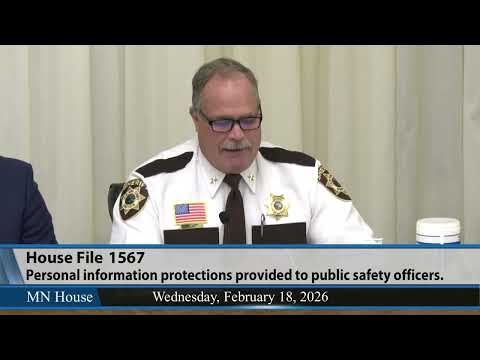
Sheriff Eric Clang of Crow Wing County described a Jan. 26 incident in which a deputy’s home was targeted — officers found a handwritten note with the deputy’s name and address and a loaded 9 mm in a vehicle — and told the committee, "I have no doubt in my mind that that individual was there to kill deputy Matt Jorgens." Multiple law-enforcement groups, including the Minnesota Chiefs of Police Association and Law Enforcement Labor Services, urged passage. Jay Henthorn, chief of police in Richfield and president of the Minnesota Chiefs of Police Association, called online publication of officers’ home addresses and family details "doxing" and said the bill "draws a line between transparency and targeted harm." David Titus, executive director of the Minnesota Police and Peace Officers Association, and Mike Ledoux of Law Enforcement Labor Services also testified in support.
Several witnesses recounted threats and harassment tied to publicly posted information. Chad Tessing, a conservation officer, said social media posts of an inspection produced thousands of hostile comments that included his home address and threats to his family, adding the episode made it "very taxing on my wife and my kids." Those accounts were used by supporters to argue the bill creates a narrow process for officers to ask that certain sensitive government-held data be treated as private and to speed removal of online postings that could lead to violence.
Opponents urged caution. Rich Newmeister, who said this was his first time testifying on the bill, argued the proposal "needs substantial rework," warned it could affect "15,000 plus employees," and said making data private immediately while remedies and penalties require claims creates a disconnect that could erode transparency and obscure conflicts of interest.
Members pressed the author on scope and limits. Representative Lisa Curran asked why property records were not included; Duran said addressing property records is broader and would require additional work. Co-chair Mueller and others expressed conditional support for the bill’s intent but urged targeted drafting and further conversation about extending similar privacy protections to other groups.
After discussion, Representative Duran’s motion that HF1567 as amended be placed on the general register carried by voice vote. The committee record does not include a roll-call tally for the voice vote.
Next steps: HF1567 will appear on the House general register for further consideration; committee members signaled willingness to refine scope in later hearings.