State seeks $50 million bonding for Rural Finance Authority as loan demand surges
Loading...
Summary
Agency officials told the committee that the Rural Finance Authority expects to exhaust available loan authorization by mid‑2027 and that the governor's 2026 bonding proposal includes $50 million to prevent a funding gap for low‑interest farm loans.
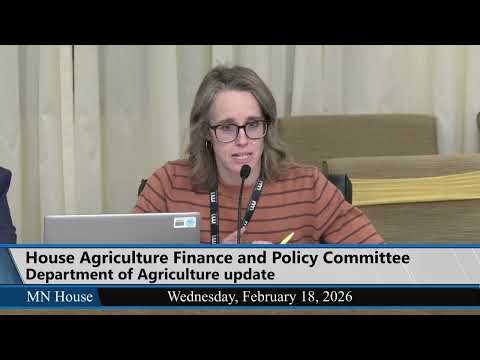
ST. PAUL — Officials from the Minnesota Department of Agriculture told the House Agriculture Finance and Policy Committee that the state’s Rural Finance Authority (RFA) is seeing strong demand for low‑interest loans and that a $50 million bonding request in the governor’s 2026 proposal is intended to prevent a funding gap.
Deputy Commissioner Andrea Vawel described the RFA as the state’s agricultural lender that partners with local banks: the local lender makes loans and the RFA purchases a portion (about 45 percent) to lower borrowing costs. The RFA is supported in part by state bond proceeds that must be repaid by the authority.
"In the governor's proposal, there's $50,000,000 for RFA in the 2026 bonding bill," Vawel said. She told the committee the 2023 appropriation left about $26 million of authorization and that active loans include 1,008 accounts with a balance of roughly $139 million. Vawel said current loan authorizations could be exhausted around July 2027 without new bonding.
Committee members expressed interest in performance metrics; Vawel cited historical program performance: since 1986 the RFA has issued 3,951 loans totaling about $390.3 million and reported a very small loss rate in recent years. She said the agency will monitor the authorization drawdown and provide updates to the committee.
The department asked the committee to consider the bonding proposal to avoid interruptions in lending to beginning farmers, livestock expansion and restructuring loans. The committee did not take formal action at the hearing but set the item for future consideration as the bonding process advances.