Get AI Briefings, Transcripts & Alerts on Local & National Government Meetings — Forever.
Minnesota ag officials say short federal funding freeze briefly threatened avian‑flu testing
Loading...
Summary
Department of Agriculture and the Board of Animal Health told the House Agriculture Committee that a temporary federal suspension of cooperative agreements disrupted grant reimbursements and raised short‑term testing concerns for highly pathogenic avian influenza, but federal partners and Minnesota’s congressional delegation helped restore key funds.
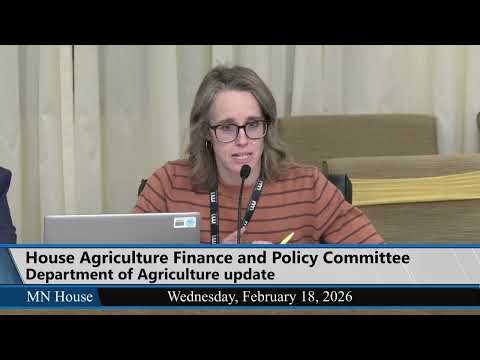
ST. PAUL — Minnesota agriculture leaders told the House Agriculture Finance and Policy Committee that a brief federal suspension of USDA cooperative agreements in January disrupted reimbursements and raised short‑term concerns about avian‑flu testing, but federal staff subsequently clarified that surveillance and diagnostic work would continue.
“On Jan. 9 the governor received a letter … suspending active and future awards to MDA,” Minnesota Agriculture Commissioner Tom Peterson said, describing initial uncertainty about whether diagnostic testing and other cooperative agreement work would be affected. “We were told grants, cooperative agreements … were suspended till further notice, pending justification and review.”
State Veterinarian Dr. Brian Hayes, executive director of the Minnesota Board of Animal Health, told the committee that Minnesota has remained operational for testing and surveillance and that, after engagement with USDA and congressional offices, cooperative agreement reimbursements were reinstated. “It took us a week to get that reversed so that funding was brought back,” Hayes said.
Hayes outlined the state’s disease picture and laboratory posture: Minnesota recorded 35 highly pathogenic avian influenza (HPAI) detections last year (27 commercial premises and 8 backyard flocks). Current genomic sequencing ties recent infections to wild birds (subtype D1.1), and Hayes warned that March migration could increase detections. He said Minnesota is working with USDA, the University of Minnesota and grower groups on response, research and biosecurity.
The Board and MDA emphasized the practical limits of federal and state roles: some diseases (for example, avian metapneumovirus) are not federally reportable and therefore lack federal indemnity support, and vaccine policy involves international trade considerations that limit unilateral state action. Hayes said federal research awards for HPAI vaccine and response work—some administered through the university and industry—are a step forward but cautioned vaccines are not a “magic bullet.”
Committee members asked how the funding disruption affected testing capacity. Peterson said the Wilmer Poultry Lab briefly faced uncertainty over reimbursement for testing but that arrangements were clarified after department staff and Minnesota’s congressional delegation intervened. Hayes confirmed that diagnostic lab funding tied to university contracts had been reinstated.
The committee requested follow‑up information on specific grants and reimbursements and on readiness for the spring migration season. Peterson and Hayes said they would provide additional documentation and remain watchful as the season approaches.