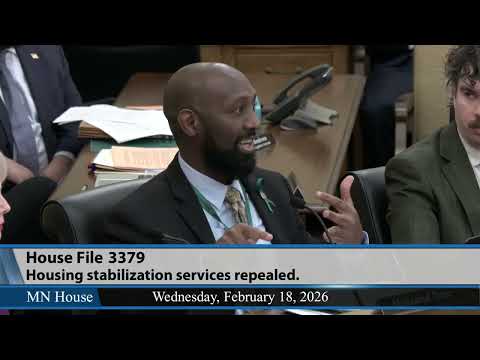
Minn. House panel debates checks on DHS authority as it advances HF3379
Loading...
Summary
Lawmakers advanced House File 3379 to the general register after withdrawing contentious oversight language and adopting a technical amendment; debate centered on whether the proposal would constrain the commissioner’s ability to terminate Medicaid-related programs amid fraud concerns and protections for vulnerable residents.
The Minnesota House Health and Human Services Finance and Policy Committee on Feb. 17 voted to place House File 3379 on the general register after a lengthy debate over amendments that would clarify when the Department of Human Services may terminate Medicaid programs.
Committee members initially considered an A1 amendment, proposed by Chair Noor, that would have required 30 days of public comment for certain Medicaid state plan or waiver amendment requests and would have limited the commissioner’s ability to “terminate any Medicaid program, waiver, or benefit that is enacted legislatively” or to ask federal authorities to terminate such programs. Supporters said the amendment was intended to preserve legislative oversight; critics warned it could hamper the administration’s ability to act on credible allegations of fraud or program failings.
Nonpartisan staff explained that Minnesota Statute 256.0064 governs MA sanctions and monetary recoveries and defines what may constitute a "credible allegation" (including fraud hotline complaints, data mining, provider audits, civil false-claims cases and law-enforcement investigations). Lawmakers pressed DHS officials on what would happen to participants in assisted-living and other residential settings if a program were terminated administratively, and on how fiscal notes associated with terminated programs would be treated.
After back-and-forth among members—where several speakers emphasized both the need to combat fraud and the need to ensure continuity of services for vulnerable Minnesotans—Representative Noor withdrew the A1 amendment and the related A3 amendment. The committee then adopted a technical A2 amendment drafted by nonpartisan staff and approved HF3379, as amended, for referral to the general register.
Chair Schumacher moved the bill and presided over a voice vote; the minutes of an earlier meeting (April 10, 2025) were also approved at the start of the session.
The committee’s discussion emphasized two competing priorities: members calling for strong tools to deter and remediate fraud, and members urging caution to avoid abrupt loss of services for people who rely on Medicaid-funded programs. Several lawmakers said further conversations and separate bills this session would address procedural details the committee did not resolve in today’s proceeding.
The committee adjourned and is scheduled to reconvene Feb. 19.