Committee warned CMS may withhold billions; DHS outlines corrective actions and budget risk

Minnesota Legislature — Human Services Budget Committee · February 19, 2026

Get AI-powered insights, summaries, and transcripts

Subscribe
AI-Generated Content: All content on this page was generated by AI to highlight key points from the meeting. For complete details and context, we recommend watching the full video. so we can fix them.

Summary

Department of Human Services budget director Elise Bailey told the human services budget committee that CMS has indicated intent to withhold $515 million per quarter and is conducting detailed claim reviews that could lead to deferrals; DHS has submitted a corrective action plan including provider revalidation and prepayment reviews.

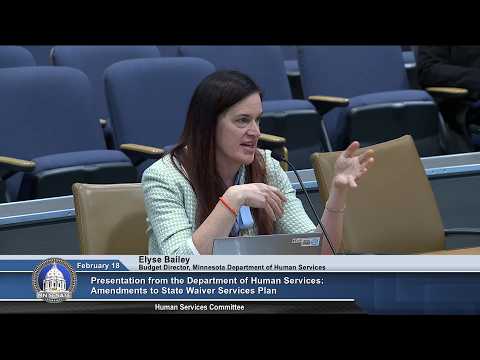
Elise Bailey, budget director at the Minnesota Department of Human Services, told the Human Services Budget Committee that federal officials have signaled an unusually large funding risk to the state. "CMS has indicated that they intend to withhold $515,000,000 per quarter," she said, and added the agency has also warned of the potential for a deferral — a retroactive review that can require states to prove past claims were paid in accordance with federal rules.

Bailey said DHS has submitted a corrective action plan to address program-integrity concerns and described measures the department is taking: "One of them is a revalidation of every single provider in all of these services. Another item is the prepayment review and assessment of all claims." She told senators DHS does not have data to support some higher public estimates of the total at risk and that the scope, timing and resolution of any federal actions remain uncertain.

Committee members pressed for facts. Senator Glenn Gruenhagen raised a figure of roughly $9 billion that he had seen in outside reporting and asked what DHS was doing to ensure federal funds reach intended recipients. Bailey responded that DHS has not seen data to validate the $9 billion figure and is continuing analytic work to separate legitimate reductions from billing lag or seasonal variation.

Members also pressed for a definition of a deferral and how the process works. Bailey explained that a deferral involves CMS reviewing claims it already paid and that the state must then work claim-by-claim to demonstrate compliance; she said the agency has not yet received final notices about timing or magnitude. "A deferral is something that CMS uses frequently," Bailey said in response to the chair's question, but she added that a large withhold of future payments is unprecedented for Minnesota in recent memory.

Senators expressed concern about possible budget effects if federal payments are reduced. Bailey estimated that federal funds account for roughly half of the DHS budget in fiscal year 2026 and warned that sustained withholding or clawbacks would require state-level budget actions. The committee asked DHS to return with more detailed analyses and for nonpartisan fiscal staff to model scenarios for the February forecast.

Next steps: DHS will provide the committee with its corrective action plan and follow up on specific data queries, including validation of NEMT and other utilization figures that members raised during questioning.