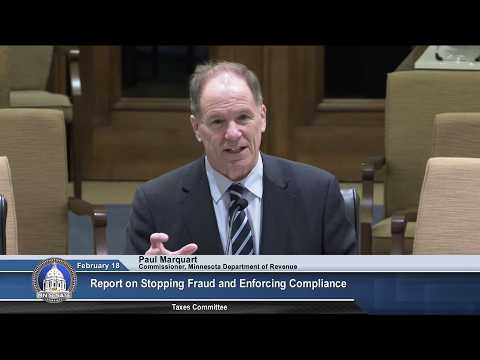
Revenue department details fraud prevention, collections and criminal enforcement
Loading...
Summary
Department of Revenue officials described voluntary compliance programs, identity verification and enforcement tools that yielded about $512 million in collections in 2025 and roughly $270 million in fraud prevented over four years; the department outlined commissioner filings, criminal prosecutions and expanded interagency data sharing.
After the HR 1 briefing, the Department of Revenue briefed the committee on voluntary compliance, fraud prevention and enforcement activities.
Commissioner Paul Marquardt summarized the department’s approach: education and simplicity to encourage voluntary compliance, analytics‑driven discovery, and enforcement when necessary. "We estimate that we get about 97 to 98% voluntary compliance," Marquardt said, summarizing the department’s reliance on accurate taxpayer filings.
The department described enforcement and collections outcomes: $512 million collected in 2025 through collections, audits and penalties and additional recoveries from other agencies, and 36 criminal tax cases charged in the prior year. Staff outlined the "commissioner filing" procedure used to prepare returns on behalf of nonfilers using available third‑party data and then notifying taxpayers before assessments are finalized.
Revenue officials detailed identity‑based schemes and the role of automated risk scoring: internal risk indicators combined with vendor identity verification generate stop signals that halt suspect refunds. The department said those systems, coupled with manual review, have prevented roughly $270 million in fraudulent payments over the last four years and helped recover other losses.
Committee members raised questions about how stopped‑transaction flags lead to taxpayer outreach, what penalties apply when the department’s earlier guidance changes, and whether the department’s expanded data sharing (after recent executive orders) created new privacy or program‑integrity issues. The department acknowledged the need for clarity and said it would follow up with memos and data, and that staff would provide more detail on year‑to‑year enforcement trends.
The hearing concluded with members thanking department staff; the committee adjourned and scheduled to reconvene the next morning.