Senate Taxes Committee hears Department of Revenue on HR 1 conformity and fiscal impacts
Loading...
Summary
Department of Revenue officials told the Senate Taxes Committee that conforming Minnesota law to HR 1 (the 2025 federal tax reconciliation law) would simplify filings but carry multi‑year fiscal effects, including a $388 million estimated cost in FY26‑27 and timing gains later; members sought incidence analysis and detail on revenue, eligibility and implementation timing.
The Minnesota Senate Taxes Committee on Feb. 18 heard a Department of Revenue briefing on HR 1, the federal tax reconciliation law enacted July 4, 2025, and how Minnesota might choose to conform to its many provisions.
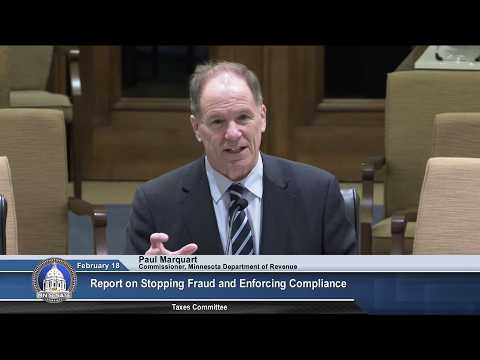
Commissioner Paul Marquardt introduced Department staff and said the presentation would focus only on HR 1. "I am Paul Marquardt, the commissioner of revenue, and, welcome to the 2026 session," he told the committee. Jeremy Ness and Dan O'Rourke of the department then laid out the mechanics of state conformity and the largest provisions that would affect Minnesota returns.
The presenters said Minnesota uses a static‑date conformity method (tied to the Internal Revenue Code as amended through May 1, 2023), which means the state must pass legislation to adopt subsequent federal changes. Dan O'Rourke told senators that general conformity to HR 1 without state decoupling would carry a $388,000,000 cost for fiscal years 2026–27 and an $89,800,000 revenue increase for fiscal years 2028–29, noting much of the effect is timing and some provisions phase in later years.
Department staff reviewed major individual and business provisions in HR 1 that would affect Minnesota filings if the state conformed, including research and experimental (R&E) expensing rules, changes to bonus depreciation and Section 179 limits, business interest expense calculations, and foreign‑source income rules (GILTI renamed to "net CFC tested income"). On R&E expensing, the department said HR 1’s allowance for immediate domestic expensing is the single largest driver of the revenue estimate because Minnesota currently requires a 5‑year amortization.
On individual provisions, the department highlighted federal expansions to the child and dependent care credit and increased employer dependent‑care exclusions, and said Minnesota would continue to compute its state child care credit using the pre‑HR 1 (20–35%) rate unless the legislature acts. Officials also described expanded qualified distributions for 529 plans, changes to ABLE accounts, and higher thresholds for 1099 reporting (1099‑MISC/NEC threshold rising from $600 to $2,000 and 1099‑K reverting to the prior higher reporting threshold).
Committee members asked about distributional effects and administrative burdens. Senator Nelson cited a Joint Committee on Taxation finding that the largest proportional benefits of HR 1 go to households making under $50,000 and asked whether the department could produce incidence estimates for specific conformity choices; Dan Ness said the tax research office might be able to provide those figures. Senators also pressed on foreign‑source income mechanics and whether Minnesota could continue to collect comparable revenue if federal calculations change; the department said the federal concepts largely remain but the calculations and timing would change and would require careful state choices.
Officials warned that conforming to HR 1 will have implementation costs: forms, instructions, software updates and a temporary pause in return processing may be required if the state adopts major changes mid‑season. Marquardt said many taxpayers have already filed for 2025 (about 570,000 filers as of the briefing), so a conformity decision later in the session would generally require amending already‑filed returns rather than automatic departmental adjustments.
No formal motion or vote occurred on a conformity bill during the hearing. Committee members requested additional materials, including more detailed revenue and incidence analysis, and the department said it would supply deeper estimates and supporting charts on request.
The committee will take up further conformity questions in subsequent meetings.