
Committee holds hearing on DCA-managed blight fund; seeks more detail before advancing
Get AI-powered insights, summaries, and transcripts
Subscribe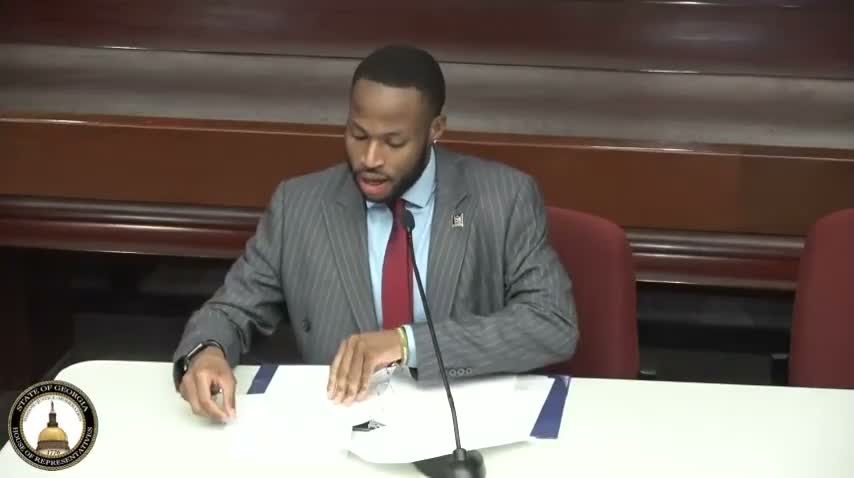
Summary
The committee held a hearing on House Bill 753, which would authorize a DCA-administered "Better Georgia Without Blight Fund" using existing grant funds to support local blight remediation. Members raised property-rights, fiscal-note and staffing questions and asked DCA for follow-up before advancing the bill.
Representative Berry presented House Bill 753, a proposal to establish the "Better Georgia Without Blight Fund," which would authorize the Department of Community Affairs to apply existing grants or other non–general-fund sources to county and local blight-rehabilitation efforts. Berry said the bill would not create a new general-fund appropriation and would rely on existing funding sources and grant applications rather than drawing on the state’s general fund.
Berry emphasized local control and a requirement that applicants show local community support (letters from neighborhood organizations or homeowner associations) to reduce the risk of displacement and ensure projects reflect neighborhood priorities. He described estimated statewide blight statistics and projected revenue impacts on tax digests if blight is not addressed.
Members questioned whether the bill could be interpreted to enable local governments to take private property, whether it would require a fiscal note, and whether DCA would need additional staff to administer a new fund. Representative Crow and others said local condemnation or land-bank actions are governed by local ordinances and that the bill, as written, is support- and grant-focused rather than a property-conveyance mechanism.
Ryan Evans, director of external affairs at DCA, told the committee DCA already runs programs that overlap with blight remediation and that the department would review potential staffing and program interactions. The committee requested DCA return with a more detailed analysis of program overlap, staffing needs and fiscal implications. The chair left HB 753 as a hearing-only item and asked for a small working group of members to meet with DCA for follow-up work before any vote.
No committee vote was taken on HB 753; the next step is a DCA briefing and follow-up with a select group of members.