Get AI Briefings, Transcripts & Alerts on Local & National Government Meetings — Forever.
House panel hears broad support to extend SmartZone tax capture for 15 years
Loading...
Summary
The House Committee on Economic Competiveness heard unified testimony supporting House Bill 5031, which would extend tax-increment capture for existing Michigan SmartZones by 15 years, include satellite SmartZones, and change some mandatory approval language to discretionary; witnesses from local economic development groups cited job creation, investment and continuity risks if extensions lapse.
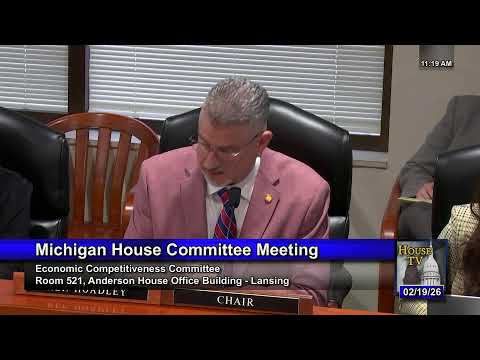
The House Committee on Economic Competitiveness on Jan. 16 heard testimony in support of House Bill 5031, which would extend the tax-increment capture period for existing Michigan SmartZone technology districts by 15 years and explicitly include satellite SmartZones.
Representative Robinson, sponsor of HB 5031, told the committee the bill "just merely extends the authorized capture period for existing smart zones by 15 years" and "strictly addresses the timeline and continuity," and does not change how SmartZones operate or otherwise expand the program.
Witnesses from regional economic-development organizations and municipal officials described SmartZones as long-term, locally rooted tools to move university research to market, retain talent and support manufacturing supply chains. Paula McPherson, executive director of Velocity in Macomb County, said Velocity helped create 155 new jobs in 2025 and retained 310, worked directly with about 300 businesses, awarded over $650,000 in grants and — according to her testimony — helped attract $6,868,000,000 in investment to businesses it assisted. She described targeted match grants, including a $21,000 grant to Standard Components that she said helped the firm retain a Lockheed Martin contract and protect 10 jobs, and an $18,000 grant to NTL Industries to maintain growth in the defense space.
Luke Bonner, senior economic development advisor for the city of Sterling Heights, and Haley Bradley, Sterling Heights assistant city manager, told the committee SmartZones operate through tax-increment financing (TIF) capture and that the local industrial corridor has sufficient energy infrastructure for current projects. Bonner clarified that under current law an applicant may seek a five-year extension subject to MEDC and Treasury review, and HB 5031 would create an explicit option to seek a full 15-year extension if the substitute is adopted.
Jillian Wynne, director of the East Lansing/Lansing SmartZone and a presenter for LEAP, provided statewide program metrics and said the SmartZone network includes 20 certified technology parks. Wynne cited multi-year outcomes: about 1,700 companies formed statewide, roughly 25,000 tech companies served, approximately 12,000 new jobs created and some 46,000 jobs retained, with more than $5 billion in capital secured, calling the program "a 25 year long, measurable, transparent record of success and outcomes."
Paul Bridal, president and CEO of Ann Arbor Spark, said a coalition of 10 regional economic development partnerships — representing a majority of Michigan's population and economic output — included the SmartZone extension in their legislative priorities. Nora Vandenbrink of Lakeshore Advantage urged the committee to create a clear pathway for extensions, saying communities such as Holland face a planning "cliff" if zones approach expiration without extension options.
Committee members asked technical questions about funding and scope. One member asked whether SmartZone capture is seeded through TIF; Bonner confirmed SmartZones are TIF-based and limited to 15 years of capture absent legislative change. Representative Altman asked whether special assessments within a TIF district would be captured; Bonner replied special assessments levied for municipal purposes continue to go to their intended purpose and would not be captured by the Local Development Finance Authority. Minority vice chair Grant asked whether the bill could inadvertently facilitate data-center development; witnesses said they were not aware of such a connection and described the program as focused on incubators, tech transfer and manufacturing supply chains.
Chair Hovley read a long list of submitted support cards and organizations backing the bill and announced the committee plans to take a vote next week on an H‑2 substitute. Representative Kate moved to excuse absent members; with no objections the absent members were excused and the committee adjourned.
Next steps: the committee plans to vote next week on HB 5031 with the H‑2 substitute; no formal committee vote on the bill was recorded during this hearing.