Get Full Government Meeting Transcripts, Videos, & Alerts Forever!
Get email alerts on the Efficiency Commission topic
No spam. Unsubscribe anytime.
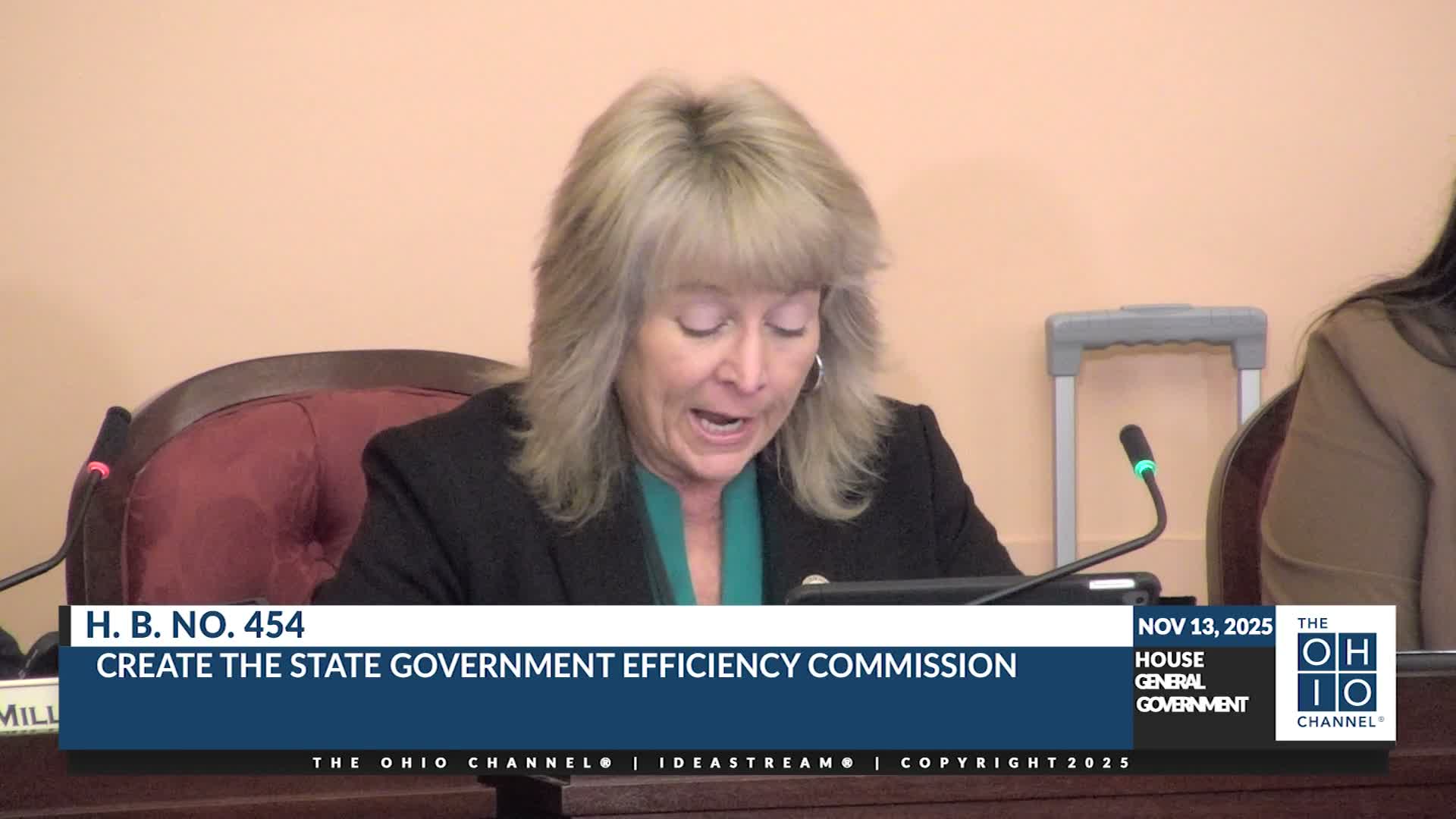
Sponsors pitch State Government Efficiency Commission in first hearing on HB 454
Summary
Sponsors of House Bill 454 told the committee the measure would create a seven‑member state efficiency commission to identify duplication, recommend consolidations, estimate savings and deliver an annual report; critics asked whether it duplicates existing functions of the finance committee and the auditor.
Representatives Sarah Heiner and Mark Matthews told the House General Government Committee that House Bill 454 would create a State Government Efficiency Commission charged with four tasks: identifying duplication or fragmentation across departments, recommending methods to improve or eliminate services, estimating potential cost savings, and delivering an annual report to the General Assembly.
"This bill strives to create a state government efficiency commission who would be tasked with 4 important duties," Representative Heiner said in sponsor testimony. Representative Matthews described the proposed body as seven members representing legislative and executive perspectives who would serve without additional compensation and act as collaborators with agencies.
Committee members probed whether the proposal duplicates existing oversight. Representative Russo asked how HB 454 differs from the finance committee's recurring agency reviews and the auditor of state's statutorily required performance audits, saying: "Why do we need a whole another layer and bureaucracy to do more?" Sponsors replied the commission would focus attention on audits and implementation gaps that can get lost in the larger budget process and would highlight where the legislature should act.
Sponsors and members discussed operational examples. Representative Matthews cited what he characterized as duplicated services in state treasurer operations and Representative Heiner described a regional public‑health grant arrangement that arguably wasted taxpayer dollars when local resources could have been used.
No vote was taken on HB 454 during the hearing; the committee concluded the first hearing and left the bill open for further consideration and amendment.