Get Full Government Meeting Transcripts, Videos, & Alerts Forever!
Get email alerts on the AI Accountability topic
No spam. Unsubscribe anytime.
Witness urges Ohio to enshrine AI explainability and audit trails in law
Summary
At a House Technology and Innovation Committee second hearing, information security officer John Crisp testified for HB 469, urging statutes to preserve human accountability for AI by requiring explainability, audit trails and human oversight to limit corporate control over algorithmic decisions.
John Crisp, identifying himself as a Toledo-based information security officer with FalconForge AI Labs, told the House Technology and Innovation Committee on May 2 that House Bill 469 should make clear in statute that humans—not programs—bear legal and moral responsibility for AI-driven outcomes.
"Every algorithm has a human author, a human deployer and a human beneficiary," Crisp said during proponent testimony on HB 469. He argued the law should require human-readability standards, explainability benchmarks and audit trails for systems used in policy, finance or defense decisions.
Crisp described practical safeguards he has used in industry: logging every interaction, dual validation for factual correctness and humane consequence, and engineered transparency rather than retrofitting accountability after deployment. He cited work across manufacturing, aviation and banking and said explainability can speed adoption by building trust.
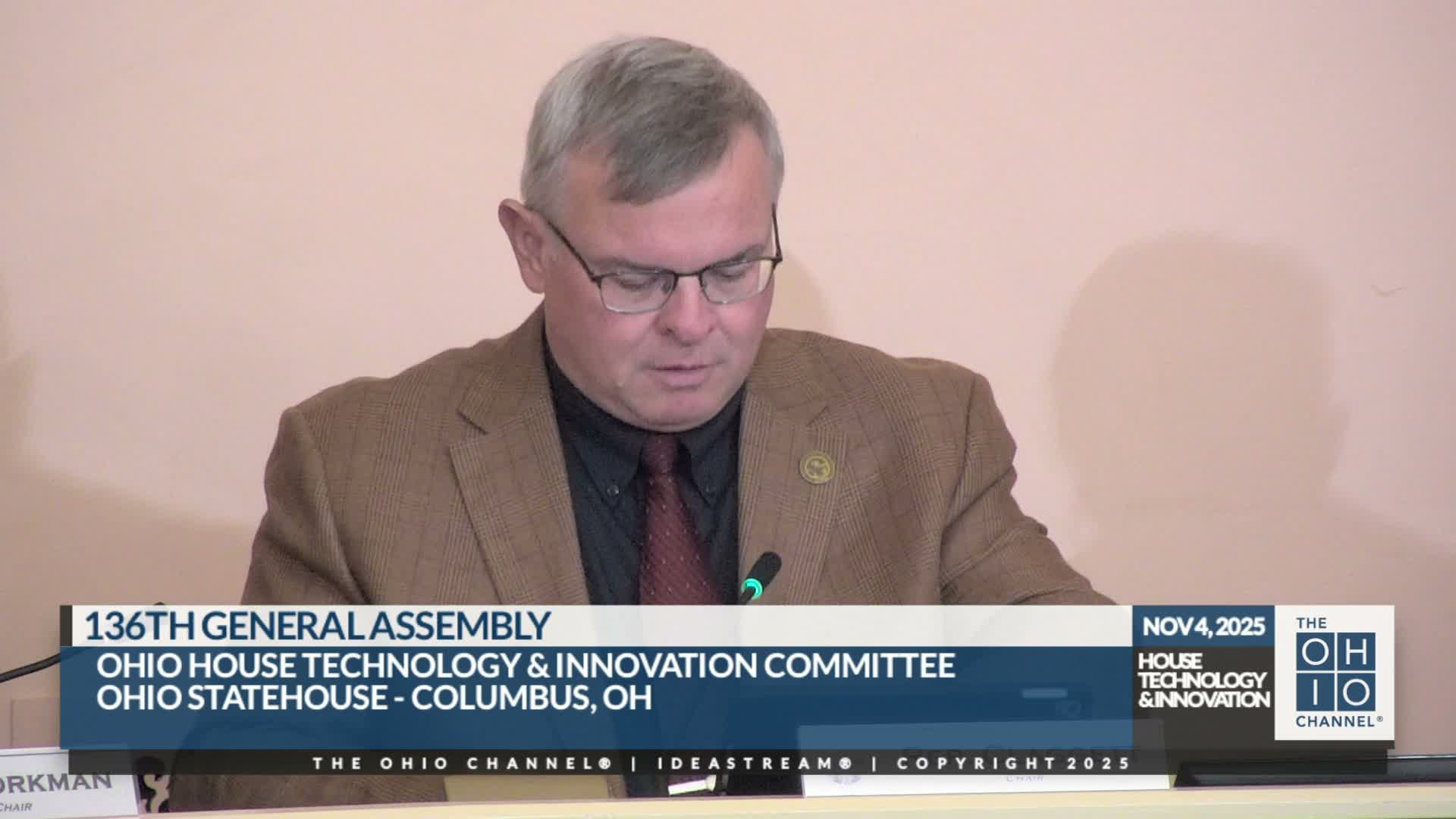
In questioning, Vice Chair Workman asked how the committee should plan for the possibility of AI becoming "sentient." Crisp replied that sentience is not present now, and recommended defining audit trails and governance so systems remain transparent and auditable.
Crisp also warned about hallucination—the tendency of models to produce false or misleading outputs—and recommended standards and training that would ensure institutions could review prompts and results. Committee members thanked Crisp and asked him to remain engaged as the bill moves forward.
The committee closed the bill's second hearing and noted additional written testimony available to members.