Get Full Government Meeting Transcripts, Videos, & Alerts Forever!
Get email alerts on the Andy S Law topic
No spam. Unsubscribe anytime.
Committee hears divided testimony on 'Andy’s Law' as advocates press for tougher penalties and opponents warn of broader harm
Summary
The House Judiciary Committee heard hours of proponent and opponent testimony on H.B. 338, "Andy’s Law," which raises penalties for assaults on corrections staff, mandates consecutive penalties in some cases and includes operational changes for prisons; supporters said it protects staff, opponents called for narrower reforms and data first.
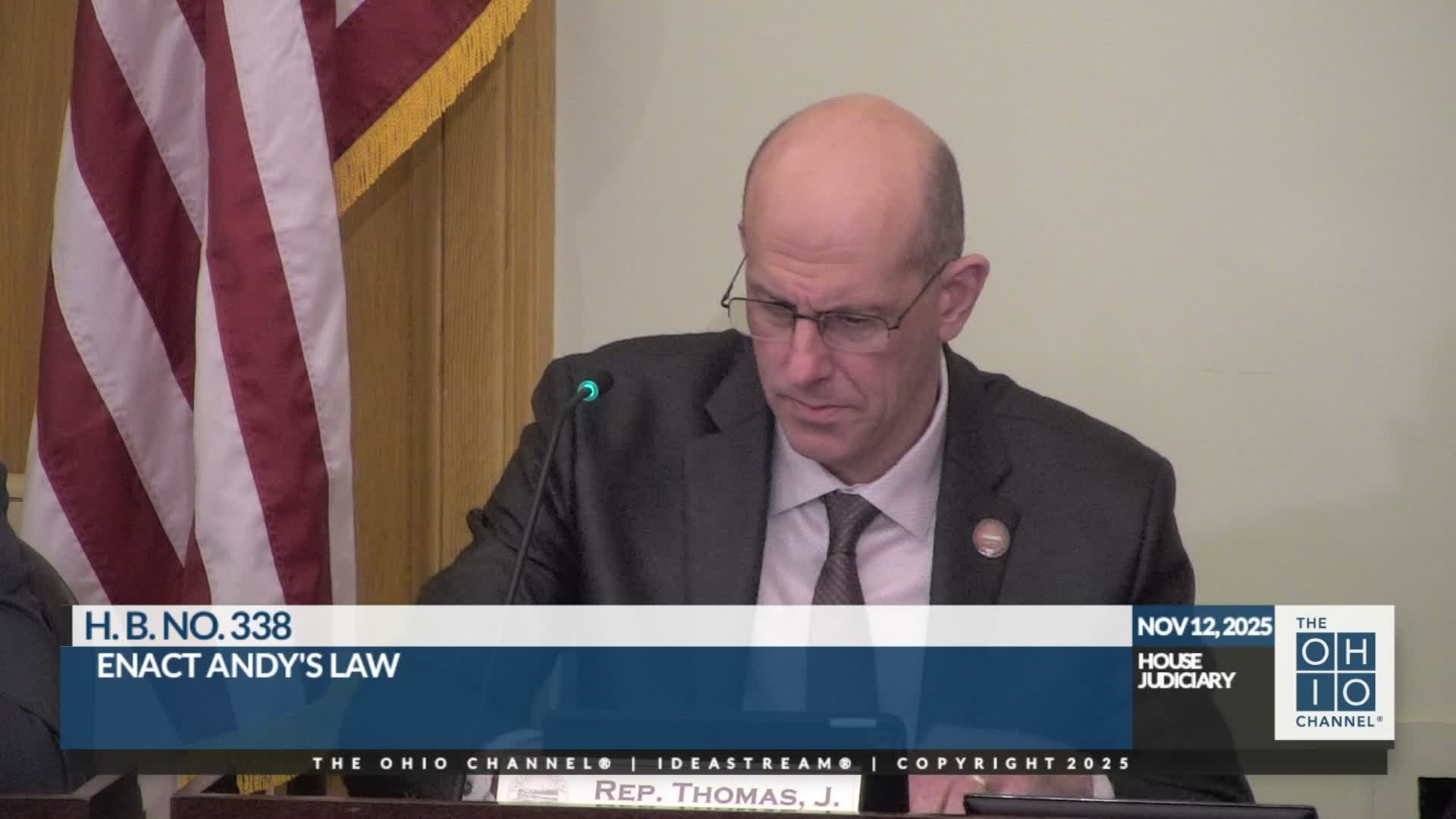
The House Judiciary Committee on Friday heard extensive testimony on House Bill 338, known as "Andy’s Law," a package of changes sponsored to strengthen protections and penalties for assaults on corrections staff.
Proponents — including former and current correctional officers, union leaders and prosecutors — said the bill responds to a December 2024 murder of a Ross Correctional Institution officer and would deter violence and improve safety. Darren Price, a retired corrections employee and homeland security consultant, said the bill would ensure "an inmate who purposely causes the death of a correctional employee will face life imprisonment without parole," and described additional mandatory terms for assaults that expose staff to bodily fluids.
Chris Tramava, president of the Ohio Civil Service Employees Association, told the committee the bill pairs sentencing changes with operational steps such as expanding sergeant positions and a pilot TASER program that, he said, reduced use-of-force incidents during testing. "Staff felt safer, incidents were resolved with less injury and fewer complaints," Tramava said of the TASER pilot.
Supporters argued enhanced penalties and clearer post-incident procedures give prosecutors and corrections leaders tools they currently lack. Lou Tobin of the Ohio Prosecuting Attorneys Association said mandatory consecutive time and specified offenses will give prosecutors "more assurance that the use of their time and resources to prosecute these offenses will achieve some sort of additional justice for the victims of these crimes."
Opponents urged the committee to narrow the bill and weigh unintended consequences. Gabe Davis of the Ohio Justice & Policy Center warned provisions that impose life-without-parole conditions tied to a specific facility placement could raise constitutional problems and trigger litigation. "Directing a person to a specific facility with restrictive conditions and banning movement could create situations where Ohio either violates state law or the Constitution," Davis said.
The ACLU of Ohio’s Gary Daniels listed several provisions he characterized as unrelated to the murder and likely to worsen conditions: limits on higher education and vocational programs in higher-security prisons, mandatory no-contact visitation at certain facilities, broad bans on individual tablet use, and a public registry of in-prison offenses with 10-year publication requirements. He urged the committee to obtain underlying data on violence, contraband, and prosecutions before advancing the bill.
Witnesses from corrections operations emphasized staffing, controlled movement and contraband prevention as immediate priorities. James Skaggs, a correction officer who said he found contraband and supported "no contact" visiting, described large daily movement of inmates, cell-phone-facilitated smuggling and the need for canines and stricter movement protocols to reduce violence.
Committee members pressed both practical and fiscal questions: where funding would come from, whether judges already have tools to impose consecutive sentences, and how the bill’s changes would affect prison population and rehabilitation. Supporters said funding reallocation and legislative prioritization can address costs; opponents warned the bill would increase incarceration and strain programs and resources.
Procedural note: Representative Plummer moved and the committee accepted an amendment to H.B. 338 earlier in the hearing that sponsors said clarifies inclusion of emergency responders, makes sentencing timing clearer, and transfers some jurisdictional functions to the attorney general.
The committee recorded multiple oral and written testimonies pro and con and did not take a final vote during the hearing. Several witnesses offered to continue working with sponsors to refine the bill or provide additional data; the committee closed the session after noting additional written-only testimony was on members' iPads.