Get Full Government Meeting Transcripts, Videos, & Alerts Forever!
Get email alerts on the Criminal Justice topic
No spam. Unsubscribe anytime.
Sponsors seek criminal penalties for juror tampering after social-media incident
Summary
Sponsors told the House Judiciary Committee that HB 478 would add explicit criminal penalties and a new juror definition to Ohio law after a juror received a Facebook message in Ashtabula County; sponsors said the change closes a statutory gap and preserves judges' instruction authority. No vote was taken.
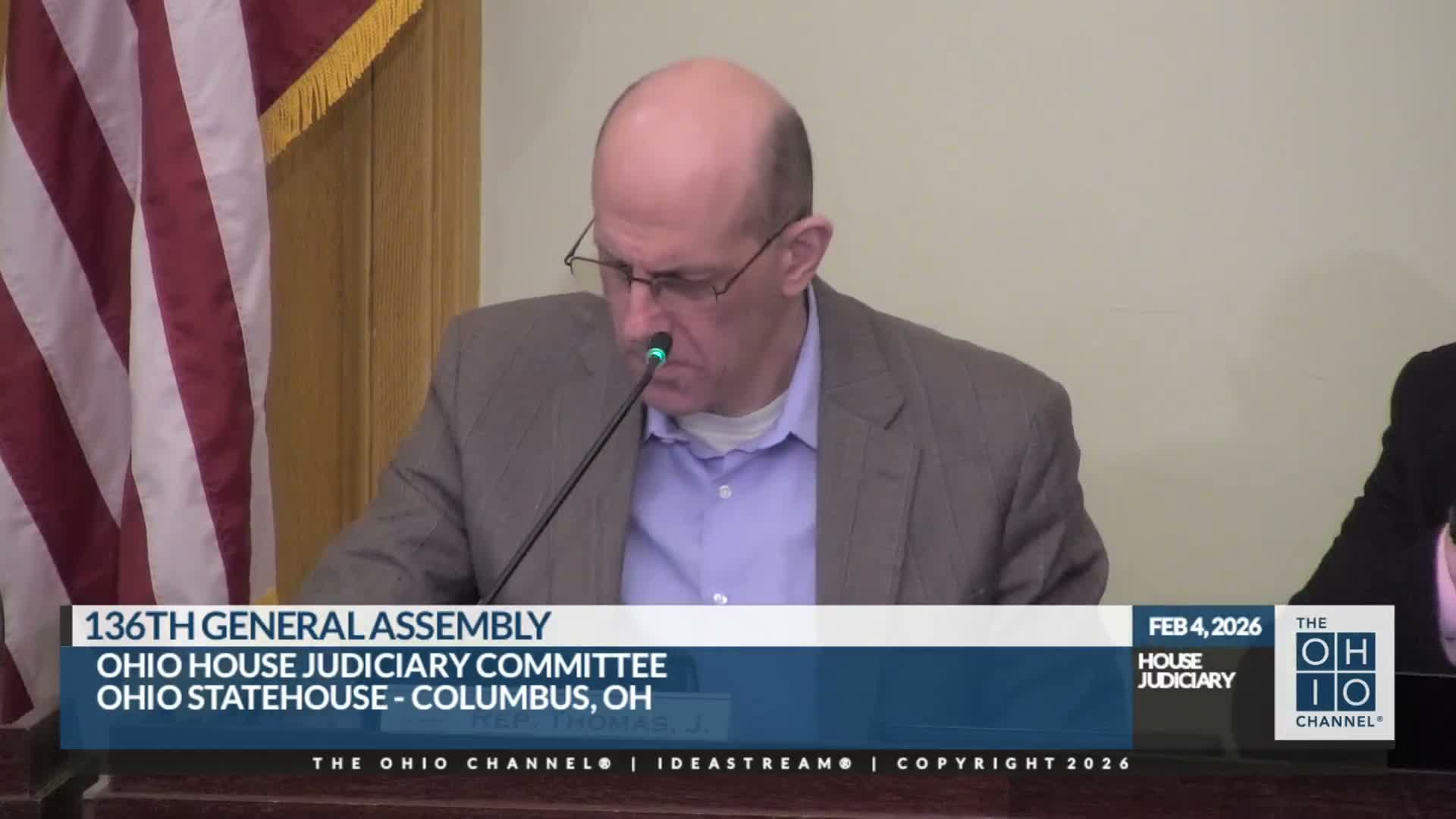
Representative Dave Thomas urged the House Judiciary Committee to pass House Bill 478 to directly criminalize attempts to influence jurors in criminal cases, citing a recent case in Ashtabula County in which a juror received a Facebook message from an associate of a defendant. "There should be a direct stop on tampering or trying to interfere with a criminal case jury," Thomas said in sponsor testimony.
The co-sponsor and ranking member, identified in committee remarks as Sundenberg, laid out the statutory fix: amend Revised Code section 29.21.04 and add a new section, 29.21.06, to define "juror" and apply existing intimidation penalties to jurors in criminal proceedings. He said the bill uses parallel language to the civil-court protection and preserves an exemption for individuals who present facts and evidence to the court and jury.
Members asked whether the new language replaces common-sense courtroom instructions or whether additional public education would be needed. Representative Piccolantonio said she supported protecting jurors but asked whether "knowingly attempt to influence" is common knowledge among the public. Sundenberg and Thomas said judges already give instructions and that the bill makes the criminal prohibition explicit: "Now, essentially, he will moving forward be able to say it is against the law for any of you in the public to contact, to try to influence any members of the jury."
Sponsors told the committee they drafted the bill with input from the County Prosecutors Association, Judicial Council and the Bar Association. No committee vote was recorded; the hearing concluded after questions and sponsor responses.
The committee received no additional witnesses on HB 478 during the recorded hearing. The next procedural step would be any committee amendment or a scheduling decision for subsequent consideration; the transcript records only sponsor testimony and committee questioning for this item.