Get Full Government Meeting Transcripts, Videos, & Alerts Forever!
Get email alerts on the Charter Revision topic
No spam. Unsubscribe anytime.
Charter Revision Commission presents draft; selectmen debate term lengths, board roles and emergency powers
Summary
The Charter Revision Commission presented a draft charter after 16 months of work and 67 written comments, recommending retention of two‑year terms, clarifying town manager and first‑selectman roles, encouraging same‑party alternates when available, and moving some boards to ordinance control; selectmen raised questions about redlines, openness and board flexibility.
The Charter Revision Commission on Feb. 18 presented a draft revision to Simsbury’s municipal charter, framing its 16‑month review as a response to concerns about transparency and checks and balances.
Commission chair Chris Burnett opened the report by summarizing the commission’s process — 25 meetings, two public hearings and 67 written submissions posted on the town website — and said the commission focused on clarifying roles, improving notice practices and strengthening public engagement. "Public audience was a big thing," Burnett said, noting repeated calls for clearer public‑hearing notices and required public audience at boards and committees where legally appropriate.
Why it matters: The charter is Simsbury’s foundational government document. Changes to terms, the organization of boards and the delegation of authority affect how accountability and municipal decision‑making function year to year.
Major recommendations and debate
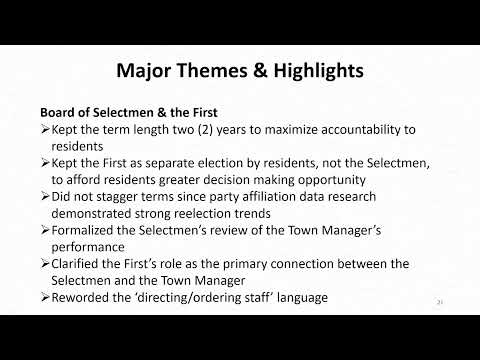
- Term lengths and selection of first selectman: After public testimony and a 30‑year review of incumbency, the commission voted 5–4 to retain two‑year terms for first selectman and other selectmen positions, citing public preference for electoral accountability. Several selectmen argued for longer terms to preserve institutional knowledge and stability.
- Elected vs. appointed boards: The commission removed the Economic Development Commission from the chapter covering elected boards, proposing it be governed by ordinance instead. Commissioners said the EDC is an appointed body and better served by the flexibility of ordinance language; selectmen pressed for clarity on which boards must remain in the charter versus which could be shifted to ordinances.
- Alternates and party balance: The draft recommends seating alternates of the same political party as the absent member "when possible" to preserve the intent of voters who elected particular party representation. Commissioners said the language is permissive — a same‑party alternate is preferred but not mandatory when none is available.
- Town manager duties and grant authority: The commission clarified the town manager’s role and recommended that the board may delegate application authority for timely grants to the town manager, while reserve the formal acceptance and appropriation of grant awards to the Board of Selectmen.
- Emergency powers: The draft aligns municipal language with state statute by designating the chief elected official with responsibility to declare a state of emergency for the town, a point raised in discussion after prior local responses to storms and a microburst were viewed as unclear for FEMA eligibility.
Other points and follow-up
The commission also proposed a four‑year code and ordinance review cycle, clarified formatting and reordering to improve readability, suggested attendance requirements for appointed boards and commissions, and recommended clearer public‑notice posting on the town website.
Selectmen asked for redline versions to compare changes, probed specific committee language (open space, culture/parks/recreation) and sought clarification on how some board memberships were prescriptive in the charter rather than managed by ordinance.
Next steps
The Board of Selectmen will hold a public hearing on the charter on Feb. 23 (with options to continue to March 2 or March 6 within statutory timelines); the commission must act on recommended changes received from the board and then return a final revised charter, which could go to referendum in November if forwarded.
Speakers quoted in this article are drawn from the meeting transcript and include Chris Burnett, chair of the Charter Revision Commission; Bob DeCrescendo, town attorney; Franklin Baruchno, commission staff liaison; and Amanda Blaze, commission clerk.