Get Full Government Meeting Transcripts, Videos, & Alerts Forever!
Get email alerts on the Zoning Regulations topic
No spam. Unsubscribe anytime.
IMEG presents line-by-line overhaul for Simsbury zoning regulations; workshop set for March 30
Summary
Consultant Francisco Gomes (IMEG) summarized a line-by-line review that produced "over 900 individual comments," recommending clearer definitions, fewer special-exception triggers, updated floodplain and sign rules, and a March 30 community workshop to inform draft regulations.
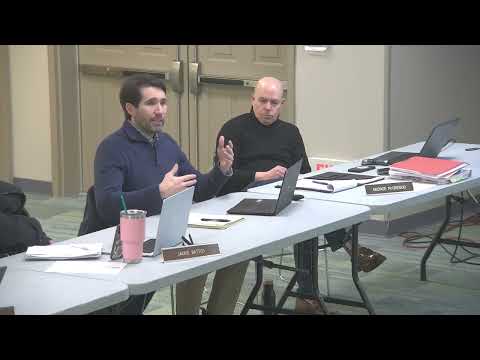
Francisco Gomes of IMEG presented a status report to the Simsbury Zoning Commission on February 18, saying his team's line-by-line review of the town's zoning regulations produced "over 900 individual comments" ranging from spelling fixes to substantive legal and procedural issues. He urged the commission to correct inconsistencies between listed zones, the zoning map and the text; tighten definitions; and reduce dependence on special-exception approvals.
Gomes told commissioners that the review focused first on statutory compliance and then on clarity and usability: "we read through the zoning regulations line by line, every line of it," and the work produced a summary report and a Word document with in-line comments. He said staff and the public should be able to find requirements easily and that many current provisions are vague or duplicated across sections.
Among the substantive items Gomes highlighted were the commission's frequent use of special exceptions for commercial and nonresidential uses and broad references to "commission discretion" without objective criteria. He said that reliance can raise cost and delay for applicants and create legal risk where waivers appear ad hoc. "If they want to do that, you need to do it in your legislative capacity," Gomes said, arguing that formal regulatory changes should replace informal on-the-fly variations.
Gomes also recommended modernizing sign rules to conform to Supreme Court precedent and to be content neutral; updating floodplain rules to reflect state building-code changes and Connecticut model regulations; and aligning the Simsbury Center form-based code with the townwide zoning document to eliminate inconsistent references. He flagged forthcoming statutory changes (Public Act 251) affecting middle-housing requirements and encouraged the commission to prepare implementing language ahead of the effective date.
The consultant described a new template for the regulations (Word-based, with headers, automated cross-references and hyperlinks) to improve usability and maintenance. He also asked the commission for direction on community engagement: staff had secured March 30 for a public workshop, which Gomes proposed as an open-house plus a two-hour presentation and small breakout sessions so participants could weigh in on topics such as housing, commercial uses, site-plan expectations, landscaping and temporary signs.
Next steps described by Gomes and staff included migrating existing regulations into the new format article-by-article, developing outreach materials (flyer, social posts, town web content), prioritizing sign-regulation updates to preserve momentum from recent public forums, and returning to the commission with draft language before any public hearing for adoption.