
City presents preliminary Thorpe Road tunnel options; consultant favors a parallel south tunnel
Get AI-powered insights, summaries, and transcripts
Sign Up Free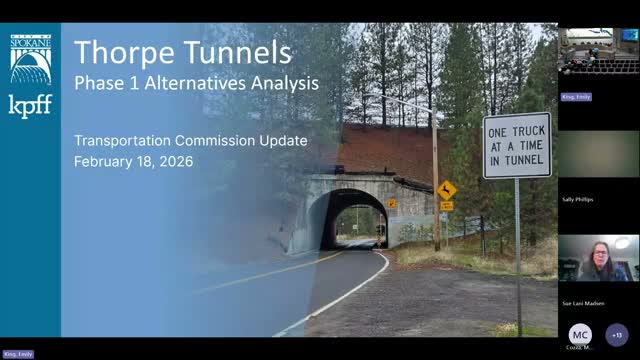
Summary
KPFF and city staff updated the commission on the Thorpe Road tunnel study, outlining parallel‑north, parallel‑south and enlargement options; preliminary preference is for a parallel south tunnel and the team flagged railroad coordination, geotechnical work and large cost differentials as next steps.
City staff and KPFF consultants presented an update on the Thorpe Road tunnel study, describing alternatives for the west crossing under BNSF rail embankments and bridge options for the east crossing under the Fish Lake Trail.
Kevin Picasso (Integrated Capital Management) introduced Mark Brower (KPFF), who said the study’s first phase focused on alternative analysis and produced preliminary preferred concepts. For the west crossing, the team evaluated three choices: a parallel tunnel south of the existing structure to carry two‑way motor traffic and shift the shared‑use path to the existing tunnel; a parallel tunnel to the north with a reversed assignment of traffic; and a costly option to enlarge the existing tunnel. Brower said preliminary estimates found enlarging the existing tunnel would be “roughly $8–9 million more” than the most expensive alternative tunnel option.
Brower described construction methods being evaluated — sequential excavation methods (SEM) and a jacked precast box — and said the team needs further geotechnical investigation to assess embankment conditions. He also emphasized that railroad coordination is essential: the rail embankment heights and active operations make certain bridge or rail‑shift options infeasible, and KPFF has already submitted concepts to the railroad and received no exceptions so far.
The east crossing under the Fish Lake Trail was evaluated primarily for bridge solutions; the team’s matrix favored a medium‑length bridge as a cost‑effective option that balances environmental, utility and property impacts.
Commissioners asked about vehicle clearances (staff cited about 17 feet for the preferred south tunnel), access to SR‑195, trail closure durations and funding. Staff said impact fees cannot cover a project of this scale and that advancing to preliminary design would position the city for potential federal or railroad‑partner funding. Brower said the next steps are additional geotechnical work, refining preliminary design and continuing railroad and DOT coordination so the city can pursue funding opportunities.