
Spokane County briefed on key state bills as House-of-origin cutoff arrives
Get AI-powered insights, summaries, and transcripts
Subscribe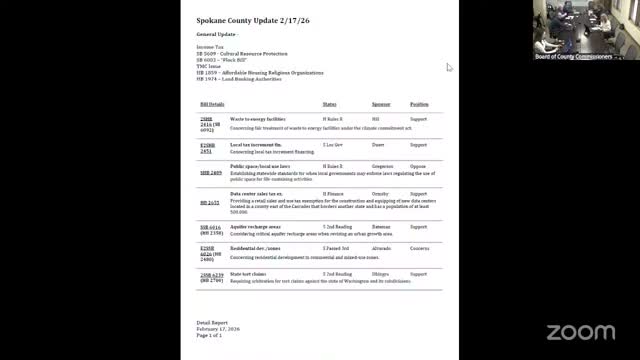
Summary
County staff told commissioners the Feb. 17 house-of-origin cutoff makes several pending state bills time-sensitive. Presenters highlighted a revenue forecast that increased available funds, a millionaire's income-tax bill with a sales-tax repeal amendment that could hit local revenue, and bills affecting cultural-resource consultation, data-center tax exemptions and public camping rules.
Spokane County commissioners received a legislative briefing Feb. 17 from county staff on measures that must clear their chamber by the house-of-origin cutoff that day and on a revenue forecast that modestly increased available budget capacity.
A county presenter said the February revenue forecast added roughly $700 million–$800 million to the current biennium and about $1.1 billion to the next, easing—but not eliminating—budget pressures as the Legislature moves toward budget-writing. The presenter urged commissioners to expect rapid, late-session amendments and to rely on staff summaries for delegation outreach.
On tax policy, staff described the Senate-passed "millionaire's income tax" bill, which retained a 7% distribution for public defense funding. An amendment attached to the bill would repeal sales taxes on a set of services (a phase-in noted for 2028–29), a change county staff said could produce a local fiscal impact; staff promised to circulate the floor-striker text and an effect statement to commissioners for review.
On cultural-resource protections, county planning staff warned about proposed changes to categorical exemptions under state environmental review (CIPA/SEPA). Scott, a county planning official, said the bill would require counties and municipalities to adopt ordinances of cooperation with tribes and could mandate tribal comment—or in some interpretations even approval—on projects that would otherwise be categorically exempt. He said that could add permitting burdens to routine housing and small development projects and that Spokane County already uses collaboration practices but would face new staff and ordinance-drafting costs if the bill advanced. County staff asked commissioners for permission to brief the county's delegation with a short technical summary.
Commissioner French and staff discussed a separate data-center package: French said Spokane County is currently excluded from a proposed tax exemption and argued inclusion is needed to support a roughly $4 billion local data-center/hydrogen project he described as bringing 1,200 jobs and a green-energy component; he said local champions in both Senate parties were working to include Spokane and that he plans to testify at an upcoming environment committee hearing.
Staff also listed other active bills of county interest—permit reform, affordable-housing provisions for religious-property owners, a waste-to-energy measure, the TIF bill with public-safety language, and a public-camping bill—many of which were facing contentious committee or floor action. Staff cautioned that several measures may be grouped or amended onto other bills as the session proceeds and recommended commissioners rely on staff for targeted follow-up.
Next steps: staff said they would circulate the specific amended language and effect statements for bills flagged as having local fiscal or operational impact and would coordinate outreach with delegation members.