
Met Council report: eliminating high‑subsidy routes could save ~$23M a year; Metro Mobility costs rose to ~$6M in 2024
Get AI-powered insights, summaries, and transcripts
Subscribe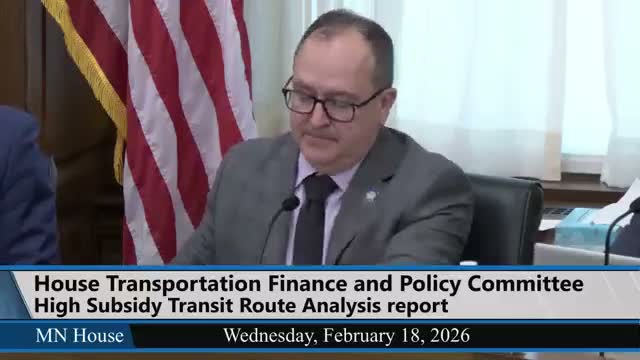
Summary
A Metropolitan Council analysis for the House Transportation Committee found a small share of high‑subsidy transit routes account for disproportionate costs: discontinuing them could save about $23 million annually and up to $72 million in capital; Metro Mobility costs tied to those routes rose from about $368,000 in 2023 to about $6.1 million in 2024.
A Metropolitan Council presentation to the Minnesota House Transportation Finance and Policy Committee outlined how a small share of transit routes have very high operating subsidies and the fiscal and service consequences of addressing them.
Charles Carlson, executive director for transportation services at the Metropolitan Council, told the panel the analysis—required by the 2025 transportation bill—measures subsidy per passenger as operating cost minus fare revenue divided by passenger counts. He said most routes meet regional guidance but a minority fall into a Tier 3 “restructure or eliminate” category. "High subsidy routes are those that have subsidies more than 60% above a peer route average," Carlson said.
Using 2023–24 provider data, Carlson said discontinuing routes classified as high‑subsidy would save roughly $23,000,000 a year in operating costs and could avoid up to $72,000,000 in one‑time capital purchases (buses). He also reported a sharp increase in Metro Mobility costs tied to those routes: about $368,000 in 2023 and roughly $6,100,000 in 2024. The council attributes the jump to changes in route frequency that moved some service areas into federally mandated ADA paratransit zones, which require shorter‑notice scheduling and higher per‑trip costs.
Committee members pressed the Met Council on why contracting sometimes reduces costs, whether contracting undermines wages and benefits, who decides route placement, and if the analysis considers capital costs. Carlson said providers use various tools—boosting ridership, contracting with third parties, reducing cost drivers, changing service type, or reducing service—and that contracting can be cost‑effective because of competitive procurement and differing overhead. He told members that contracts include minimum wage or other standards in many cases.
Members cited examples of extreme per‑passenger subsidies (figures in the report range into triple digits per passenger for some services) and called for legislative follow‑up; the committee chair signaled staff will draft bills to address high‑cost routes while emphasizing the need to avoid leaving riders with disabilities or essential transit needs without alternatives. Carlson noted the report focuses on operating costs; capital comparisons (for example BRT build‑out) were not included in this analysis.
The Met Council recommended providers address high‑subsidy routes through the plan’s three intervention tiers—minor modifications, major changes, or restructuring/elimination—while also considering Metro Mobility impacts and equity. Carlson said detailed per‑route tables and maps are included in the council’s report and offered further briefings for members.
The committee did not take formal action on the report during the meeting; members voted earlier to adopt minutes from the previous meeting by voice vote. The Met Council’s analysis is expected to inform draft legislation and future committee work.