
Officials: individual-market premiums climbed while enrollment fell after enhanced tax credits ended
Get AI-powered insights, summaries, and transcripts
Subscribe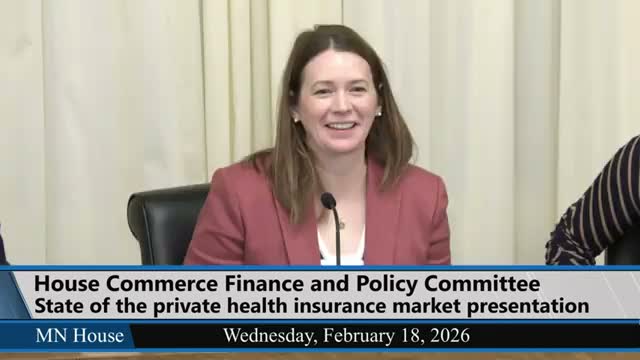
Summary
State officials told the House Commerce Committee that 2026 individual-market premiums rose sharply and early MNsure data show fewer new enrollees and higher cancellations after enhanced premium tax credits ended, while the state's reinsurance program and federal rules shape near-term outlooks.
Erica Helvick Anderson, senior director of public affairs at MNsure, and Julia Dreyer, Deputy Commissioner of Insurance at the Minnesota Department of Commerce, told the House Commerce Finance and Policy Committee on Feb. 18 that the individual insurance market is facing steep rate increases and enrollment volatility after the expiration of enhanced premium tax credits.
Helvick Anderson said MNsure sign-ups were down about 3% to 162,000 for 2026 coverage and that new consumers coming to MNsure dropped roughly 40% (about 18,000 fewer people). "Households eligible for tax credit fell from 61% last year to just over 50% this year," she said, adding that cancellations rose and that active enrollees and effectuated coverage were lower compared with last year. "These are early numbers but the trend appears to be clear: we are seeing some consequences from the loss of enhanced tax credits," Helvick Anderson said.
Deputy Commissioner Dreyer told lawmakers Commerce reviews carrier filings for the individual and small-group markets to ensure rates are "actuarially justified," and cited several cost drivers including specialty prescription drugs (she mentioned GLP-1 weight-loss drugs), an aging population, higher utilization and higher provider contracting costs tied to consolidation and staffing. She summarized 2026 filings by saying the average increase for individual-market plans sold for 2026 was a little over 21% and that the medical trend is roughly 9.4%; she said the small-group market saw an average increase of about 14.2%.
Dreyer also described Minnesota's reinsurance (premium security) program, saying it typically reduces premiums by about 20% but this year "we're seeing an impact closer to 47%" in the individual market. She explained the program is funded this year by a state appropriation and would be funded next year by an assessment on group carriers while the state seeks a new waiver.
Committee members pressed presenters on specific drivers and data. Several lawmakers asked whether mandate changes versus overall health-care cost growth were larger contributors to recent rate increases; Dreyer said mandates tend to show more effect in the small-group market but that underlying health-care costs are the principal driver. Members also requested geographic (regional or county-level) breakdowns of MNsure data; Helvick Anderson said the agency can check whether county-level drilldowns are possible and will follow up.
MNsure reported record contact-center demand during open enrollment: Helvick Anderson said the contact center handled 134,000 calls, a 42% increase over the prior year, and that consumers were actively shopping and often choosing lower-premium plans or "buying down" metal levels to manage affordability. "Consumers were actively managing their affordability," she said.
Deputy Commissioner Dreyer said Commerce examines carriers' actuarial justifications and medical-loss ratios to verify rates are not underpriced but noted that affordability is shaped by tax-credit eligibility and plan choices. She said Commerce and MNsure will continue monitoring enrollment month to month to track attrition and other trends.
The committee did not take formal votes on bills during the hearing; members said they expected follow-up data from Commerce, MNsure and the Department of Health as the session proceeds.