
State broadband office briefs senators on BEAD award, mapping and remaining gaps
Get AI-powered insights, summaries, and transcripts
Subscribe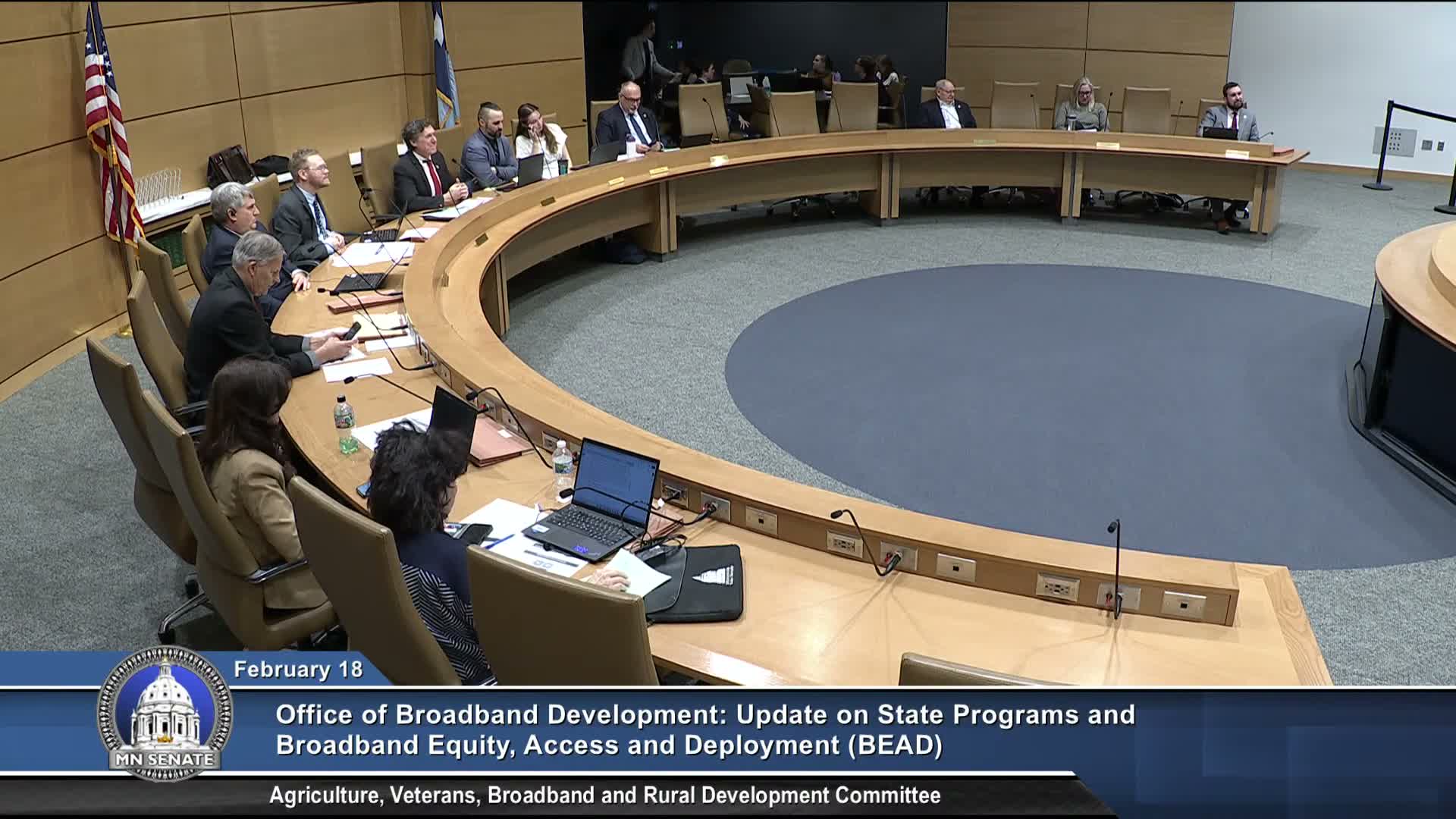
Summary
DEED’s Office of Broadband Development told a Senate panel Minnesota’s BEAD proposal was approved by NTIA in December and that the state still lists roughly 121,000 homes without 25/3 service and about 155,000 without 100/20; officials outlined contracting timelines, mapping validation and next steps for grantee agreements.
Brie Mackie, executive director of the Office of Broadband Development at the Minnesota Department of Employment and Economic Development, told the Senate Committee on Agriculture, Veterans, Broadband and Rural Development on Feb. 18 that Minnesota has received federal approval to proceed with its BEAD (Broadband Equity, Access and Deployment) award and is now working through contracting, environmental reviews and closeout steps for state programs.
Mackie said Minnesota submitted its BEAD proposal Sept. 4 and received notification on Dec. 19 that NTIA had approved the state’s application. “We received notification on the December 19 that that was approved by NTIA,” she said.
Why it matters: BEAD funding will bring federal dollars to expand broadband access in unserved and underserved areas. Mackie said Minnesota’s proposal showed roughly $570 million of eligible project cost with a BEAD request of about $379 million; the proposed technology mix in applications was approximately 58% fiber, 25% low‑Earth‑orbit satellite (LEO), and 17% fixed wireless.
Mackie outlined state programs and milestones: the Border‑to‑Border grant program (reimbursing up to 50% of eligible costs, capped at $10 million per project after a legislative increase), the Low Population Density program (covers up to 75% of eligible costs), and the Line Extension program that connects homes directly. She said the office closed 58 projects in 2025, completed field validations on more than 35,000 locations, and built multiple rounds of line‑extension projects that reached hundreds to thousands of homes.
On remaining gaps, Mackie said about 121,000 homes lack the statutory 25/3 baseline and about 155,000 homes lack 100/20 service statewide; rural communities lag these statewide averages. She emphasized that roughly 75,000 of the unserved locations are BEAD‑eligible under NTIA definitions, while others are excluded by eligibility rules.
Contracting and compliance: Mackie said the state must submit a Notice of Funding Award to NIST within 30 days, then has six months to finalize grant agreements with BEAD grantees. She noted that NTIA’s rules treat non‑deployment dollars differently; the Department of Commerce has not yet issued full guidance on how states may use those funds. For LEO satellite projects, Mackie said Minnesota is still coordinating with NTIA on how to measure milestones and capacity rather than paying subscriptions. “We are not able to pay bills for any of our providers. This is not a program that pays for service,” she told senators.
Accessibility and outreach: the office maintains an interactive mapping platform and takes self‑registration from households, including paper and phone applications to accommodate people who lack service. Mackie highlighted a ‘telecommuter‑forward’ recognition program (50 communities) and upcoming training for grantees and local officials, and invited members to the Connecting One Minnesota event on April 29, 2026.
What’s next: the office is finalizing contract language to meet state and federal rules, preparing permitting and environmental documentation, and conducting outreach to local units of government and ISPs as it transitions from planning to contracting and buildout phases.
Sources and attribution: statements and figures are drawn from testimony by Brie Mackie and DEED staff to the Senate Committee on Agriculture, Veterans, Broadband and Rural Development, Feb. 18, 2026.