Get Full Government Meeting Transcripts, Videos, & Alerts Forever!
Get email alerts on the Program Budget Update topic
No spam. Unsubscribe anytime.
Richmond Rising partners report progress on projects and budgets; staff to publish updated slides and timelines
Summary
City and program staff reported spending and progress across Richmond Rising projects, highlighted near-term deliverables (renter-inspection flyers, facade outreach) and timelines including the Richmond Wellness Trail construction expected in spring 2027.
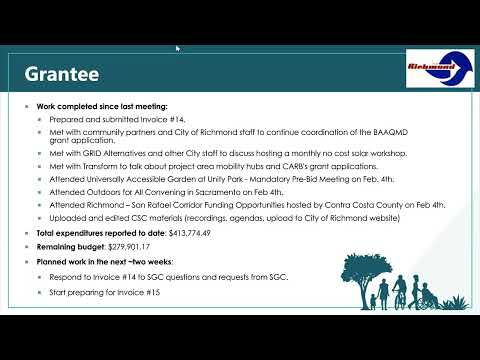
Beatrice, a Richmond Rising project staff member, opened the meeting with a status report on the collaborative’s programs and budgets, saying the displacement-avoidance and residential-renter inspection work continues and the Small Business Facade Improvement Program has launched and is accepting applications.
The presentation flagged recent expenditures and remaining funds: staff reported $163,000 spent on facade-related work with $518,000 remaining; workforce-development expenditures totaled $286,000 with $1.1 million left. Beatrice said the next two weeks’ tasks include printing and packaging renter-inspection flyers and continuing outreach to businesses for the facade program.
Why it matters: the update bundles dozens of locally funded pilot projects that aim to pair climate-resilience investments with community supports (tenant outreach, workforce training and small-business improvements). Staff highlighted projects where major construction or operations will shift spending, including the Richmond Wellness Trail, which staff said is expected to reach construction around spring 2027.
Project-by-project details included progress percentages and schedules. Beatrice said active-transportation elements — such as the e-bike share hubs — are largely installed and now in the operations phase, while neighborhood complete-streets projects remain in design and carry most future construction costs. On housing and energy, the Resilient Homes program and ADA-accessible garden are moving toward construction and anticipated to show larger budget changes once built.
The committee asked for clearer slides; Beatrice said staff will publish corrected slides and updated numbers ahead of the next meeting. The meeting record also notes a correction supplied by Alejandro of MCE on the low-income solar tally and staff promised to provide updated installation numbers.