Get Full Government Meeting Transcripts, Videos, & Alerts Forever!
Get email alerts on the Local Revenue topic
No spam. Unsubscribe anytime.
Committee accepts substitute for bill requiring PILOTs from large conservation landowners
Summary
The Ways and Means Committee accepted a substitute to House Bill 540 that moves from a pilot to a partial‑exemption reduction (proposed 97.5% exemption) for very large nonprofit landholdings; Adams County and township officials testified that Nature Conservancy holdings create infrastructure and emergency‑response costs without contributing property taxes.
The committee accepted a substitute amendment to House Bill 540 that changes the bill from a pilot program to a reduction of property tax exemption for certain very large nonprofit conservation landholdings.
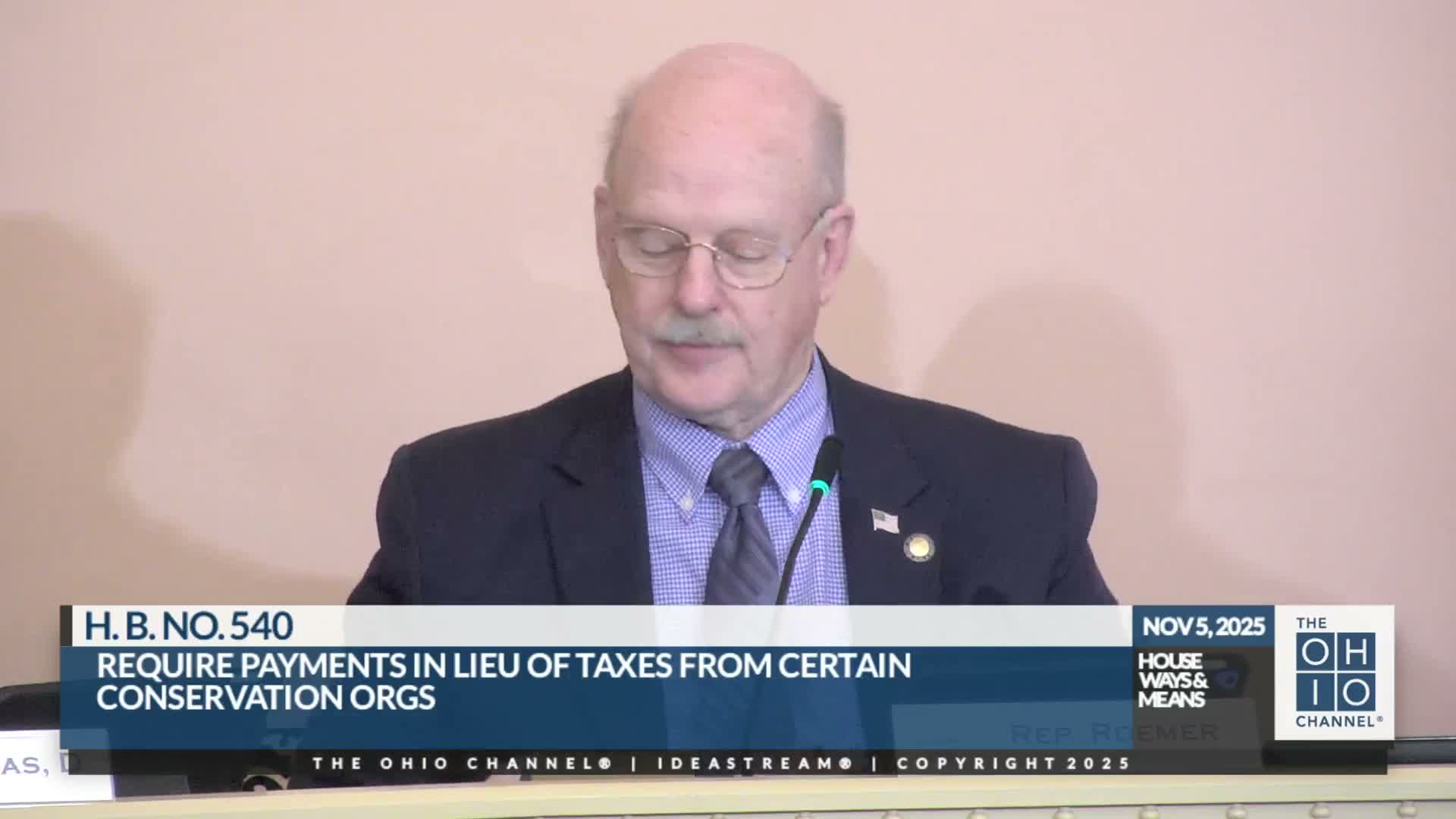
Vice Chair Thomas moved the substitute, which the chair called and the committee accepted with no objections. The substitute as presented reduces exempt status from 100% to 97.5% for qualifying properties, rather than creating a limited pilot, a change supporters said would better allow localities to recoup some costs incurred from unpaid property tax rolls.
Jason Hayslip, Adams County Commissioner, testified in support and said the Nature Conservancy "owns approximately 20,000 acres in Adams County," arguing that such holdings impose road maintenance, emergency response and other costs while producing revenue from activities such as carbon credits. Multiple township trustees testified they bear maintenance costs for roads, culverts and emergency services in areas where large swaths of land are tax‑exempt; one trustee said the Nature Conservancy owns roughly 27% of his township and that even modest PILOTs would allow needed road and drainage work.
Supporters told the committee the proposal is about fairness, not opposition to conservation, and asked the legislature to identify an objective statewide standard (for example, an acreage threshold) to determine when a nonprofit holding should be subject to a reduced exemption. Committee members raised constitutional and uniformity questions about singling out particular entities or property classes and asked staff to provide revenue estimates and precedents.
The committee accepted the substitute and heard proponent testimony; no final vote on the bill was taken at this meeting.