
Ohio committee hears testimony for SB 9 to align state tax code with federal changes; R&D expensing draws support and skepticism
Get AI-powered insights, summaries, and transcripts
Subscribe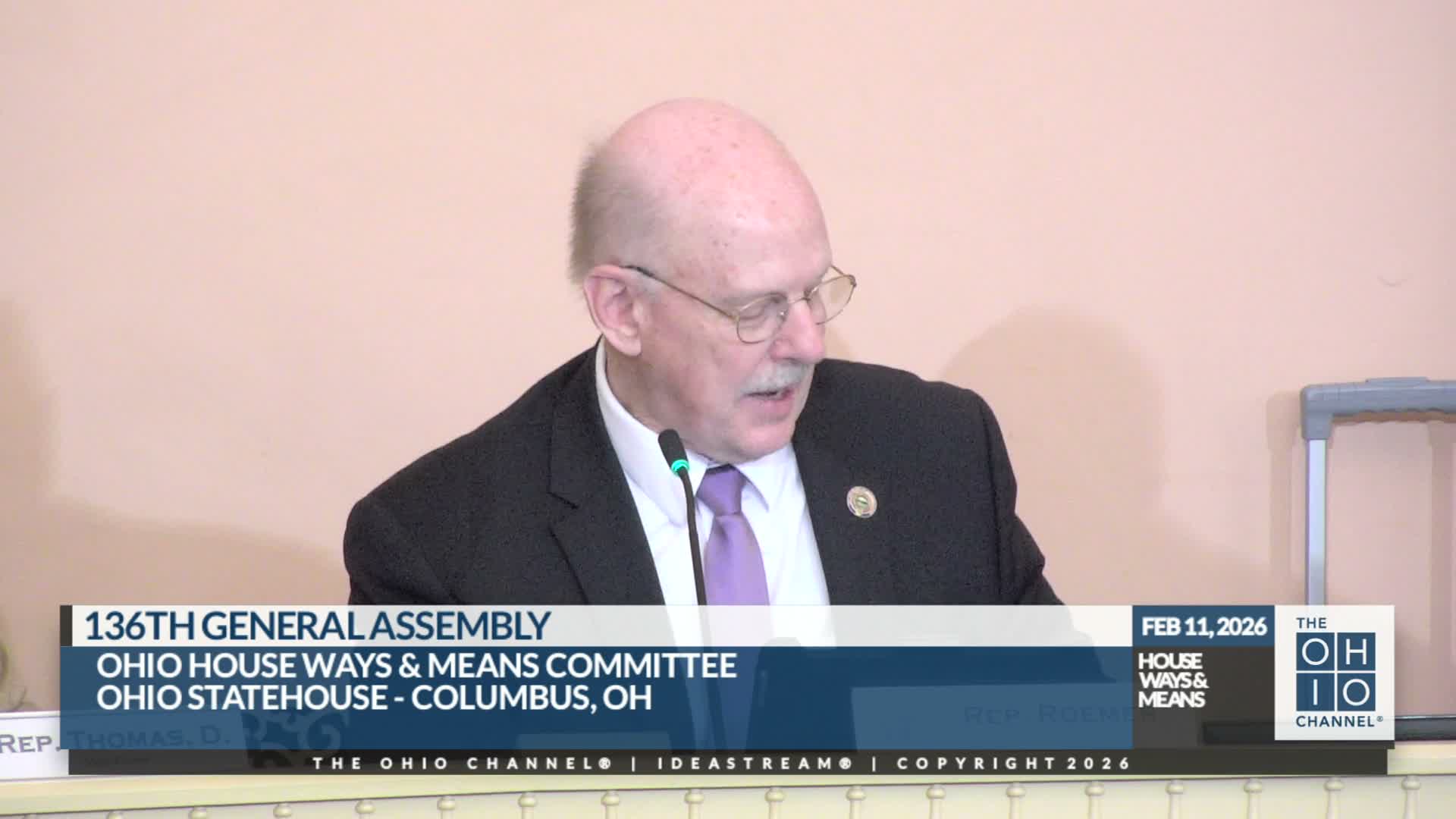
Summary
A second hearing on Senate Bill 9 drew proponent testimony from accountants, business groups and manufacturers urging prompt conformity with federal tax rules—especially changes to R&E (R&D) expensing—while a policy researcher urged decoupling several provisions she says chiefly benefit wealthier taxpayers and could cost Ohio revenue.
Chairman Romer convened the second hearing on Senate Bill 9, Ohio’s annual tax conformity measure, where experts and business groups urged the House Ways and Means Committee to adopt federal changes quickly to reduce compliance burdens and improve cash flow for innovation‑focused employers.
Ron Antal, mayor of Boston Heights and a certified public accountant, told the panel that “tax conformity is not a theoretical exercise. It's the plumbing of the tax system,” and argued Ohio’s treatment of the state research and experimental (R&E) credit is currently limited by amortization rules and the Commercial Activity Tax (CAT) minimum. Antal said those rules can prevent startups and smaller firms from realizing the credit’s benefits and recommended allowing the R&E credit to offset Ohio income tax or otherwise be monetized so credits actually influence location and hiring decisions.
Liz Baumgartner, director of economic development and tax policy at the Ohio Chamber of Commerce, said conforming Ohio law with federal changes—including full expensing for certain R&E expenditures and enhancements to the child and dependent care credit—would simplify filings and reduce add‑backs and administrative costs for businesses. The Chamber also supported the bill’s emergency clause so taxpayers and preparers can rely on consistent rules for 2025 filings.
Rick Kleban of Sycamore Growth Group, representing manufacturers, said the practical harm has been ‘‘a cash‑flow problem’’ for many engineering and small manufacturing firms. He described cases where amortization rules left firms short of operating cash and said timely conformity or alternatives such as transferability (used in some states) could restore usability without adding undue complexity.
Not all testimony was uniformly favorable. Aditi Srivastava, tax policy researcher at Policy Matters Ohio, said Ohio should pass a conformity bill but urged the committee to decouple from seven specific sections of federal HR 1 that she argued would reduce state revenue without commensurate benefit to residents. She singled out the retroactive R&E provision and an expansion of the qualified small business stock (QSBS) exemption as likely to produce windfalls for investors and to shift revenue outside the state. Srivastava cited Department of Taxation and other estimates that certain provisions could reduce state revenue in FY 2026 and beyond.
Committee members pressed witnesses on several recurring questions: whether the retroactive R&E provision simply creates a windfall rather than incentives, which businesses would qualify (a $31 million federal small‑business threshold was discussed), whether qualifying investments must be made in Ohio, and the bill’s net fiscal effect over 10 years. Several members emphasized the need for the Department of Taxation’s 10‑year estimates; the chair confirmed the committee had received a 10‑year analysis from the department.
The committee concluded the second hearing on SB 9 without a vote and moved on to first hearings on other bills. The record shows a mix of support for rapid conformity—largely framed as reducing compliance costs and improving short‑term cash flow for small innovators—and concern about long‑term revenue impacts of certain HR 1 provisions, with witnesses offering both policy alternatives (transferability, targeted decoupling) and calls for more fiscal analysis.
The committee did not take a formal vote on SB 9 during this session; the bill remains under consideration.