Get Full Government Meeting Transcripts, Videos, & Alerts Forever!
Get email alerts on the Tax Conformity topic
No spam. Unsubscribe anytime.
Ohio Ways and Means Committee opens first hearing on Senate Bill 9 to align state code with federal tax changes
Summary
The committee heard sponsor, Department of Taxation and CPA testimony on Senate Bill 9, a federal tax‑conformity bill; officials urged rapid enactment to ease filing, while some members warned of sizable near‑term revenue costs and potential windfalls to large tech/data centers.
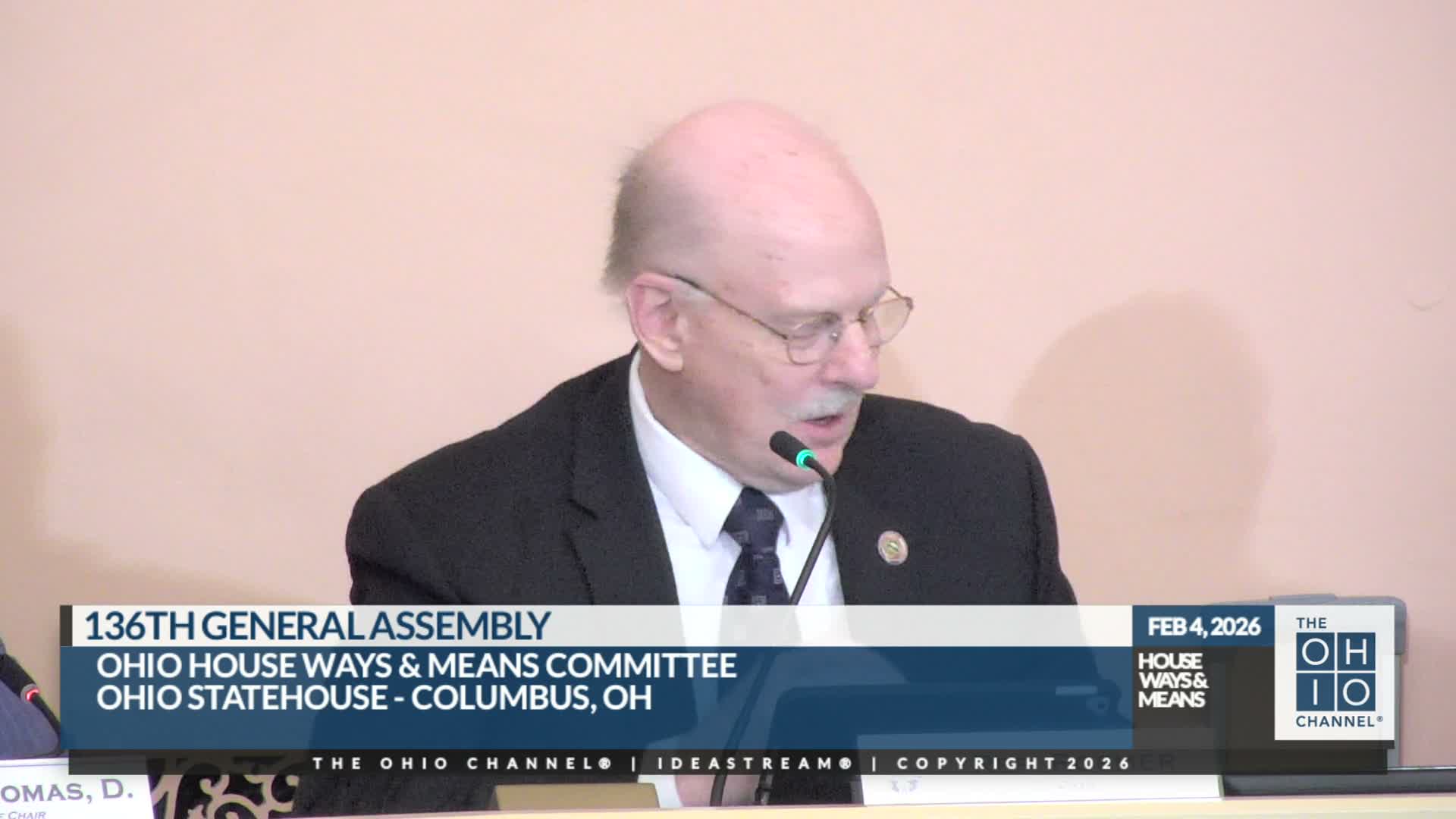
Chairman Romer convened the House Ways and Means Committee to hear sponsor and agency testimony on Senate Bill 9, a conformity bill intended to incorporate federal Internal Revenue Code changes into Ohio law and avoid added paperwork for taxpayers and preparers.
Senator Blessing, sponsor of the measure, said the bill generally follows last year’s conformity work but flagged three sections that merit closer review: a change to section 168(n) tied to qualified production property (highlighted as primarily affecting HVAC and roofing), a modification to IRC section 174(a) that restores immediate expensing for certain research and experimental (R&E) expenditures, and a change to the business interest limitation. “The retroactive provision in particular is pure windfall because you can’t incentivize investments that already happened,” Blessing said, urging the committee to consider decoupling some provisions for further study.
Tim Lynch, policy director at the Ohio Department of Taxation, testified the chief practical reason for conformity is to align Ohio adjusted gross income with the federal definition used on Form 1040 and thereby reduce filing complexity and errors. “We encourage conformity,” Lynch said, adding the department had received questions from tax preparers and filers and would provide technical scoring and a list of states that have decoupled from specific federal provisions.
Lynch and the department’s analysis team gave preliminary fiscal estimates for the most significant items: an estimated foregone revenue of $63,300,000 in fiscal year 2026 and $29,500,000 in fiscal year 2027. Department staff and committee members emphasized much of the impact is front‑loaded because of retroactive look‑back features; staff said out‑year impacts are expected to be lower.
Greg Saul, representing the Ohio Society of CPAs, urged timely action to minimize compliance burdens for taxpayers and firms and emphasized why many stakeholders support an emergency clause: without it, taxpayers and preparers face add‑backs and suspended returns during filing season. “Timing is critical,” Saul said, noting the administrative complexity that follows when the state and federal starting points for AGI diverge.
Several members expressed concern about specific provisions. Some, including Senator Blessing, warned that retroactive expensing for R&E and the look‑back could deliver outsized benefits to large technology companies and data‑center operators; others pressed staff for more detailed, multi‑year scoring before final committee action. Representative Troy asked the department to provide a current list of states that have decoupled from parts of HR 1 and additional scoring detail; Lynch agreed to provide that information to the committee clerk.
The committee closed the first hearing on SB9 after agreeing staff would update the fiscal note and provide additional analysis. No final committee vote on the underlying bill was taken; the chair said further hearings and technical exchanges would follow.