Get Full Government Meeting Transcripts, Videos, & Alerts Forever!
Get email alerts on the Self Storage Law topic
No spam. Unsubscribe anytime.
Committee hears testimony on changes to Ohio self-storage law to allow certain negligence waivers
Summary
Attorney and industry witnesses testified in support of HB 366, which would close gaps in Ohio law by allowing enforceable negligence waivers in self-storage agreements (except for willful or wanton misconduct) and create remedies when a current customer’s lease is terminated.
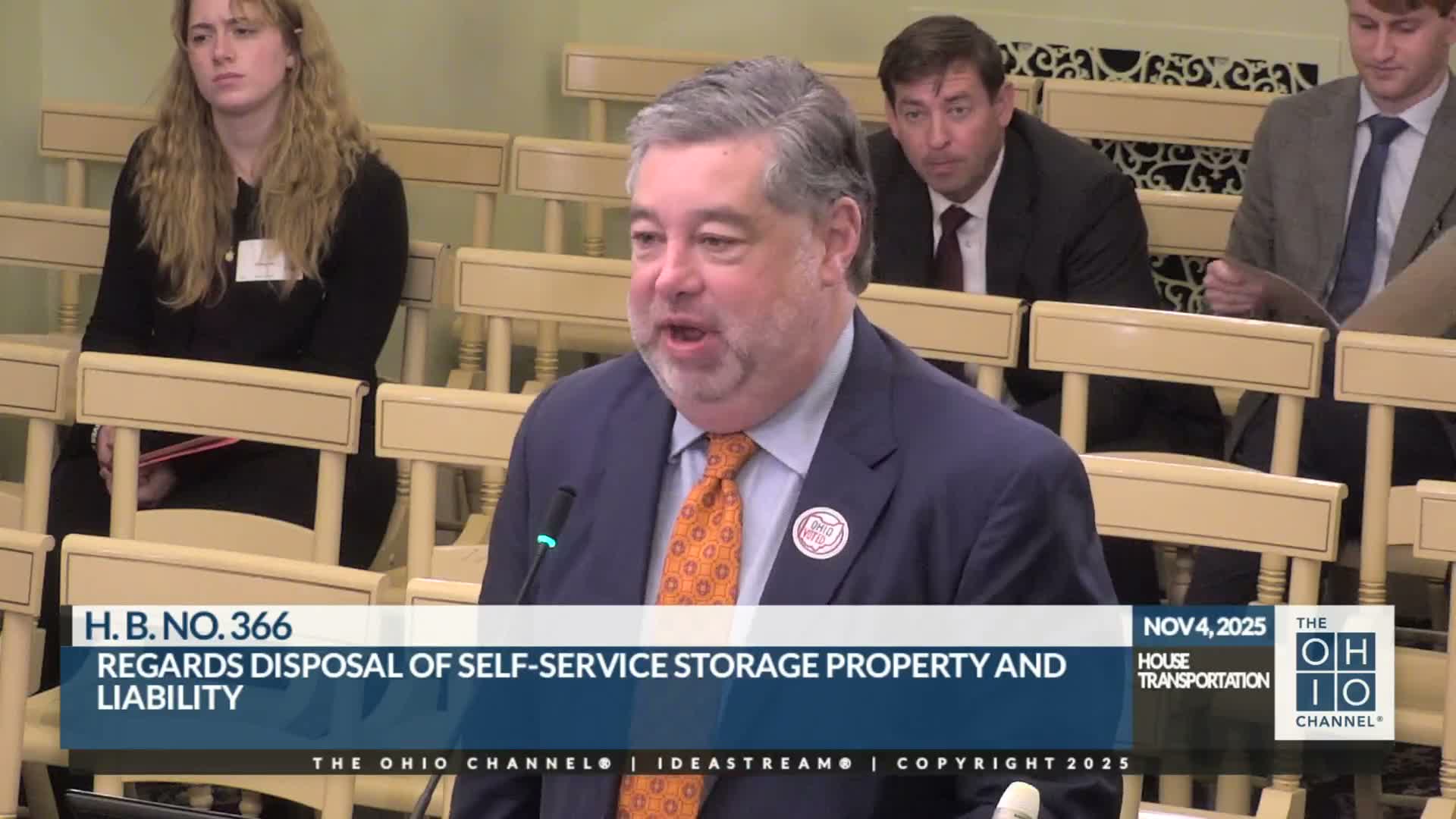
At a second hearing on House Bill 366, attorney Jeffrey Greenberger and Prestige Storage principal Corey Banda testified for changes to Ohio’s self-storage law.
Greenberger said changes in lines 286–287 would make Ohio consistent with most other states by allowing clear, unambiguous negligence waivers in self-storage contracts while preserving claims for willful or wanton misconduct. "This change in line 286 to 287 would simply ensure that self storage contracts are treated the same way as many other contracts in our state," he told the committee.
Corey Banda described operational gaps under current law that leave owners without remedies when a current-paying tenant’s lease is terminated for criminal or fraudulent uses. Banda recounted a recent company case in which a customer rented a unit with another person’s photo ID, the rental was terminated, and neither the customer nor the ID-holder returned to remove property; the company incurred time and expense to evict and dispose of the items.
Committee members asked clarifying questions about the law’s origins and whether the changes would penalize nonpayment; Greenberger said the change addresses contract-enforcement inconsistency introduced in a transportation budget amendment two years prior and is not intended to alter standard nonpayment protections.
What’s next: The hearing was designated a second hearing; no committee vote was taken. Proponents said the bill fills a statutory gap; opponents were not recorded in the transcript.