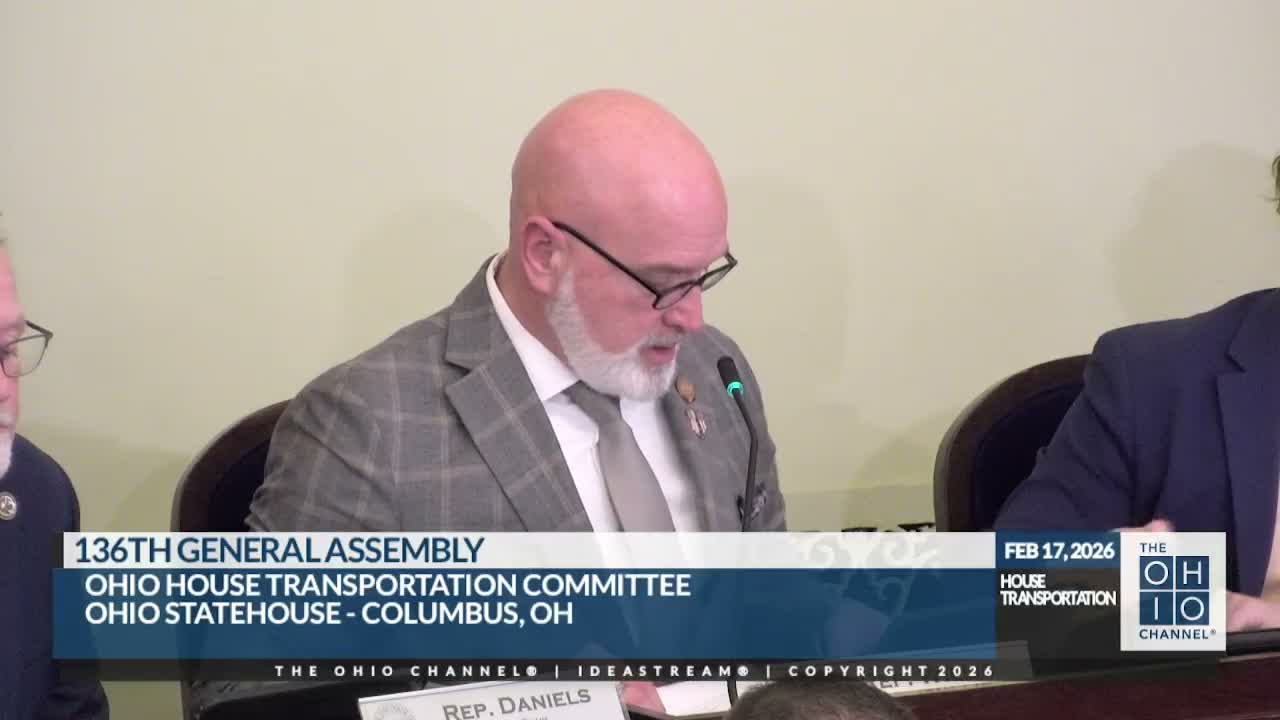
Committee hears bill to ban knowingly flying drones over schools; amendment adds standalone childcare centers
Loading...
Summary
Representative Seegrest presented sponsor testimony on HB 597 to prohibit knowingly operating unmanned aerial vehicles over schools and certain standalone childcare centers, with graduated penalties and exemptions for government and authorized commercial operators; Vice Chair Daniels' amendment to explicitly include standalone childcare centers was adopted without objection.
Representative Seegrest told the Transportation Committee that House Bill 597 would close a legal gap uncovered after incidents in another state where drones were flown near school windows.
"This bill is a proactive measure to protect the safety, privacy, and security of students and young children," Seegrest said, describing episodes in which drone operators approached school windows and local law enforcement found no statute that clearly prohibited the conduct.
Under the bill as presented, "school" is defined broadly to cover traditional public schools, community schools, STEM schools, charter nonpublic schools, joint vocational schools and educational service centers; the sponsor said the text also covers certain standalone childcare centers used for infants to preschool-aged children.
The proposal creates a graduated penalty structure: a first offense is a minor misdemeanor and a subsequent offense is elevated to a fourth-degree misdemeanor, Seegrest said. The bill contains exemptions for individuals acting under federal or state authority, law enforcement, and commercial operators who have required federal authorizations. Prior written consent from a principal or assigned school resource officer would also permit operation over a school. Children under age 14 would be exempt for enforcement purposes.
To enable on-the-spot response, the bill authorizes a principal, vice principal, assigned school resource officer, or peace officer who witnesses a drone being operated over the school to temporarily take possession of the drone and provide it to local law enforcement as evidence, the sponsor said. He added that judges could dismiss charges for defendants under 17 if there was no intent to harm and the court required completion of an educational program on drone safety.
Representative Rogers questioned the legal authority and risk of making school principals responsible for taking custody of drones, saying, "I see issues potentially with the principal taking on the role of law enforcement." The chair and sponsor agreed the intent is to restore calm and hand evidence to law enforcement rather than give principals ongoing enforcement duties; the committee acknowledged some language refinement may be needed to resolve federal-legal complexities.
Vice Chair Daniels moved an amendment (Amendment 1361707) to extend the bill's prohibition to standalone childcare centers; the amendment was described, placed in order and, "without objection," became part of the bill. The committee closed the first hearing on HB 597 for further consideration.