Get Full Government Meeting Transcripts, Videos, & Alerts Forever!
Get email alerts on the Right To Compute Act topic
No spam. Unsubscribe anytime.
Supporters tell Ohio committee Right to Compute Act will protect innovation while critics press for infrastructure and workforce safeguards
Summary
Proponents at the House Technology and Innovation Committee described House Bill 392 (the Right to Compute Act) as a pro‑innovation framework to prevent patchwork local AI rules and to promote data center growth; members asked for written analyses and raised workforce, incident‑reporting and critical‑infrastructure concerns.
Supporters of House Bill 392 told the House Technology and Innovation Committee the measure would guarantee the right to use computer software and artificial intelligence for lawful purposes while establishing limited guardrails for uses that pose significant harm.
Greg Lawson of the Buckeye Institute testified that HB 392 "is an extremely important piece of legislation" that would provide regulatory certainty, prevent a patchwork of costly local rules and help position Ohio as a leader in artificial intelligence and data processing. "This legislation guarantees the right to use computer software and AI for lawful purposes while establishing clear regulatory guardrails to properly balance innovation and responsible oversight of emerging technology," Lawson said.
Lawson emphasized the larger competitive context, warning against heavy‑handed rules he said have emerged in California and Europe and calling the current moment an "Oppenheimer moment" for policy. He argued a light, clear framework would help Ohio attract data centers and associated economic activity.
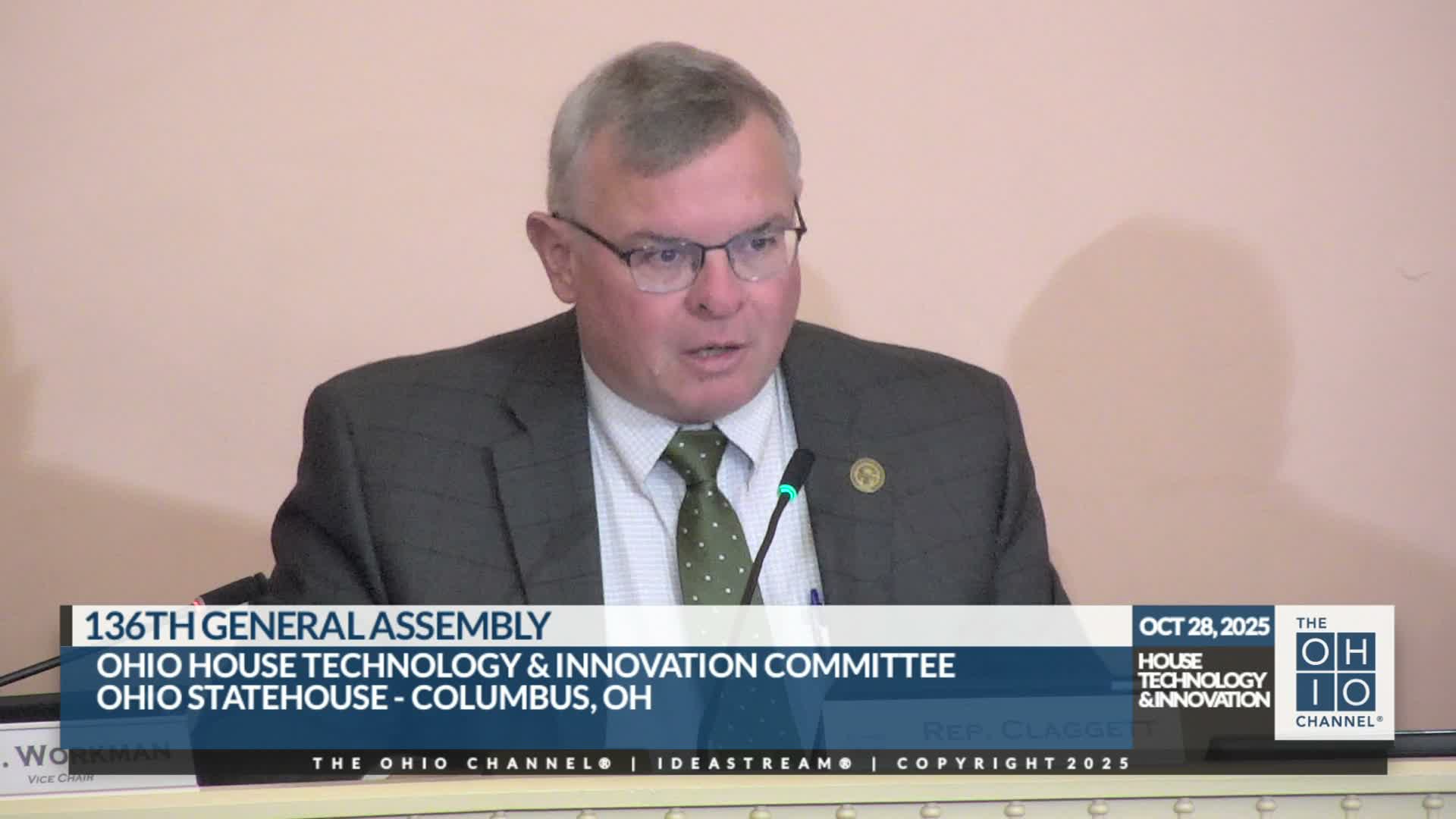
Committee members pressed for more detail. Representative Mohammed asked how Ohio compares with other states and whether the bill sets a floor or a ceiling for future rules; Lawson characterized the bill as proactive and a foundation for subsequent, more targeted legislation. Representative White raised workforce and critical‑infrastructure concerns and asked for a workforce impact statement and a statewide incident‑reporting mechanism to ensure a human remains in the loop for important systems. "It can't be open for business on the backs of workers," Representative White said.
Logan Golis, director of technology policy at the American Consumer Institute, endorsed HB 392 as "a bold vision for Ohio technological leadership," recommended adopting Montana's least‑restrictive‑means test for defining a compelling government interest, and warned of hundreds of patchwork state AI bills that could create regulatory uncertainty.
The chair asked proponents to provide a concise, written list of out‑of‑state bills and specific problem provisions for committee review; proponents agreed to submit a one‑ to two‑page summary. The hearing concluded without a vote, with committee members requesting follow‑up materials to inform next steps.