Get Full Government Meeting Transcripts, Videos, & Alerts Forever!
Get email alerts on the Motorcycle Safety topic
No spam. Unsubscribe anytime.
Panel hears sharply split testimony on bill to let motorcycles use freeway shoulders during heavy congestion
Summary
House Transportation Committee heard competing arguments for and against HB 13 67, a bill to let motorcycles use right shoulders under low‑speed conditions; supporters cited reduced rear‑end exposure, opponents including law enforcement and WSDOT warned of debris, enforcement and responder safety concerns.
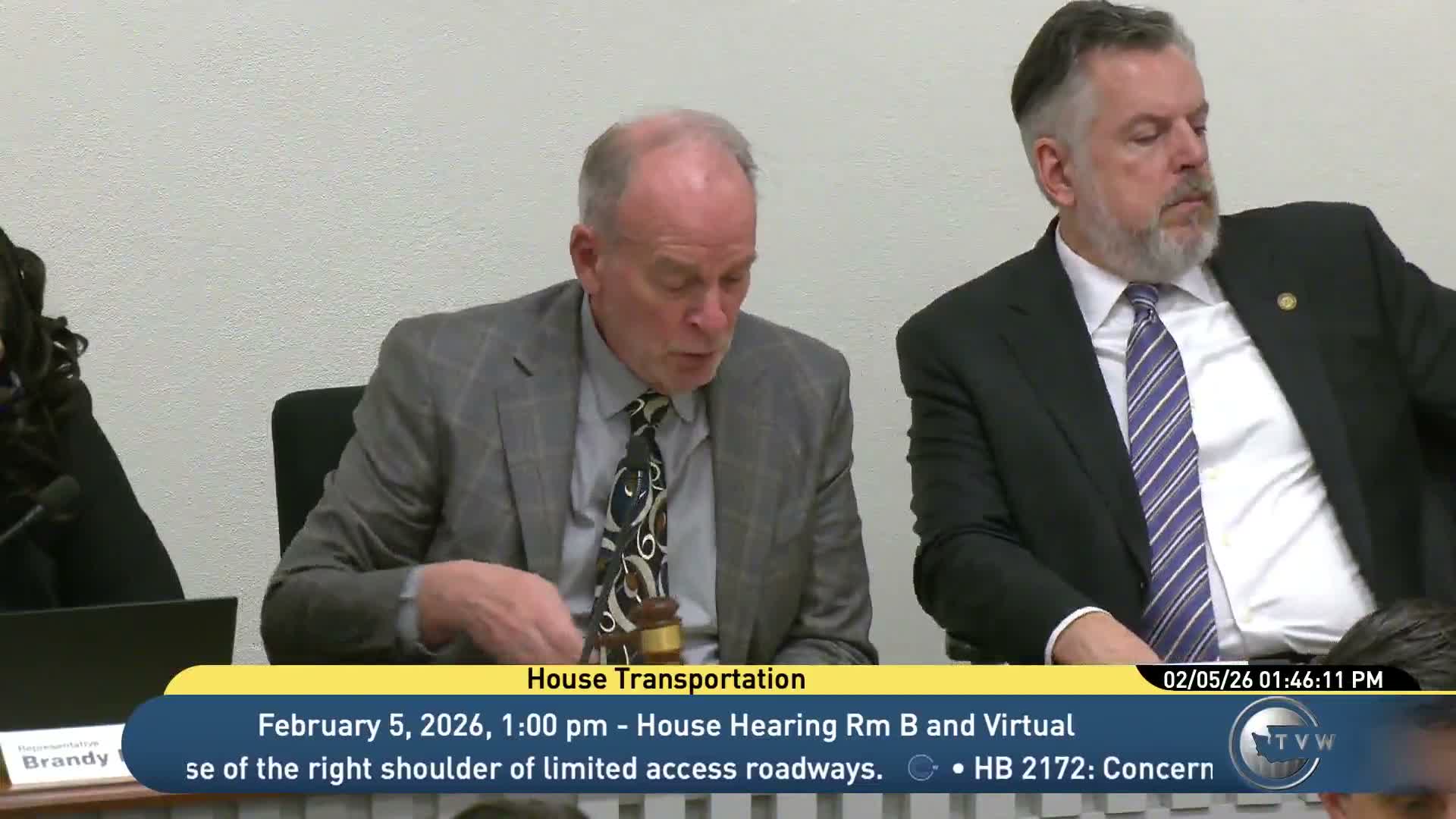
The House Transportation Committee heard public testimony on House Bill 13 67 on Feb. 5, a proposal to allow motorcycles to use the right shoulder of limited‑access roadways during slow or stopped traffic under detailed limits.
Sponsor Representative Ed Orcutt said he opposed lane splitting but favored a constrained shoulder rule to reduce rider heat stress, fatigue and rear‑end vulnerability: "Lane splitting is not the answer... I believe right shoulder driving is." Orcutt and staff described a substitute that would limit shoulder use to shoulders wider than 4 feet, require hazard lights while on the shoulder, prohibit passing more than one abreast on the shoulder, and impose liability and immunity provisions for governments and for motorcycle operators.
Public safety groups and law enforcement urged caution. James McMahon of the Association of Sheriffs and Police Chiefs testified: "Shoulder driving is simply not safe in our view," citing data showing motorcycles are overrepresented in fatal collisions and pointing to debris, emergency vehicle use of shoulders, and impaired drivers. Captain Dion Glover of the Washington State Patrol told the committee the bill could create enforcement challenges and increase risk to responders because shoulders are used for emergency stops and incident response.
Motorcycle instructors and some rider advocates urged the change as a targeted safety and risk‑reduction measure. Nathan Sharp, a longtime firefighter/EMS responder and riding instructor, cited research showing that allowing riders to move out of stopped traffic can reduce rear‑end exposure and secondary collisions. Several motorcyclists and an AP government student also gave personal testimony supporting a legal, predictable alternative to informal lane splitting.
Staff fiscal briefings noted a Department of Licensing estimate of roughly $142,000 in one‑time costs to create outreach and testing changes and an indeterminate fiscal impact to WSDOT for additional shoulder maintenance and sweeping if the practice expanded.
Committee members asked technical questions about visibility, debris on shoulders and how enforcement and signage would work. No final committee vote was taken on Feb. 5; sponsors said a substitute was expected to be posted.