Get Full Government Meeting Transcripts, Videos, & Alerts Forever!
Get email alerts on the Route Jurisdiction Transfers topic
No spam. Unsubscribe anytime.
Transportation commission urges clearer rules for road transfers; committee hears HB 2,172 briefing
Summary
The House Transportation Committee heard a Washington State Transportation Commission study and public testimony on HB 2,172, which would bring some abandonments into the route-jurisdiction-transfer process, require pre-request conferences and expand required reporting on costs and risks. Local officials urged clearer criteria and more transparency.
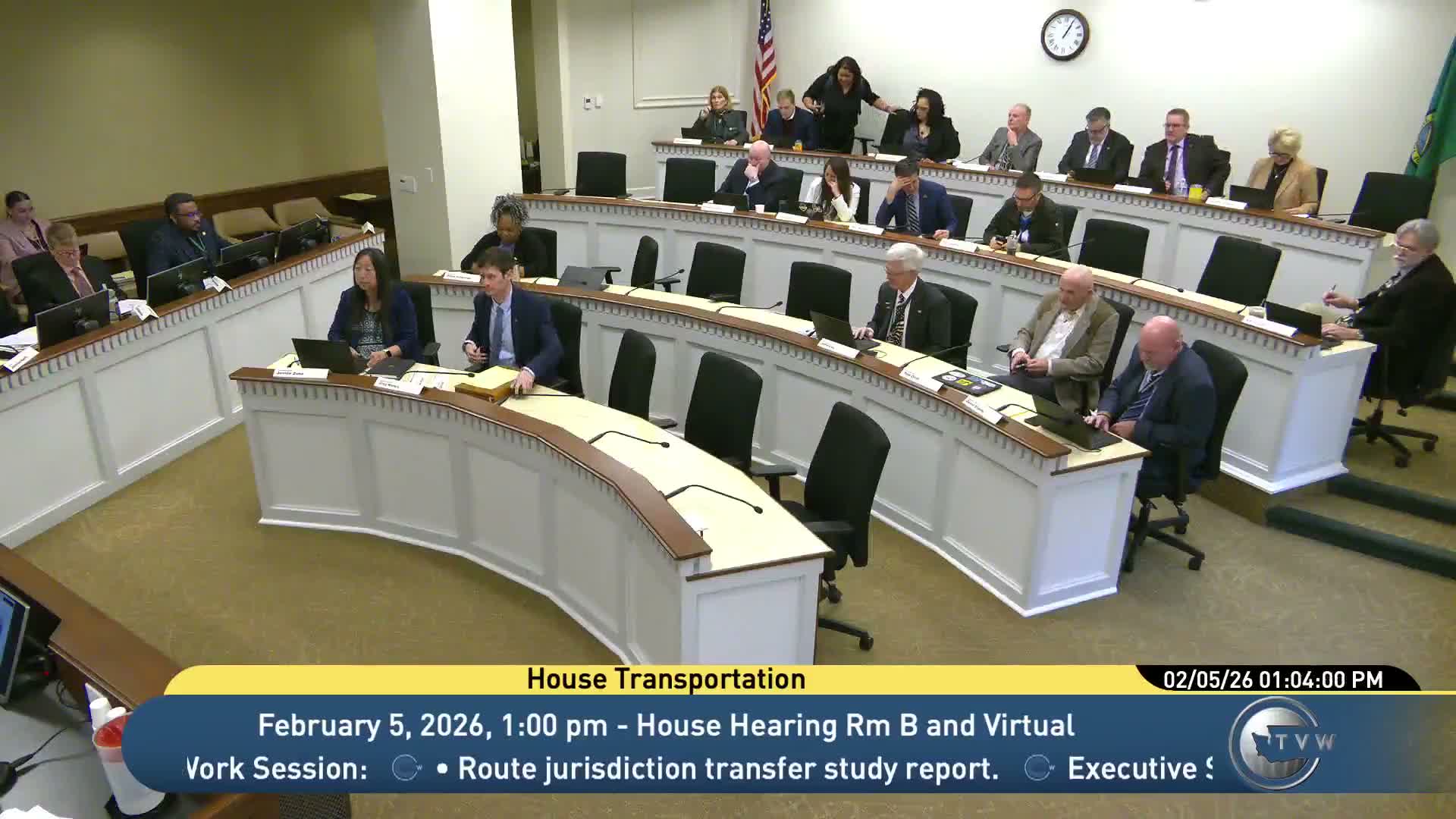
The House Transportation Committee on Feb. 5 heard a work‑session briefing from the Washington State Transportation Commission on a study of route jurisdiction transfers and a public hearing on House Bill 2,172.
Rima Griffith, executive director of the Transportation Commission, told the committee counties currently own about 49% of the state's centerline miles while cities hold roughly 22% and the state about 9%. She said transfers are rare: "there have been a total of 16 transfers with a net change of transferring about 10 miles of state highway to cities." The study recommended updating statutory criteria, clarifying the legislature's decision role for significant abandonments, and improving interagency coordination and record keeping.
Staff summarized HB 2,172 as widening the commission's RJT (route-jurisdiction-transfer) oversight to include abandonments longer than 2 miles or those that include a bridge, requiring a pre‑request conference, and directing the commission to report potential costs, risks and impacts to the legislature. David Meneke, staff to the committee, said the bill would take effect July 1, 2026 and include a fiscal note noting indeterminate WSDOT costs and a biannual maintenance estimate example of about $500,000 tied to transferred lane miles.
Local officials and city staff urged support. John Hynes, a Tacoma city council member, said transfers can create major local costs: "these bridges... left us holding the bag," citing multi‑hundred‑million‑dollar investments in bridge projects that followed earlier transfers. Tacoma city representatives asked for a transparent process that gives local governments time to plan and for public hearings rather than unilateral administrative abandonments.
Commission staff and Transportation Improvement Board representatives said the proposed analysis tool would score transfer requests on statutory criteria and provide a consistent, transparent way to present continuity, connectivity and function for each route. Counties and cities generally supported more notice and a pre‑request conference, while some county representatives said they wanted stronger guarantees that transfers would not add unaffordable maintenance burdens.
The committee took public testimony and questions; no final committee vote on HB 2,172 was taken during the Feb. 5 session. The bill proceeded to the caucus and executive session portion of the meeting for later action on other measures.