Get Full Government Meeting Transcripts, Videos, & Alerts Forever!
Get email alerts on the Climate Funding topic
No spam. Unsubscribe anytime.
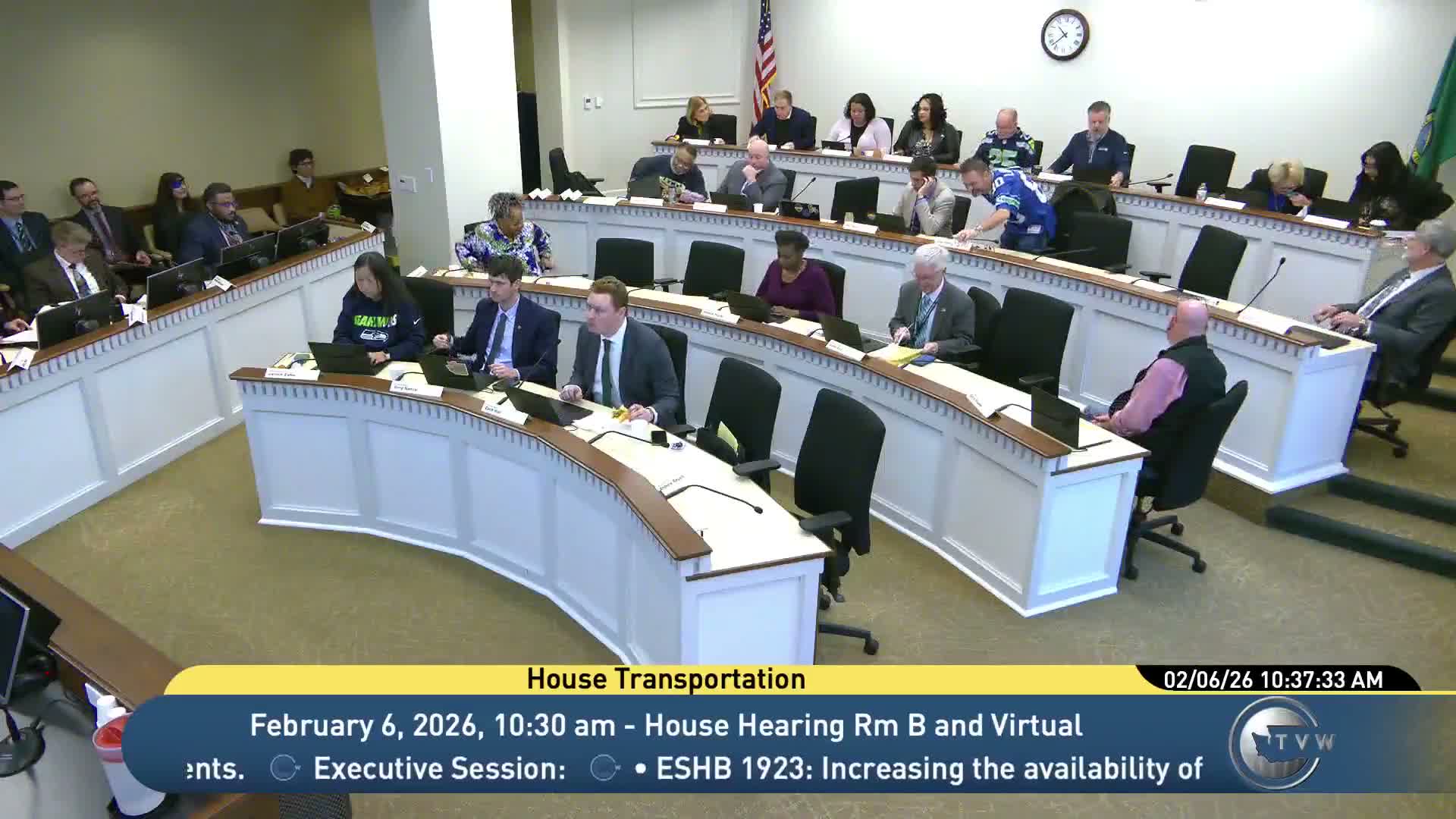
Committee hears substitute bill to reorganize Climate Commitment Act accounts and alter auction-revenue splits
Summary
Committee staff and supporters said substitute House Bill 2251 would consolidate several Climate Commitment Act accounts into clearer operating and capital accounts and set formulaic percentage splits for auction proceeds; tribal leaders and advocates urged clearer tribal set-asides and protections for equity and habitat.
Committee staff told the House Transportation Committee that substitute House Bill 2251 would create two new Climate Commitment Act (CCA) accounts — a capital account and an operating account — and repeal three existing accounts, producing "fewer accounts, in a slight different arrangement." Amy Skay, committee staff, described a new revenue distribution: $25 million off the top for Ecology administration, then percentage allocations (68% to the Carbon Emissions Reduction Account, 15% to the CCA capital account, 15% to the CCA operating account up to an $80 million cap, and 2% to the Air Quality and Health Disparities Improvement account up to $10 million), with several caps and a $359 million ceiling for the CIRA allocation.
The staff briefing also flagged fiscal-note complexities. Skay said the fiscal note attached to the underlying house bill can be confusing and cautioned members to focus on the bill’s distribution mechanics rather than anomalies in the fiscal figures. She estimated a one-year reduction to the carbon emissions reduction account on the order of about $179 million under the underlying bill’s assumptions; she said the substitute’s 68% allocation would change that illustrative number.
Public witnesses generally supported the substitute while urging clarifications and protections. Leanne Mysic of Climate Solutions said the bill "brings clarity to how much CCA revenue is allocated" and would allow lawmakers to spend less time negotiating allocations and more time evaluating investments. W. Ron Allen, tribal chairman and CEO of the Jamestown S'Klallam Tribe, urged that tribal set-asides be expressly identified and isolated in statute, including a 10% tribal set-aside and a carryover mechanism for unused tribal funds, and said government-to-government consultation had been inadequate. Paula Filmore Sardinas of the Build Back Black Alliance backed the bill’s transparency and said the split into operating and capital accounts strengthens equity mandates and labor standards.
Other testifiers urged specific changes: rail advocates asked that rail be explicitly recognized in the new account language; forestry representatives warned of competing uses that can draw capital away from projects such as culvert replacement and referenced an obligation under "RCW7613." Staff and witnesses emphasized that the substitute uses fixed percentages rather than Ecology forecasts to allocate funds, so outcomes will vary based on total auction revenue and whether accounts reach their statutory caps.
The committee closed public testimony on the bill and moved on to its next agenda items. No formal committee action on substitute House Bill 2251 was recorded in the transcript excerpt.
Ending: The committee closed testimony on SHB 2251 and advanced to the next hearing; members and witnesses indicated they would return with amendment language and additional clarification requests as the bill moves forward.