Get Full Government Meeting Transcripts, Videos, & Alerts Forever!
Get email alerts on the Tax Policy topic
No spam. Unsubscribe anytime.
Senate committee waives notice and advances hearing on proposed "millionaires'" income tax
Summary
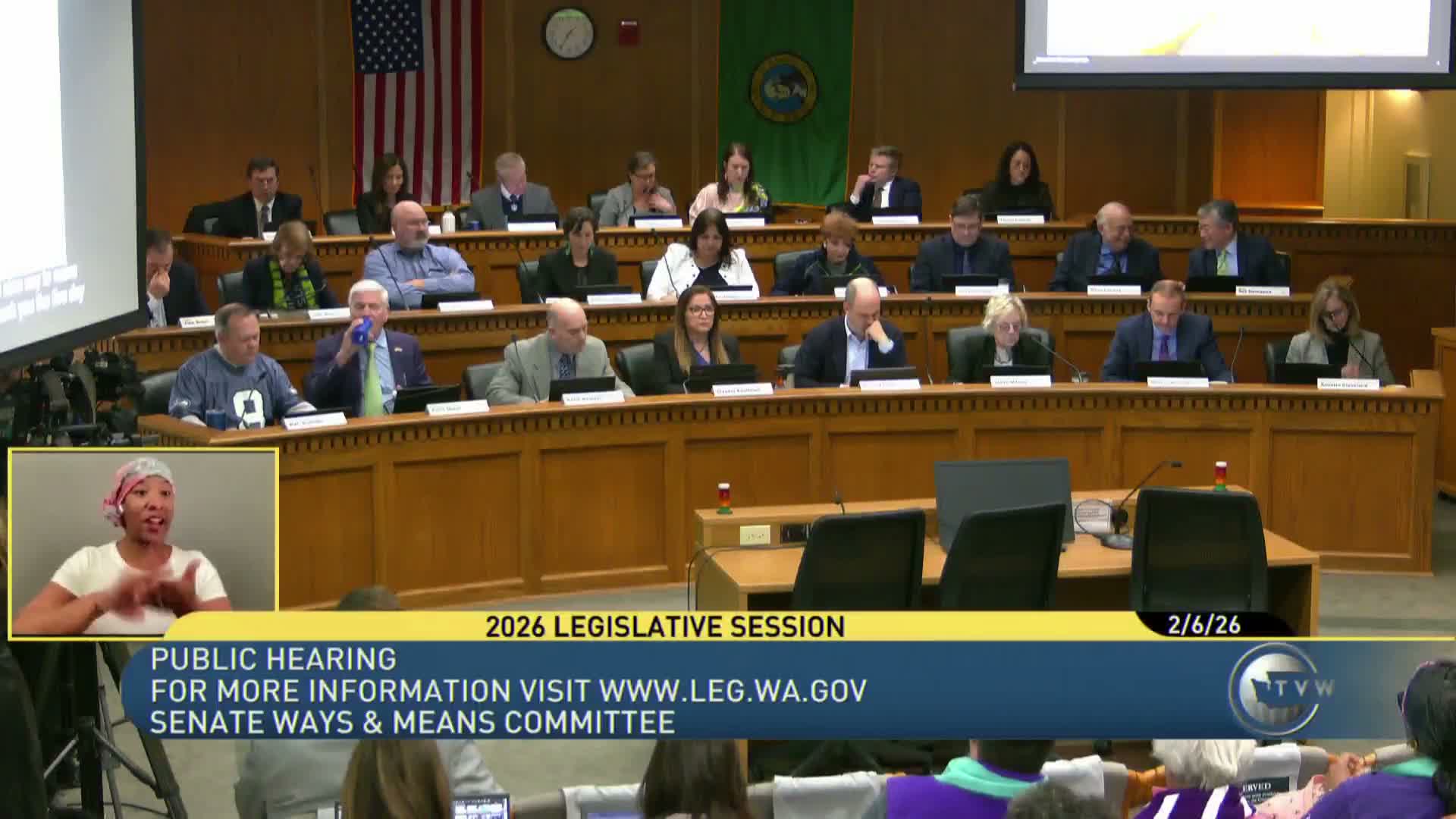
After waiving the committee's five‑day notice rule by roll call (15–9), the Ways and Means Committee held extended testimony and debate on Senate Bill 6,346, a proposed 9.9% personal income tax on household Washington taxable income above $1,000,000; advocates emphasized education, health and public defense funding while businesses warned of pass‑through impacts and constitutional risk.
The Senate Ways and Means Committee waived its five‑day notice rule and proceeded with a full hearing on Senate Bill 6,346, a proposal to impose a 9.9% income tax on Washington households’ taxable income above a $1,000,000 standard deduction.
Staff presented the bill’s mechanics and fiscal effects. Jeff Mitchell, committee staff, said the proposal would use federal adjusted gross income as a starting point, add and subtract specified adjustments to compute Washington taxable income, and include credits — notably for capital gains taxes and business B&O/public utility taxes. He told the committee the earliest tax filings would begin in 2029 and estimated roughly $3.5 billion in annual revenue affecting roughly 30,000 taxpayers. He said 5% of the revenues would be earmarked for a Public Defense services stabilization account, with the remainder deposited to the general fund and distributed by existing formulas.
Committee members sought legal and technical clarity. Multiple senators asked whether the bill would conflict with Initiative 2111’s statutory prohibition on a personal income tax and whether the proposal effectively circumvents a voter referendum. Staff and the bill’s supporters acknowledged legal risk and said the drafters included a null‑and‑void clause if a court invalidates the tax. Lawmakers also pressed staff about treatment of pass‑through entities, estimated tax prepayment rules for seasonal or resource industries, the measure’s charitable deduction cap, and the recent timing of the fiscal note.
Public testimony ran for hours and split sharply. Supporters included labor unions, healthcare and education advocates, the King County executive and a coalition of local nonprofits. They said the tax would rebalance Washington’s regressive revenue system, expand the working families tax credit, shore up health and education funding and provide state support for public defenders. “This is a monumental opportunity to begin to truly shift our upside down tax code more right side up,” said Eli Taylor Goss of the Washington State Budget & Policy Center.
Opponents included trade associations, builders, contractors, small‑business owners and national‑policy groups. They raised concerns that taxing pass‑through income would hit small businesses that use retained earnings for payroll and capital needs, that the bill’s treatment of carryforwards and lack of income averaging would penalize long‑term projects, and that the law may encourage relocation of highly compensated taxpayers. Former Washington Attorney General Rob McKenna warned of constitutional obstacles and urged a proposed constitutional amendment rather than a statutory workaround.
The hearing closed without a committee vote on the underlying bill. The committee first approved suspending the five‑day notice rule on a roll call vote (15 aye, 9 nay), allowing the extended hearing to proceed.