House Finance advances tax package including grocery‑store incentives and cigarette tax increase
Loading...
Summary
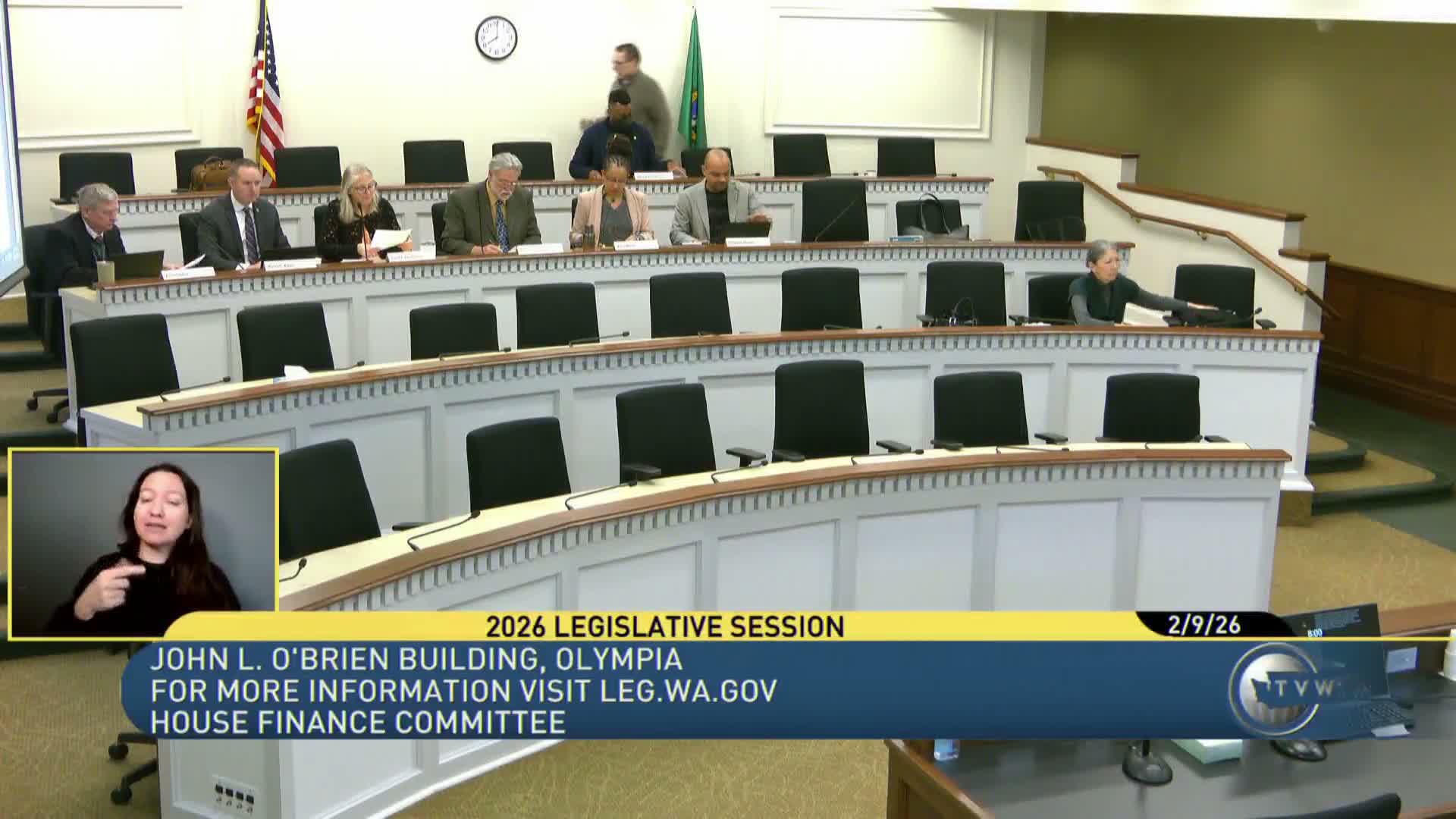
In an executive session Feb. 9, the House Finance Committee advanced a set of tax and revenue bills — including a grocery‑store incentive package (HB 22 97), a $2 per‑pack cigarette tax increase (HB 23 82), and changes to tax increment financing and cooperative housing rules — reporting them out with due‑pass recommendations.
The House Finance Committee on Monday, Feb. 9 advanced a slate of tax and revenue measures, moving several bills out of committee with due‑pass recommendations after amendment debates and roll‑call votes.
The most heavily discussed item was substitute House Bill 22 97, a proposal described by committee staff as an incentive package for grocery stores in underserved community zones. Christina King, staff to the committee, said the proposed substitute (H‑3481.1) would let cities set preferential B&O (business and occupation) tax rates for retailing, create a targeted exemption or remittance for qualifying grocery stores in designated underserved community zones, and add tax‑credit and local‑ownership carve‑outs for certain grocery formats. King summarized changes to certificate timing and compliance and said the bill would authorize local requirements that qualifying stores accept SNAP/Washington Basic Food benefits.
Rep. Orcutt led the amendment that would remove the state and local property tax exemption portion of the bill. He told members: “I’m growing increasingly concerned with bills that do property tax exemptions. … Whenever you exempt somebody from paying property tax, it doesn't take the actual tax off of being paid. So that means everybody else has to make up for it. It's what we refer to as the shift.” Rep. Mena, the sponsor’s lead supporter, countered that the property exemption is central to incentivizing grocery stores to open in limited zones and asked members to vote against the striking amendment: “The property tax incentive is a really big part of incentivizing grocery stores to come in these underserved communities zones.” The Orcutt amendment failed; substitute HB 22 97 was reported out of committee with a due‑pass recommendation (9 ayes, 5 nays, 1 excused).
Committee members also debated and advanced HB 23 82, legislation that would raise the cigarette tax by $2 per pack, restructure the vapor products tax to 95% of taxable sales price, and adjust other tobacco‑product tax caps. Staff said the bill directs portions of the new revenue to a foundational public health services account and includes provisions for the Andy Hill Cancer Research Endowment Fund. Several amendments were considered; one (CLOD430) was adopted to clarify timing/mechanics for funding transfers to the Andy Hill account. The committee reported the substitute out with a due‑pass recommendation following recorded votes and amendment actions.
Other bills advanced included: - HB 2,487 — changes to the B&O tax treatment for insurers and the definition of insurer; staff noted removal of retroactivity in an Orcutt striking amendment. Reported out with a due‑pass recommendation after amendment votes. - HB 2,089 — eliminates a multi‑state location threshold for applying B&O tax on interest from certain mortgage loans and defines a high‑volume mortgage‑lender standard; reported out with a due‑pass recommendation. - HB 24 31 — raises the limit for fundraising activities under the nonprofit public assembly halls property tax exemption; reported out by voice vote (14‑0, 1 excused). - HB 2,451 (second substitute) — changes to tax increment financing (TIF) rules, including CPI references, apportionment after levy lifts, and an emergency clause; reported out after discussion and a voice vote with one recorded nay. - HB 2,590 — clarifies rules for limited equity cooperatives, adopting an amendment to tighten purchaser income‑restriction language; reported out with a due‑pass recommendation. - HB 23 25 (second substitute) — establishes a tourism self‑supported assessment program administered by the Washington Tourism Marketing Authority, with an amendment ensuring tribes and tribal businesses are not included without an affirmative opt‑in; reported out with a due‑pass recommendation.
Committee members repeatedly framed their remarks around the local fiscal impacts and fairness of tax shifts. Rep. Orcutt voiced concerns that property‑tax exemptions shift burdens to homeowners and can be regressive; members on the other side emphasized access to groceries, public‑health funding, or local flexibility as reasons to move bills forward. Several amendment makers described their changes as technical clarifications to improve implementability or to protect specific groups (for example, tribal opt‑in language in the tourism assessment bill).
Votes at a glance (selected bills reported out with due‑pass recommendations): - Substitute HB 22 97 (grocery‑store incentives): reported out, 9 ayes, 5 nays, 1 excused. - HB 2,487 (insurer B&O changes): reported out, recorded roll call and amendment votes (reported in session; amendments considered and one striking amendment debated). - Substitute HB 23 82 (cigarette/vapor taxes): reported out after amendment votes; committee adopted an amendment to clarify Andy Hill account mechanics. - Substitute HB 2,089 (financial institution tax change directing revenue to wildfire mitigation): reported out, recorded roll call; members debated retroactivity and funding approach. - HB 24 31 (nonprofit assembly halls exemption): reported out by voice vote, 14 ayes, 0 nays, 1 excused. - Second substitute HB 2,451 (TIF): reported out, voice vote with one nay recorded. - Second substitute HB 23 25 (tourism self‑assessment): reported out, 8 ayes, 6 nays, 1 excused (voice/recorded votes and amendments noted in transcript).
What’s next: committee chair closed the executive session after rolling votes and amendments; bills advanced out of committee will proceed to the next steps in the House of Origin process per regular floor scheduling. The committee noted two bills listed for public hearing earlier will not be taken up today and may be rescheduled after House of Origin cutoff.
Sources and attribution: quotations and attributions are taken directly from committee proceedings (Feb. 9), including staff briefings by Christina King, Peter Klawfelter, Tracy Taylor and others, and member remarks by Representatives Orcutt, Mena, Santos, Rammell, Penner and Zahn.
Ending note: The committee adjourned following the executive session with multiple bills reported out of committee with due‑pass recommendations.