
Appropriations committee advances dozens of bills after hours of briefings and roll calls
Get AI-powered insights, summaries, and transcripts
Subscribe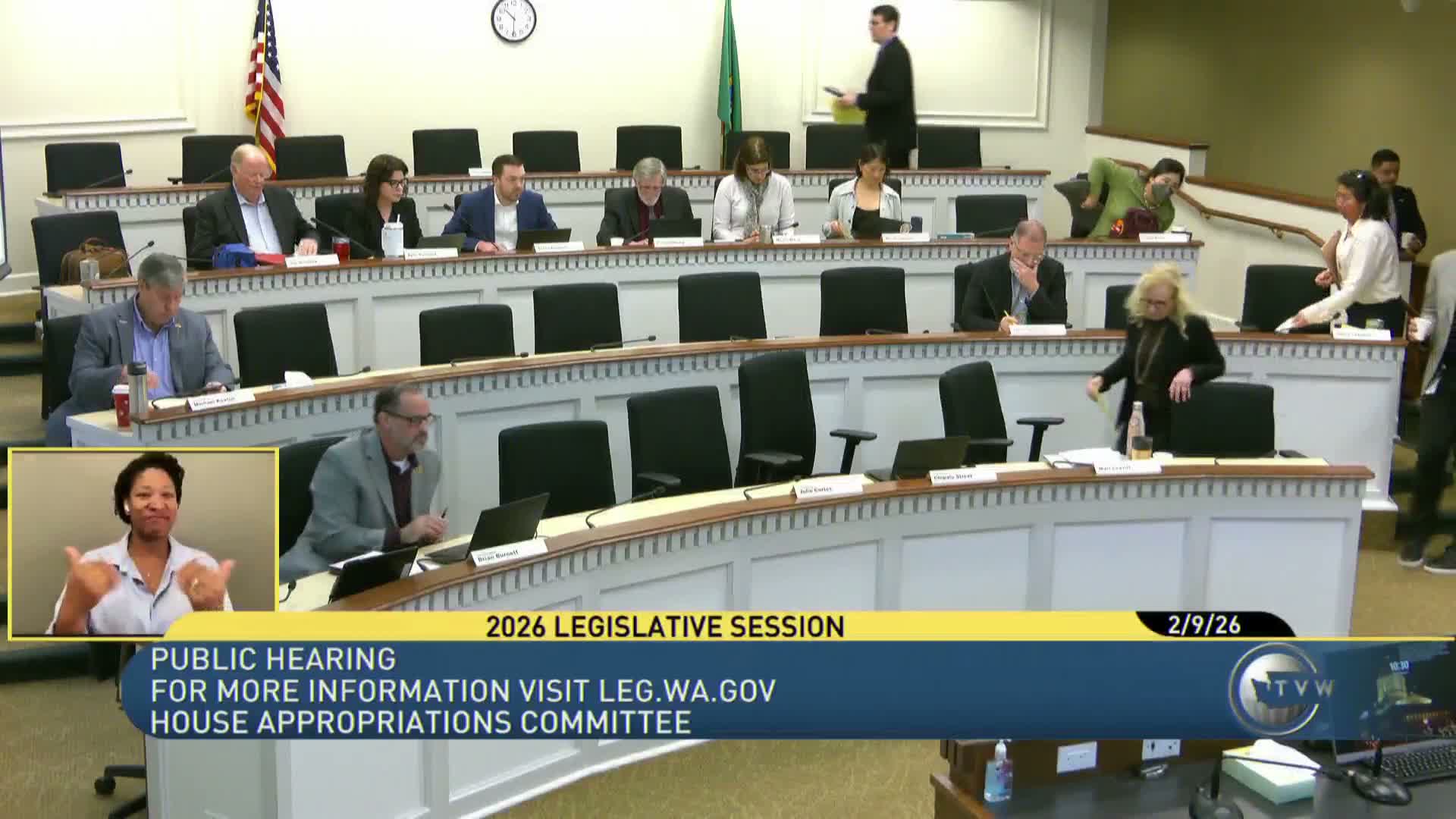
Summary
The House Appropriations Committee met in extended session to brief and vote on roughly 40 bills. Members adopted and rejected dozens of amendments; several high‑profile measures including childcare, student homelessness and data‑center bills were reported out of committee by roll call.
The Washington House Appropriations Committee convened Feb. 20 for briefings and an executive session on the first half of its agenda, then returned after caucus to move dozens of bills toward floor consideration.
Staff from policy committees walked members through proposed substitutes and line amendments for at least 40 bills on topics ranging from childcare and student homelessness to digital equity and large energy‑use facilities. Committee members debated fiscal notes, emergency clauses and delegation provisions before voting by oral or roll‑call on many of the items.
Among roll‑call outcomes reported on the record: House Bill 1073 (reported with a due‑pass recommendation, tally 28‑0 with 3 excused); second substitute House Bill 11‑28 (child care workforce board), which included adoption of amendment Leon 245 and was reported with a 18‑11 tally and 2 excused; substitute House Bill 13‑16 (students experiencing homelessness) was reported 29‑0 with 2 excused; and House Bill 14‑08 (community preservation & development authorities) reported 29‑0 with 2 excused after adoption of an emergency clause amendment (WELL 316).
Committee leaders repeatedly flagged indeterminate fiscal impacts where agency math depends on later rule‑making or appropriations. For example, staff said the revised substitute for HB 19‑06 would shift most costs away from the Department of Health while adding ongoing costs for the Utilities and Transportation Commission; the committee nonetheless reported that bill out of committee.
The committee spent extended time on several contested proposals. Data‑center legislation that would change ELUF (emerging large energy use facility) obligations and impose a fee generated sustained debate over grid reliability, new‑resource requirements and ratepayer impacts; the chamber adopted an amendment removing the annual fee but ultimately reported the substitute with a narrow margin. The Community Reinvestment Program drew pointed comments about past program oversight failures and produced contested amendments; the committee reported the second substitute with a recorded 18‑12 vote and one excused.
Several health‑care, education and housing measures moved through the committee largely with bipartisan consent after technical and null‑and‑void amendments. Committee staff and members emphasized that many fiscal estimates remain indeterminate and asked members to reserve detailed floor questions for subsequent sessions.
The committee paused twice for caucus and returned to executive session to complete votes, then adjourned after completing briefings and reporting the first batch of bills for floor consideration.