Get Full Government Meeting Transcripts, Videos, & Alerts Forever!
Get email alerts on the Biosimilars topic
No spam. Unsubscribe anytime.
Committee hears bill to let pharmacists substitute biosimilars; supporters tout savings, advocates warn of point-of-sale cost risk
Summary
The House Health Care and Wellness Committee heard Gross Second Substitute Senate Bill 5,594 to add biosimilars to state substitution rules and allow carriers to require a biosimilar trial before covering branded biologics starting 01/01/2027. Proponents said it lowers costs; patient advocates cautioned about out-of-pocket costs at the pharmacy counter.
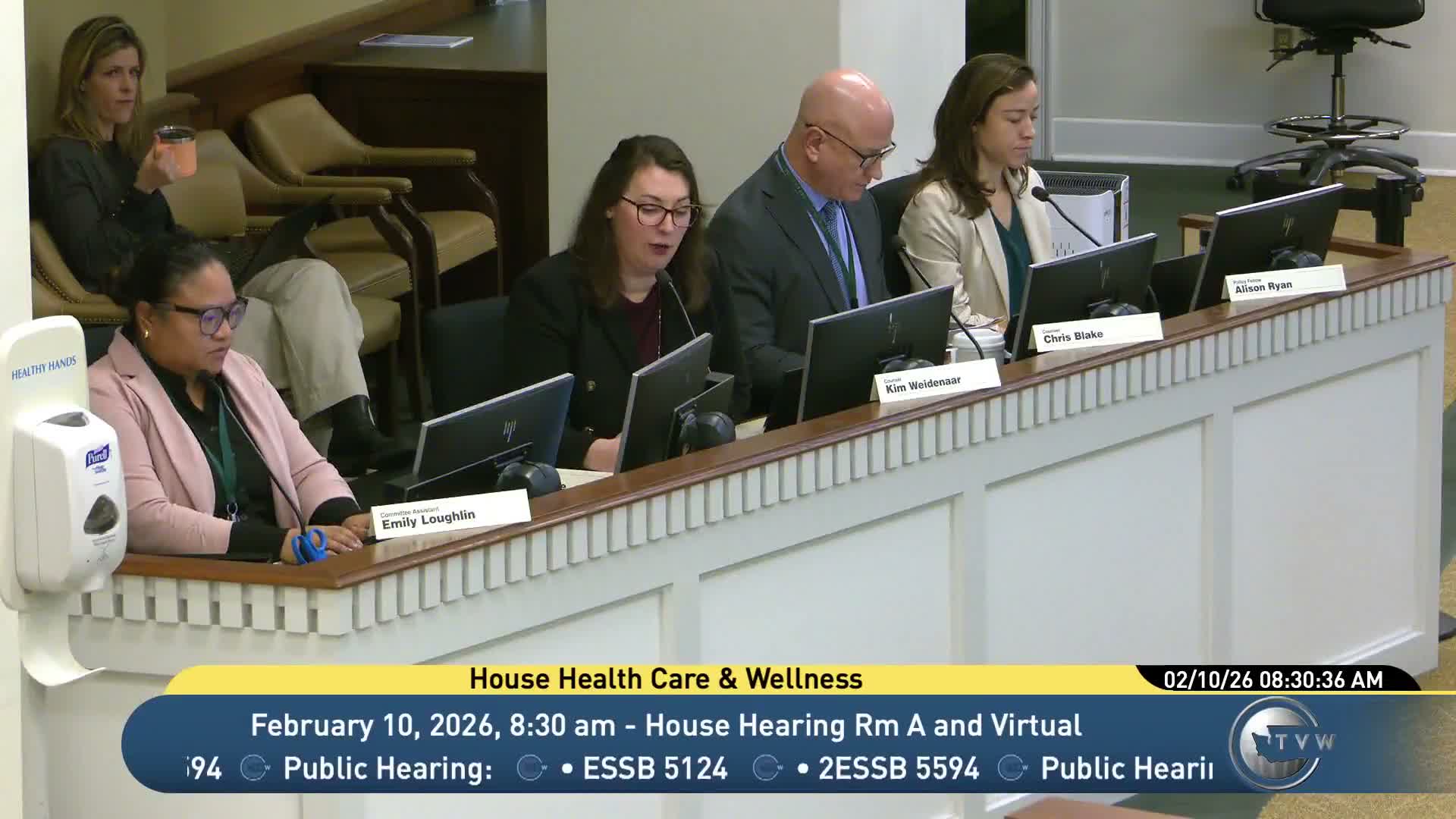
On Feb. 10, the House Health Care and Wellness Committee heard Gross Second Substitute Senate Bill 5,594, a measure that would expand pharmacists’ authority to substitute FDA‑approved biosimilars for prescribed biologic drugs and add biosimilar utilization goals to state purchasing contracts. The bill would allow health carriers to require patients to try a biosimilar before providing coverage for the equivalent branded drug beginning Jan. 1, 2027, according to committee staff.
Supporters across insurers and industry said the change would reduce costs for consumers and the health-care system. "Biosimilars are safe, FDA approved alternatives to high cost biologics, and on average, launch at approximately 50% of the cost," Marissa Ingalls of the Association of Washington Healthcare Plans said. Chris Bandley of America's Health Insurance Plans said the state has a history of encouraging lower‑cost prescription choices and that biosimilars represent "a really good, next step that will save consumers many, many thousands of dollars over the course of time at the pharmacy counter."
Industry trade groups that represent generic and biosimilar manufacturers also urged action and proposed a narrow statutory approach. "Adding biosimilars back into section 1a alone will help expand patient access to these lower cost and safe and effective drugs," Brett Michelin of the Association for Accessible Medicines said, while also cautioning that not all biosimilars are identically priced and that competition among biosimilars helps lower costs.
Patient advocates and some committee members pressed for implementation safeguards at the point of sale. Erin Jajic of the Patient Coalition of Washington said the bill’s aim is appropriate but that current pharmacy and payer systems can prevent pharmacists from verifying whether substitution actually reduces a patient's cost share. "At the point of sale, when you... they can't run the two meds to see what my cost sharing will be," Jajic said. She recommended requiring carriers to place biosimilars on preferred tiers to ensure substitutions do not raise patient out-of-pocket costs.
Committee staff told members the bill also removes statutory prescription‑form requirements that mandated signature lines indicating whether substitution is permitted; under the bill a pharmacist may substitute unless a prescriber marks "dispense as written." Representatives and sponsors discussed possible bill language or a follow‑on measure to address formulary and pharmacy point‑of‑sale mechanics.
No formal vote was recorded at the hearing. The committee suspended further action on the bill to continue consideration with stakeholders, and public testimony concluded for the day.