Snohomish reports 36,000 acres underwater; farmers seek tailored recovery and conservation funding
Loading...
Summary
Snohomish County officials and agriculture leaders told the House Agriculture & Natural Resources Committee that tens of thousands of acres flooded in December 2025, small and specialty farms suffered major losses USDA programs often don't cover, and witnesses urged funding the State Conservation Commission's disaster program and a tailored ag damage-assessment tool.
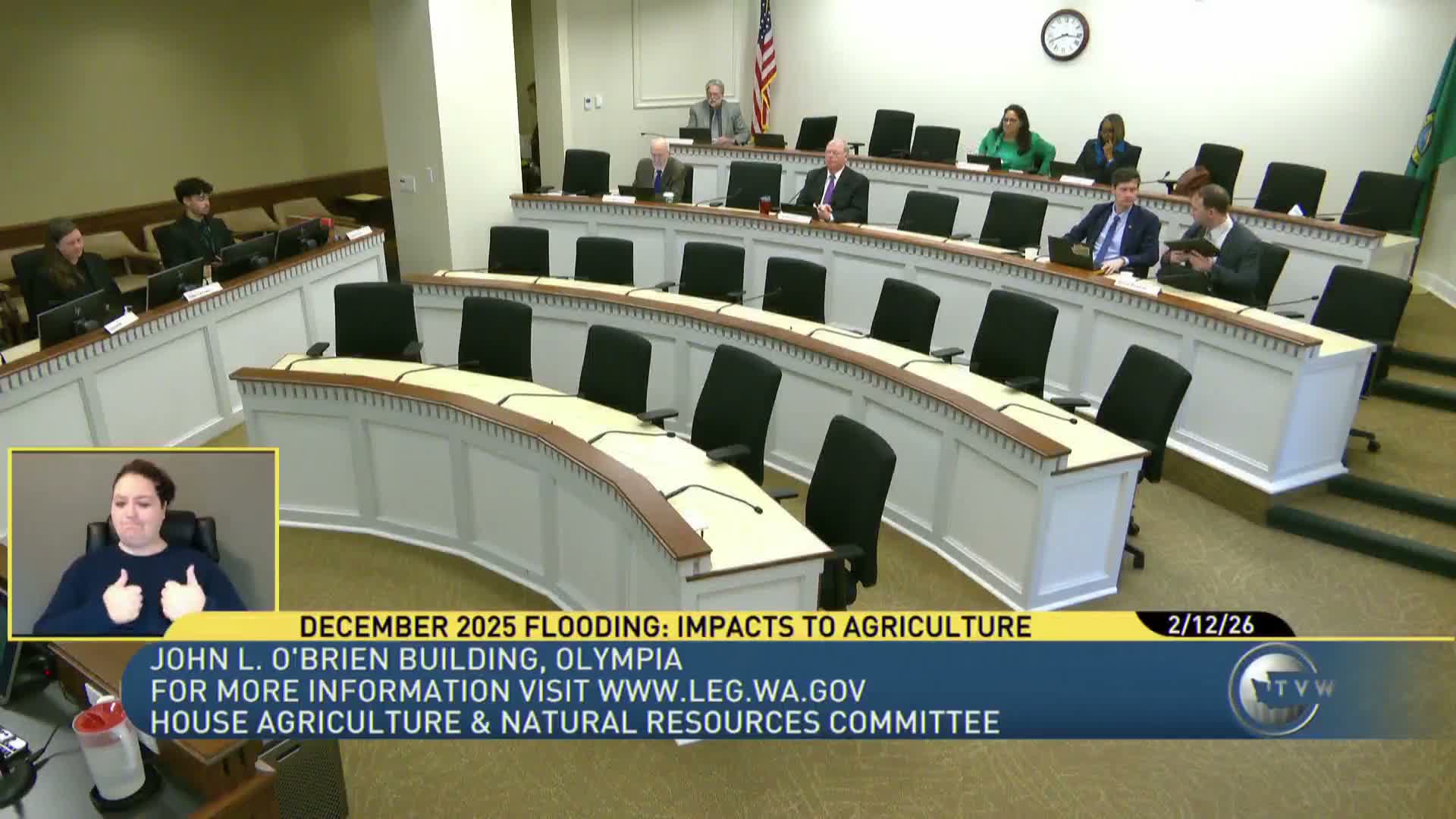
Snohomish County emergency management director Lucia Schmidt told the House Agriculture & Natural Resources Committee on Feb. 12 that at peak flood levels in December 36,000 acres (about 56 square miles) in the county were underwater, and that farmland often served as a natural buffer for communities.
"At peak flood levels in December, 36,000 acres of Snohomish County were underwater," Schmidt said, showing maps that overlaid agricultural parcels on floodplain imagery and describing damage to vehicles, equipment, fences, hoop houses, feed and overwintering crops.
Schmidt said a county survey of 45 agricultural businesses estimated a combined profit loss of $7,800,000 and that many specialty operations — nurseries, berry and produce growers and hoop-house operations — face losses that USDA disaster-support programs were not designed to cover. She noted USDA disaster aid generally requires on-site verification and that few applicants had appointments yet, delaying access to federal recovery.
Kelly MacLean, assistant director and policy advisor at the Washington State Department of Agriculture, outlined WSDA's emergency work: coordinating Emergency Support Function 11, identifying supply-chain disruptions (including a feed mill offline for a week), arranging waivers to allow commercial vehicles to move feed, coordinating cross-border feed shipments and vet outreach, and connecting producers to conservation districts and relief programs.
"We are the lead and we coordinate emergency support function 11 for the state," MacLean said. She added that WSDA is working on a report, due in July, with recommendations vetted by small and mid-sized producers and larger commodity groups.
Jay Gordon, policy director for the Washington State Dairy Federation and a sixth-generation farmer, described operational challenges for dairies and noted gaps in assistance for farm employees and seasonal workers who lose work when crops or operations fail. Gordon urged basin-level collaborative planning and local solutions to reduce long-term risk to farms and fish habitat.
Witnesses recommended restoring or funding the Washington State Conservation Commission's disaster assistance program and building a comprehensive agricultural disaster-assessment tool to better estimate monetary damages and long-term impacts for small and specialty producers.
Committee members requested follow-up information on insurance availability and affordability for farms and on policy options to bolster small and mid-sized producers; WSDA said it would provide a report with recommendations later this year.