
State emergency managers outline scale of December floods; governor's office to file federal disaster request
Get AI-powered insights, summaries, and transcripts
Subscribe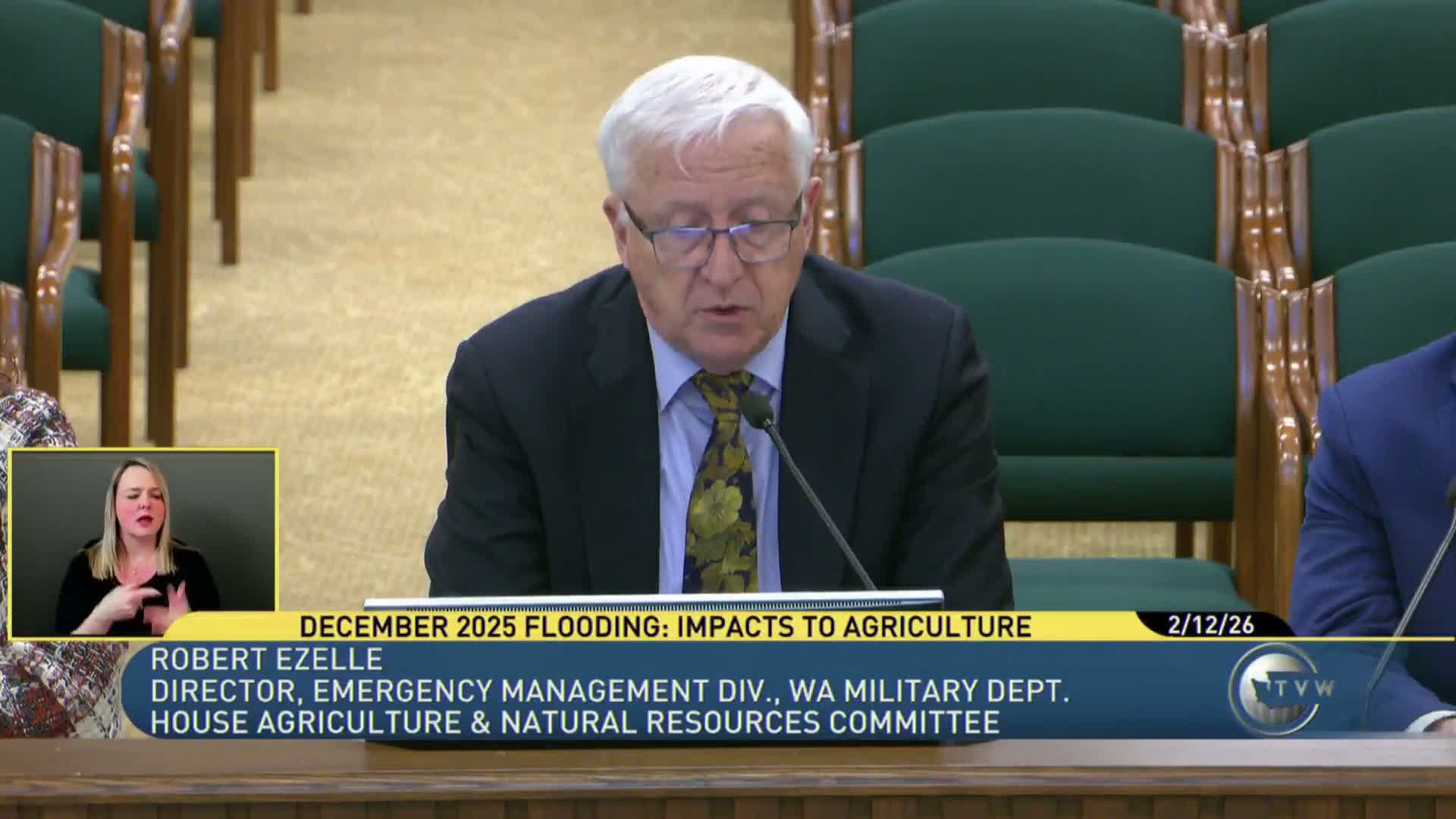
Summary
At a Feb. 12 House Agriculture & Natural Resources work session, Emergency Management Division Director Robert Ezell said two atmospheric rivers dumped 20–40 inches of rain, flooding dozens of rivers and producing an initial estimate of about $180 million in qualifying damages as the governor's office prepares a federal major-disaster request.
Emergency Management Division Director Robert Ezell told the House Agriculture & Natural Resources Committee on Feb. 12 that Washington was hit by back-to-back atmospheric rivers in December 2025 that “dropped between 20 and 40 inches of rain,” producing widespread flooding and infrastructure damage.
Ezell, of the Washington Military Department, said 33 rivers flooded during the storm sequence, 18 exceeded major flood stage and three — the Skagit, Snohomish and Cedar — exceeded record flood stage. He gave preliminary tallies that about 4,000 homes were affected, 440 of those had major damage or were destroyed, roughly 75,000 residents were under evacuation orders at one point, there was one fatality, and response teams conducted about 380 successful rescues and roughly 1,000 assisted evacuations.
"We were impacted by back-to-back atmospheric rivers," Ezell said. "They dropped between 20 and 40 inches of rain." He added the event was "historic and devastating" and described the strain on roads, utilities, and flood-control infrastructure.
Ezell said a preliminary damage assessment done with FEMA and local partners has identified approximately $180,000,000 in qualifying damages that could be eligible for FEMA reimbursement or assistance. He said the governor's office will finalize and submit a request for a federal major disaster declaration for public assistance and aimed to file before the Feb. 18 administrative deadline.
Committee members pressed Ezell on the federal process and whether it remained reliable. He described the standard path — the governor proclaims an emergency, the state develops the request, FEMA Region 10 reviews and forwards to FEMA headquarters and then to the White House — and cautioned that a lapse in DHS funding could slow processing and awards.
Ezell emphasized interagency and intergovernmental coordination during the response, citing assistance by the Department of Fish and Wildlife, the Department of Ecology on hazardous materials, the Department of Natural Resources and WSDOT on roads and culvert clearing, and aircraft imagery for damage assessment.
The committee did not take formal action; Ezell said the next step is completing the governor's request for a major disaster declaration and continuing damage assessment work with FEMA and local partners.