Get Full Government Meeting Transcripts, Videos, & Alerts Forever!
Get email alerts on the Speed Humps topic
No spam. Unsubscribe anytime.
St. Louis City committee advances eight speed-hump board bills to slow traffic near schools
Summary
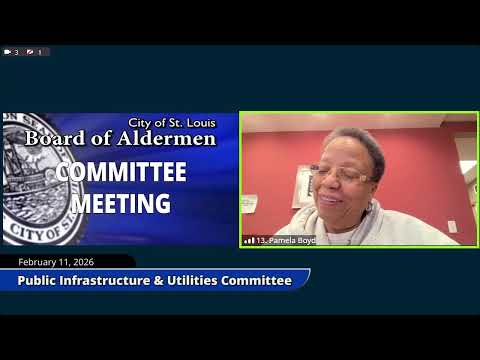
The Public Infrastructure and Utilities Committee on Feb. 11 forwarded eight board bills authorizing speed-hump installations across multiple wards, citing child safety near a Montessori elementary school and Loyola Academy; all bills received 'do pass' or 'due pass' recommendations and will move to the full board.
The St. Louis City Public Infrastructure and Utilities Committee advanced eight board bills on Wednesday that would authorize installation of speed humps on blocks across multiple wards.
Alderwoman Laura Keyes, presenting board bill 81, told the committee the stretch of Washington Avenue near the 3600–3800 blocks — adjacent to a Montessori elementary school and Loyola Academy — has motorists traveling “really, very, very fast.” She said volunteers have been directing crossings and that “we really do need speed humps as an additional barrier, to keep the children in that area safe.” Keyes asked the committee for a favorable, do-pass recommendation; the committee approved the bill and forwarded it out of committee.
Vice Chair Schweitzer described board bill 135 as the result of a neighborhood petition in Boulevard Heights and said more than half of residences on the street signed in favor of a single speed hump. Alderwoman Boyd said several of the subsequent bills (139, 140, 141, 142, 143, 144) are clerical or documentation "cleanup" items intended to ensure prior or proposed speed-hump projects have the paperwork and checks required for the Department of Streets to proceed.
Votes at a glance
- Board Bill 81 — Introduced by Laura Keyes; directs the director of streets to install speed humps pursuant to Ordinance No. 70333 as amended by Ordinance No. 71394 on specified blocks of Randall Square and Washington Avenue; outcome: passed out of committee with a do-pass recommendation. - Board Bill 135 — Introduced by Vice Chair Schweitzer; single-block speed-hump petition in Boulevard Heights; outcome: passed out of committee with a do-pass recommendation. - Board Bill 139 — Introduced by Alderwoman Boyd; documentation cleanup for prior speed-hump installations; outcome: due pass recommendation. - Board Bill 140 — Documentation/administrative cleanup for speed-hump installations; outcome: due pass recommendation. - Board Bill 141 — Documentation cleanup; clerk noted a discrepancy on the agenda (line 12 lists “5300 Block Of Clayton,” line 13 lists “Claxton”) flagged as a typo to be corrected; outcome: due pass recommendation. - Board Bill 142 — Administrative cleanup related to speed humps; outcome: due pass recommendation. - Board Bill 143 — Bookkeeping/records alignment for the street department; outcome: due pass recommendation. - Board Bill 144 — Establishes checks and balances to allow the Department of Streets to proceed with speed-hump installations; outcome: due pass recommendation.
What it means
The committee’s action clears these items for consideration by the full Board of Aldermen. Several bills were characterized as routine paperwork fixes that allow field work to proceed; board bill 81 drew the most descriptive safety rationale, with key advocates stressing proximity to schools and volunteer-led crossing assistance.
Direct quotes in context
“...we really do need speed humps as an additional barrier, to keep the children in that area safe,” Alderwoman Laura Keyes said while describing the situation on Washington Avenue near a Montessori school and Loyola Academy.
“We had more than 50% of residences along the street sign on,” Vice Chair Schweitzer said of the petition tied to board bill 135.
Next steps
All eight bills were advanced with a do-pass or due-pass recommendation and will be scheduled for consideration by the full Board of Aldermen. The committee did not hear public testimony on these items during the Feb. 11 meeting.